
Best backpack for hiking and travel: Versatile beginner choices

The best backpack for hiking and travel is usually a 30–40L pack with a supportive hip belt, a torso-fit carry system, and panel or clamshell access; choose 25–30L for day hikes and 40L only if you pack light. A poor match leaves you with sore shoulders, wasted space, or a bag that is awkward on buses and at trailheads. This guide shows how to compare volume, carry style, and access for beginner-friendly trip types.
Hiking travel backpack comparison table
The trade-off is straightforward: hiking comfort comes from fit and load transfer, while travel convenience comes from easy access and cabin-friendly sizing. A beginner usually needs enough structure for the trail, but not so much bulk that the pack becomes annoying in terminals, trains, or city streets.
| Trip type | Recommended volume | Carry-on likelihood | Must-have features | Avoid if |
|---|---|---|---|---|
| Day hikes | 20L to 30L | High for many carriers, but check the rule | Adjustable shoulder straps, ventilated back panel, hydration sleeve, secure pockets | You plan to carry a full travel load or bulky overnight gear |
| City-travel weekends | 30L to 40L | Often possible, but airline limits vary | Clamshell opening, laptop sleeve, mesh pockets, lockable zips, lightweight construction | You want a hiking-first pack with minimal organisation |
| Mixed trail-plus-travel trips | 35L to 50L | Some 40L to 50L bags comply with cabin baggage rules | Hip belt support, torso-fit carry system, panel access, abrasion-resistant fabric, bottle holders | You will mostly do short hikes and want the lightest possible day pack |
For beginners, the right volume follows the trip, not the wishlist. A 25L pack that fits your torso can carry better than a poorly fitted 40L pack with more empty space.
What size backpack should you choose?
For most beginners, 20L to 30L works for short trips and day use, while 35L to 50L suits longer backpacking trips. Some 40L to 50L bags comply with cabin baggage regulations, but airline size limits vary, so check the exact carrier rule before you buy.
When 20L to 30L is enough
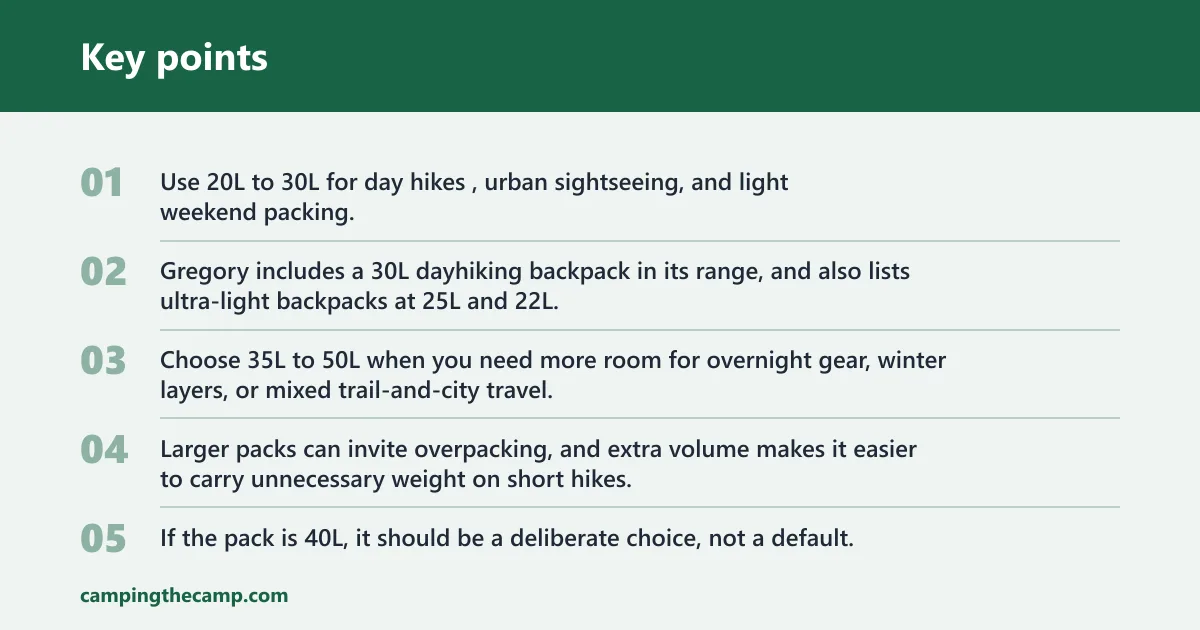
Use 20L to 30L for day hikes, urban sightseeing, and light weekend packing. This range is the most practical if you want one bag that stays compact on trains, in overhead bins, and on short trail days. Gregory includes a 30L dayhiking backpack in its range, and also lists ultra-light backpacks at 25L and 22L.
This size range works best when you carry layers, lunch, water, and a small first-aid kit, not a full travel wardrobe. It is also easier to keep organized because there is less dead space to overfill.
When 35L to 50L makes sense
Choose 35L to 50L when you need more room for overnight gear, winter layers, or mixed trail-and-city travel. This is the range that starts to make sense for beginners who want one pack for a longer trip and a few hikes along the way.
It also brings a trade-off. Larger packs can invite overpacking, and extra volume makes it easier to carry unnecessary weight on short hikes. If the pack is 40L, it should be a deliberate choice, not a default.
Why 40L does not always mean carry-on
Some 40L to 50L bags comply with cabin baggage rules, but that does not make every 40L pack cabin-safe. Airline size limits vary, and common cabin-friendly dimensions are around 40 x 30 x 20 cm. Samsonite lists a carry-on-sized travel backpack at 40 x 30 x 20 cm, which gives you a concrete benchmark to compare against.
Picture a beginner who buys a 40L bag for a weekend trip. If the bag is tall, deep, or rigid, it may fit the volume target but miss the airline’s size rule. Volume and dimensions are not the same thing.
Which features matter most?
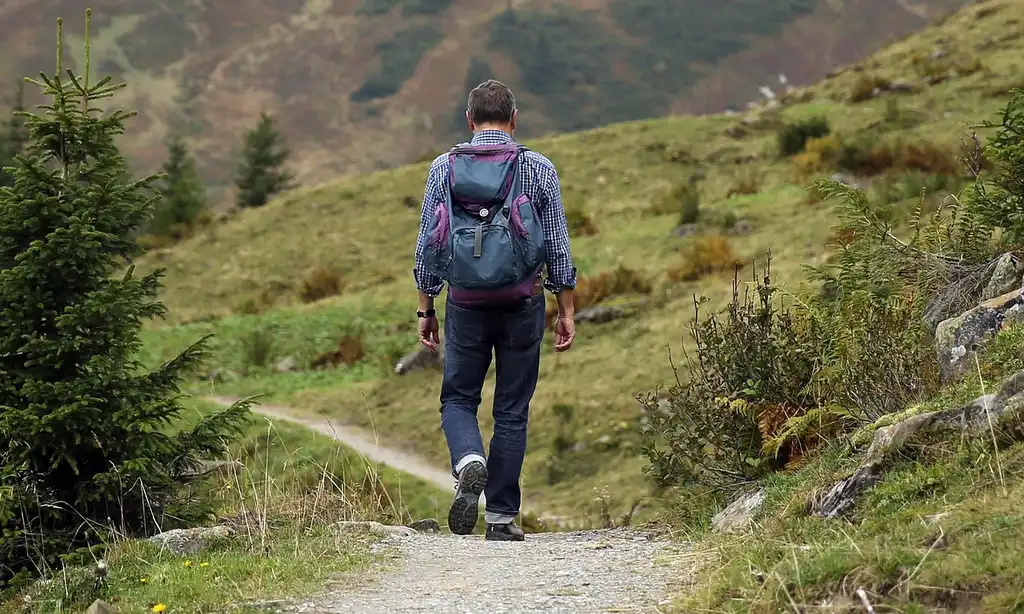
The right features do more than add convenience. They change how the pack rides, how hot it feels, how fast you can reach gear, and whether it works as both a hiking pack and a travel bag.
Fit and load transfer
Travel backpacks should have adjustable shoulder straps and padded back panels. That is the baseline. A hip belt or sternum belt helps distribute weight, which matters more as the pack gets heavier or as the trip gets longer.
-
Measure torso fit. Check the manufacturer’s sizing guidance for torso length, then match the pack to that range before you look at colors or pocket layouts. A good size match keeps the load closer to your hips instead of hanging from your shoulders.
-
Adjust the carry system fully. Tighten the shoulder straps, then set the hip belt so it sits on your hips, not your waist. If the pack still swings or pulls backward, the carry system is not doing enough work.
-
Load the pack like a trip. Put heavier items close to your back and lower in the pack. That position improves balance and makes a 35L pack feel calmer than a poorly packed 25L one.
Ventilation and hydration
A ventilated back panel matters on warmer hikes and longer wear because it helps airflow and reduces sweat buildup. Gregory highlights ventilated back panels for airflow and comfort, which is the kind of feature that beginners notice quickly on a steep climb or in humid weather.
Hydration compatibility is worth paying for if you hike in warm conditions or dislike stopping to reach for a bottle. Gregory lists hydration reservoir compatibility as a key feature. Look for a reservoir sleeve and a hose port so you can drink hands-free while moving.
Suppose a beginner is walking a shaded 3-mile trail with a 22L pack. A simple bottle may be enough. On a hotter route with more climbing, a reservoir sleeve and hose port are easier to use and reduce the chance that you skip water because it is inconvenient to stop.
Organization and security
Useful organisation features include compartments, internal dividers, laptop sleeves, mesh pockets, and external water bottle holders. For travel use, secure zippered pockets matter because they keep passport, phone, and keys separate from trail snacks and layers.
Clamshell openings help when you need suitcase-style access in a hotel room or hostel. Roll-top designs are often better when you want a simple, weather-aware closure and a cleaner outer shape. A beginner should choose one access style on purpose, not by accident.
Materials and weather resistance
Durable materials should include water-resistant fabric, reinforced stitching, sturdy zippers, and abrasion resistance. Those features do not make a pack indestructible, but they do help it survive rough bus rides, trail brush, and repeated stuffing.
Lightweight construction matters too. A travel pack that starts heavy gives away capacity to the pack itself, while a lighter shell leaves more room for actual gear.
How travel-friendly should the pack be?
A beginner should think about access style, security, and size checks together. A pack can be comfortable on the trail and still be annoying if it opens badly, weighs too much empty, or misses cabin limits.
Clamshell versus top-load access
Clamshell access is usually better for travel because it opens like a suitcase and makes packing simpler. Top-load packs can be fine for hiking, but they are slower to organize in hotels and can bury small items under larger ones.
Choose clamshell if your trips lean toward weekends, buses, and repeated repacking. Choose top-load or roll-top if the pack will spend more time on trails than in terminals.
Roll-top and security features
Roll-top designs suit travelers who want a compact outer shape and a more weather-aware closure. Lockable zips or similar security features are useful in transit, especially on crowded trains or in shared dorms.
Samsonite includes a 2-in-1 travel backpack at 48 x 33 x 26 cm and also lists a backpack at 1.1 kg. Those details show why checking both dimensions and empty weight matters before you buy.
Carry-on dimensions and airline checks
Airline size rules vary, so verify the exact carrier limit before you buy. A common cabin-friendly benchmark is around 40 x 30 x 20 cm, but that is only a reference point. A bag that is close to 40L may still be too tall, too deep, or too rigid for a specific airline.
-
Check the airline rule first. Look up the carrier’s cabin-bag dimensions before you compare products. That step tells you whether you need a travel-first pack or a more hiking-first design.
-
Compare external dimensions. Do not shop by liters alone. Measure the backpack’s listed dimensions against the airline limit, because a roomy interior can still fail a bin check.
-
Decide how strict you need to be. If you fly often, prioritize a bag that stays near cabin dimensions even when packed. If you fly rarely, you can lean more toward hiking comfort and accept a less compact shape.
Choose hiking-first or travel-first?
The right choice depends on which part of the trip matters most. If the pack must feel stable on steep trail days, start with hiking-first features. If it spends more time in airports and hotel rooms, start with travel-first features.
Choose hiking-first if…
Choose hiking-first if you expect regular day hikes, warmer weather, or heavier water carry. Look for a ventilated back panel, a fitted carry system, and a hip belt that actually takes load. Gregory’s hiking-oriented packs fit this use case better than a pure city-travel bag.
Choose hiking-first if you care more about shoulder comfort and trail ventilation than about suitcase-style packing. That trade-off usually points you toward 20L to 30L for day use, or 35L to 40L for mixed trips.
Choose travel-first if…
Choose travel-first if your trips are mostly weekends, city breaks, or business travel with occasional light walks. A clamshell opening, laptop sleeve, secure zippered pocket, and compact dimensions matter more here than a full hiking carry system.
The same source says a travel backpack can be for a weekend city break, business trip or extended adventure. That framing is useful for beginners who want one bag that behaves more like luggage but can still handle light outdoor use.
Choose a true hybrid if…
Choose a true hybrid if you want one bag for short hikes and short trips, and you are willing to pay for both fit and access. That means a torso-fit carry system, hip belt support, hydration compatibility, and travel-friendly organisation in the same pack.
A common first-timer mistake is buying a 40L travel bag because it sounds versatile, then finding that the load rides badly on the trail. Another is buying a hiking pack with excellent suspension but almost no organisation for city use. The hybrid has to do both jobs well enough, not one job perfectly.
Frequently asked questions
What size backpack is best for hiking and travel for a beginner?
For many beginners, about 30L to 40L is a versatile range for both hiking and travel. Use about 20L to 30L for day hikes and short trips, then move up to about 35L to 50L only when more clothing or overnight gear is needed. Fit still matters more than liters alone.
Can one backpack work for both day hikes and carry-on travel?
Yes, but only if the pack balances comfort, access, and dimensions. A 30L to 40L backpack with an adjustable carry system, hip belt support, and travel-friendly organisation can do both jobs. Check airline size limits separately, because some 40L packs fit cabin rules and others do not.
What features should a beginner look for in a versatile hiking backpack?
Start with adjustable shoulder straps, padded back panels, and a hip belt or sternum belt for weight distribution. Then add a ventilated back panel, hydration reservoir compatibility, compartments or dividers, mesh pockets, external bottle holders, and secure zippered storage if you also travel with it.
Is a 20L, 30L, or 40L backpack better for hiking and travel?
About 20L is best for light day use, about 30L is often a good fit for many short hikes and compact travel, and about 40L can suit mixed trips or longer stays. A 40L pack only helps if you truly need the space; otherwise it can become bulky and harder to manage.
Which backpacks have hydration compatibility and travel-friendly organisation?
Look for packs that list a hydration reservoir sleeve, hose port, internal dividers, mesh pockets, and external bottle holders. Gregory highlights hydration reservoir compatibility and ventilated panels in its hiking-oriented range, while Samsonite lists travel-focused sizing and 2-in-1 layouts in its carry-on style options.
How much should a beginner spend on a hiking and travel backpack?
Spend enough to get the fit and access features you will actually use. The value usually comes from a proper carry system, a supportive hip belt, durable fabric, and better organisation, not from extra liters. If the pack will be used often, those features are worth more than cosmetic extras.
What makes a travel backpack comfortable enough for hiking?
A travel backpack becomes hike-worthy when it has adjustable shoulder straps, a padded back panel, and load transfer from a hip belt or sternum belt. Ventilation matters on warmer routes, and a torso fit that matches your body shape matters even more. Without those, the pack will feel fine only when it is lightly loaded.
Are carry-on travel backpacks suitable for hiking adventures?
Some are, but not all. A carry-on-sized travel backpack can work for easy day hikes if it has a comfortable carry system, ventilated back panel, and enough structure to sit well on your body. If the pack is built mainly for airports, it may carry weight poorly on steep or hot trails.