Best hiking backpack for beginners: Long-distance

For many beginners planning a long-distance hike, the best overall first pack is a 50+10 liter internal frame backpack like the Decathlon Forclaz Trek 500, with an adjustable suspension, a supportive hip belt, and a load range of about 25–35 pounds. Pick a pack that is too small, too flimsy, or too heavy, and you pay for it in poor packing, sore shoulders, and wasted money. This guide shows how to match capacity, fit, and load-management features to your actual first trip.
Top pick for most beginners
A 50+10 liter internal frame pack like the Decathlon Forclaz Trek 500 is the safest first pick for most beginners because it gives you enough room for food, water, sleep gear, and the extra items that often show up on a first long trip. That extra space matters when your kit is still changing and your packing system is not yet set.
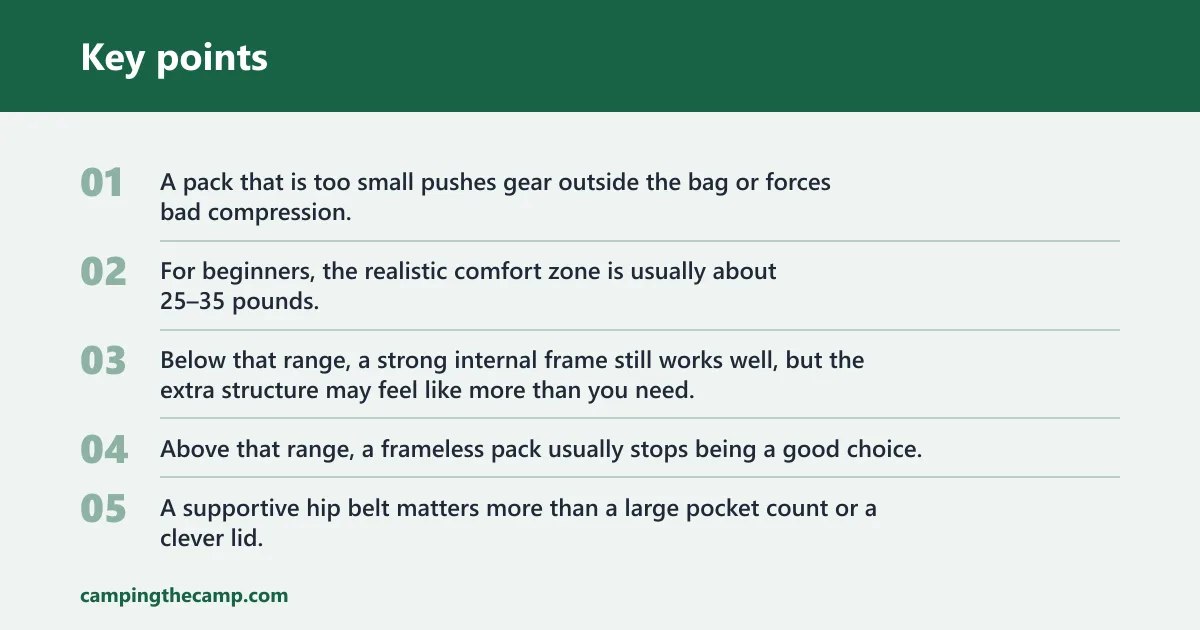
This is the size range that best absorbs beginner mistakes. A pack that is too small pushes gear outside the bag or forces bad compression. A pack that is too large can tempt you to carry extra weight you do not need, so the goal is usable space, not empty space.
Why this pick fits most first long-distance trips
Long routes like the Pacific Crest Trail at 2,600 miles, the Camino Frances at 480 miles, and the Kungsleden trail at 240 miles need more than a daypack approach. Even shorter long-distance walks still need room for food carry, insulation, a sleep system, and weather protection that a beginner often cannot trim far enough on the first attempt.
A 50+10 liter pack is especially useful when you do not know how much food a section will require, when water carries can change, or when your resupply plan is still cautious. That margin cuts down the chance that your first trip turns into a packing puzzle every morning.
What load range it handles best
For beginners, the realistic comfort zone is usually about 25–35 pounds. Below that range, a strong internal frame still works well, but the extra structure may feel like more than you need. Above that range, a frameless pack usually stops being a good choice.
A supportive hip belt matters more than a large pocket count or a clever lid. When the belt carries weight properly, your shoulders do less work and your posture stays steadier over long miles.
Quick picks
- Best 40–45L for lighter first trips: A pack around this size can work if your base weight is modest, your food carry is short, and your water carry is small. The Osprey Kestrel LT 45 has a 45-liter capacity, weighs 4.02 pounds, and uses an internal frame.
- Best 50–60L for most beginners: The Decathlon Forclaz Trek 500 is a 50+10 liter backpack, which makes it a practical first long-distance option when you need a little extra room for changing loads.
- Best frameless option for ultralight setups: Frameless packs are only a fit when your packed weight stays very low and your gear is already compact, so they are usually not the best first choice for most beginners doing long-distance hiking.
- Best heavy-load budget-style option: If you expect to carry more food, more water, or less compressed gear, a larger internal frame pack is the better starting point than a minimalist pack that will feel overloaded fast.
What size hiking backpack do you need?
Most beginners doing long-distance hiking should start in the 50–65 liter range, with 60–65 liters the safer bet when food, water, or gear volume is uncertain. Smaller packs can work, but only when your kit is already compact and your route has predictable resupply and water.
35L and 40L
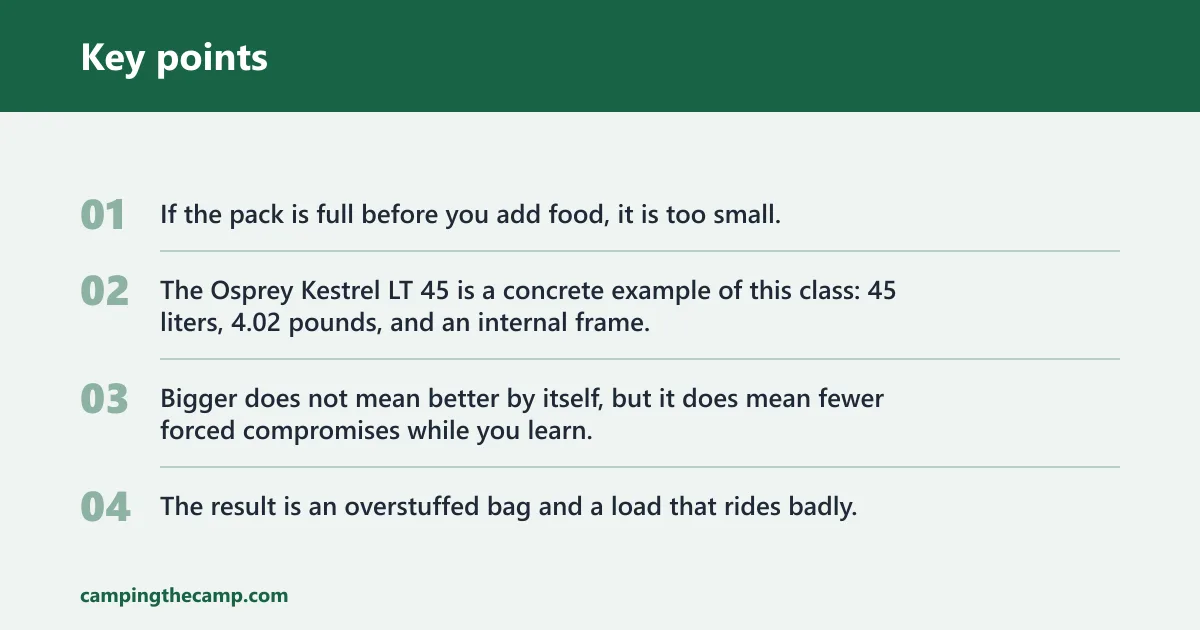
A 35L or 40L pack can suit a beginner only if the load is already very compact and the trip is short enough that food carry stays limited. These sizes leave little room for bulky insulation, a larger sleep system, or extra water. If the pack is full before you add food, it is too small.
Fit and load control matter more here because overpacking a small pack usually creates hard pressure points and poor balance. A beginner who buys too small often ends up strapping items outside the pack, which makes the load less stable on uneven trail.
45L
A 45L pack can be enough for a beginner doing long-distance hikes, but only for a lighter kit and a shorter or better-supported itinerary. It works best when food carries are modest, the sleep system is compact, and water sources are reliable enough that you are not hauling large volumes between camps.
The Osprey Kestrel LT 45 is a concrete example of this class: 45 liters, 4.02 pounds, and an internal frame. That combination points to a pack that can carry a real load, but it still asks you to keep your gear volume under control.
50L and 60L
A 50L or 60L pack is the practical beginner band for most first long-distance trips because it leaves room for food, weather gear, and imperfect packing. The Decathlon Forclaz Trek 500 is a 50+10 liter backpack, which shows how some models build in extra room for changing loads.
A 60L pack is often the better answer when your trip duration is longer, your resupply spacing is less certain, or your water carry changes through the route. Bigger does not mean better by itself, but it does mean fewer forced compromises while you learn.
A common first-timer mistake is buying a 45L pack because it sounds lighter, then discovering that a bulkier sleeping bag, extra food, and rain protection leave no room for comfortable packing. The result is an overstuffed bag and a load that rides badly.
Internal frame vs. frameless: which fits you?
Beginners should usually choose an internal frame backpack for long-distance hiking because it transfers load to the hips, holds shape under uneven packing, and stays comfortable over a wider weight range. Frameless packs make sense only when your gear is already very light and compact.
Internal frame backpacks
Internal frame packs use a structured frame to move weight toward the hip belt, which makes them the safer choice for heavier beginner loads. They also usually offer torso adjustability, which helps when you need to match the pack to your body rather than forcing your body to adapt to the pack.
This type is the better match for longer routes, uncertain food carries, and first trips where the load may change from one section to the next. If your pack may start at 30 pounds and drop later, internal frame support gives you a larger comfort margin.
Frameless backpacks
Frameless backpacks belong to ultralight use cases, where the packed weight stays very low and the gear shape itself creates enough structure. Beginners often outgrow them because comfort depends heavily on what is inside the bag and how well that load is packed.
If the weight is too high or the packing is uneven, the back panel can collapse, pressure can move to the shoulders, and the bag can feel worse mile after mile. That is why frameless packs are a poor first choice for heavy or poorly planned long trips.
Hiking backpack decision table
| Trip length and load | Expected base weight | Food carry | Water carry | Recommended capacity | Frame type | Must-have features | Common beginner failure |
|---|---|---|---|---|---|---|---|
| Short section trip or very compact first hike | Light, already trimmed down | 1 to 2 days | Light, predictable access | 35L to 40L | Internal frame preferred; frameless only if truly ultralight | Adjustable torso, hip belt, compression straps, easy bottle access | Buying too small and then strapping gear outside the pack |
| Most beginner long-distance trips | Moderate, still changing | 2 to 4 days | Moderate, with some variation | 45L to 55L | Internal frame | Supportive hip belt, ventilated back panel, top access, bottle pockets | Choosing a pack that fills up before food and rain gear are packed |
| Longer section hike or uncertain resupply | Moderate to heavier | 3 to 6 days | Moderate to heavy | 55L to 65L | Internal frame | Load-transfer frame, compression straps, reservoir sleeve, weather protection | Buying a minimalist pack that cannot handle real trail weight |
| Very light, highly dialed setup | Very light | 1 to 2 days | Light | 30L to 40L | Frameless only if the packed weight stays low | Simple access, stable packing, bottle access, careful compression | Using a frameless pack before the rest of the kit is truly light |
What features matter most on long hikes?
Fit and load transfer matter most. After that, look at suspension, hydration access, weather protection, access style, and compression. A pack with many pockets is still a poor choice if it carries weight badly or fits the wrong torso length.
Suspension system
The suspension system is what makes the pack workable over distance. Shoulder straps spread contact pressure, the hip belt shifts load off the shoulders, the sternum strap steadies the straps across your chest, and back panel ventilation helps reduce heat buildup when the pack is moving all day.
On long hikes, a weak hip belt or a mismatched torso length causes the pack to sag. Once that happens, shoulder straps take more weight than they should, and the pack feels worse with every mile. Good ventilation helps comfort, but it cannot fix bad fit.
Hydration and access
Hydration compatibility can be useful, especially if you like sipping while moving, but it is not the first thing most beginners should optimize. Water bottle pockets are often easier to use on the trail because you can reach them without unpacking anything, while a reservoir sleeve can still be helpful if the hose routing is simple and the sleeve is well designed.
Water bottles are often the easiest to access while hiking because you can reach them without unpacking anything. A reservoir can be useful for sipping, but if the hose routing is awkward or the sleeve is cramped, it becomes less practical than it looks on paper.
Pack access also matters. Top access is simple and common, side access can help when you need a mid-pack item, a zippered lid can improve organization, and a single-pull drawstring opening is fast but less structured. Beginners usually benefit most from access that is easy to understand under trail fatigue.
Rain protection and compression
Rain protection helps, but it does not make a pack fully waterproof in prolonged wet weather. An included rain cover or water-resistant fabric can protect against surface rain and short exposure, yet sustained wet conditions still call for dry bags or careful liner use inside the pack.
Compression straps matter because they hold the load close to the frame. That reduces sway and makes the pack feel smaller and more stable on uneven ground. Without good compression, a half-full pack can pull backward and feel clumsy on long climbs.
Picture a beginner carrying a 60L pack with only half the volume filled. If the compression straps are loose, the load shifts on descents and turns. Tighten the straps, and the contents stay closer to the frame with less side-to-side movement.
How do you know if the pack fits?
A proper fit means the torso length matches the frame, the hip belt sits on the hip bones, and the shoulder straps follow your body without digging or leaving large gaps. If the fit is wrong, no amount of ventilation or pocket layout will make the pack comfortable on long hikes.
Torso fit
Start by matching the pack’s torso adjustment to your back length. The frame should let the hip belt sit on top of your hip bones, not your waist, and the shoulder straps should connect without pulling the pack too low or too high. If the pack rides low, your shoulders will carry too much.
- Measure your torso length. Find the distance from the bony bump at the base of your neck to the top of your hip bones. Use that measurement to choose a pack size or torso-adjustable frame that lands the belt in the right place.
- Load the pack realistically. Put in the kind of weight you expect on trail, not an empty shell. A realistic load reveals whether the suspension transfers weight properly or just feels fine in a store.
- Check hip-belt placement. Buckle the belt so the padding wraps the hip bones. If the belt sits too high, the shoulders take more weight; if it sits too low, the pack can slide and feel unstable.
- Walk and recheck. Take a short walk with the packed bag, then retighten the straps. Small fit problems become obvious once the pack moves with your stride.
Hip belt and shoulder straps
The hip belt should carry most of the load without collapsing, and the shoulder straps should stabilize rather than lift the entire pack. Sternum straps help keep the shoulder straps in place, but they do not fix a pack that is too heavy or poorly fitted.
Comfort under heavier loads comes from the whole system working together. If the hip belt is weak, the shoulder straps are overworked. If the back panel is too soft for the load, the pack can bow away from your back and feel unstable.
How to choose the right pack for your first trip
Choose capacity first, then frame, then features. Long-distance beginners should start with the trip’s expected food carry, water carry, and base weight, because those three things decide whether a 45L pack is enough or whether a 60L internal frame pack is the smarter choice.
- Estimate your heaviest section. Look at the longest stretch between resupply points and the driest stretch of trail. That section usually determines the maximum food and water carry you need to support.
- Match capacity to volume. Use 35L to 40L only for compact loads, 45L to 55L for lighter to moderate beginner loads, and 55L to 65L when the trip is longer or less predictable.
- Choose the frame for the load. Pick an internal frame when the pack will carry real weight. Save frameless packs for very light, highly controlled loads that you already know you can maintain.
- Check the comfort features last. Prioritize torso fit, hip belt support, and load transfer before pockets, lid style, or venting. Those extras help only after the pack already fits well.
Suppose your first route has a 4-day food carry and limited water sources. In that case, a 50L to 60L internal frame pack with compression straps and a reservoir sleeve is a better choice than a 40L frameless pack, because the larger load is more realistic even if the total trip is not extreme.
Should a beginner buy one pack for day hikes and long-distance hikes? Usually no. A day-hike pack is often too small or too lightly built for multi-day loads, while a long-distance pack can feel overbuilt on short outings. If you must choose one, pick the long-distance pack and keep its load light for day use.
What is the best budget hiking backpack for long-distance hiking? The best budget choice is the one that fits your torso, carries weight well, and has the capacity you actually need. A lower price is not a bargain if the pack is too small, too heavy, or missing the support you need for a 25–35 pound load.
Frequently asked questions
What size hiking backpack do I need for long-distance hiking as a beginner?
Most beginners do best with 50L to 65L, and 60L to 65L is the safer starting point if your load is not fully dialed in. That size range leaves room for food, water, weather gear, and the packing mistakes that usually happen on the first trip.
Is a 45L pack enough for a beginner doing long-distance hikes?
Sometimes, but only if your gear is compact, your food carry is modest, and your water carry stays controlled. A 45L pack can be enough for a lighter setup, but it gives very little margin for bulky insulation or an uncertain resupply plan.
How do I choose between internal frame and frameless backpacks?
Choose an internal frame if the pack will carry real weight, if your torso needs adjustment, or if your load may change during the trip. Choose frameless only when your entire setup is already very light and you are sure the packed weight stays low enough to keep the bag comfortable.
What backpack features matter most for comfort on long hikes?
Fit comes first, then load transfer, then ventilation. A supportive hip belt, properly fitted shoulder straps, and a torso-matched frame matter more than pockets or a fancy lid. Compression straps and a stable back panel also help keep the load from shifting and pulling on your shoulders.
How do I know if a backpack fits my torso correctly?
The hip belt should sit on your hip bones, not your waist, and the shoulder straps should connect without forcing the pack to ride too high or too low. If the weight stays on your shoulders after tightening the belt, the torso length is probably wrong.
Do I need a rain cover and hydration compatibility in a hiking backpack?
They can both be useful for some beginners, depending on the climate and how you prefer to carry water. A rain cover helps with surface rain, while hydration compatibility makes drinking easier on the move. Neither one replaces smart packing, and neither makes the pack fully waterproof in sustained wet weather, so you still need protection inside the bag.