
How to choose a hiking backpack for men vs women: Key differences

Choose the pack that matches your torso length, hip belt shape, and shoulder width; the men’s or women’s label matters less than fit, and the hip belt should carry most of the weight. A poor match causes hip slip, shoulder pressure, and faster fatigue on climbs and descents. This guide shows how to compare How to choose a hiking backpack for men and women by anatomy, fit points, and load carry.
| Decision factor | How to choose a hiking backpack for men | women | Winner |
|---|---|---|---|
| Torso length match | Often suits longer torsos and taller upper bodies. | Often suits shorter torsos and smaller upper backs. | Depends on torso length |
| Hip belt shape | Often works better for straighter hips. | Often works better for a more pronounced hip curve. | Depends on hip shape |
| Shoulder strap geometry | Often fits broader shoulders and less chest contour. | Often fits narrower shoulders and more chest clearance. | Depends on shoulder and chest geometry |
| Fit range and sharing | Can fit mixed body types if the backpack strap system adjusts enough. | Can fit mixed body types if the backpack strap system adjusts enough. | Tie |
How backpack fit changes by body shape
The biggest differences are torso geometry, shoulder strap shape, and hip belt shape. There is no single rule that fits every man or every woman. Labels are only a starting point. A pack fits when the back length matches the torso, the belt lands on the hip bones, and the shoulder straps follow the body without creating pressure points.
What usually changes in torso shape
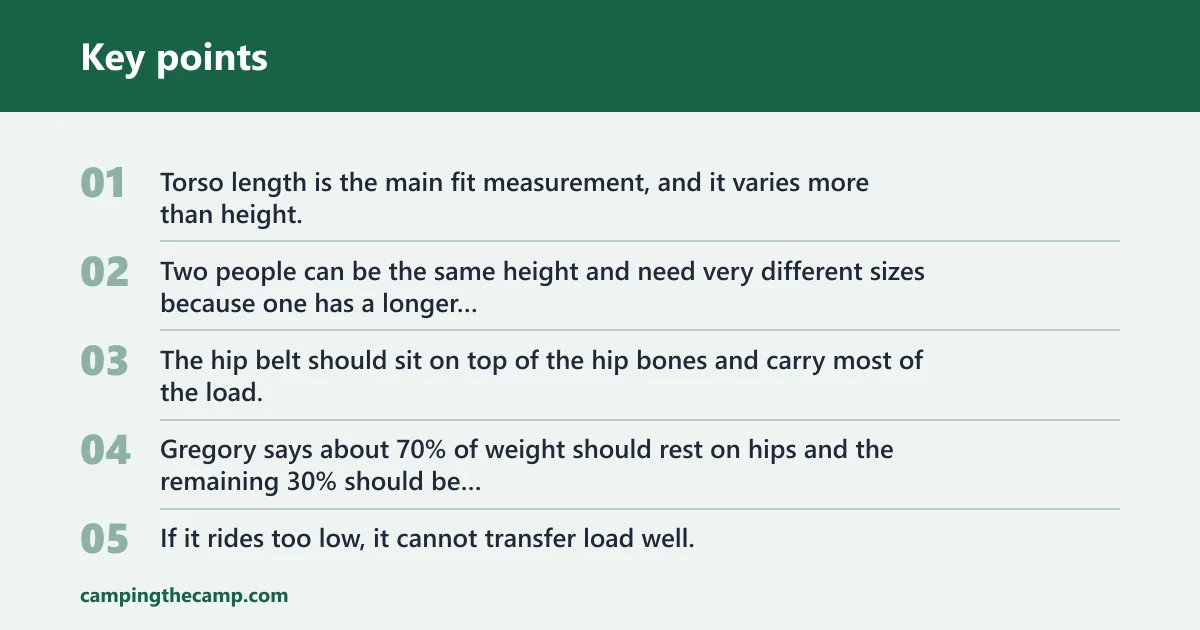
Torso length is the main fit measurement, and it varies more than height. Two people can be the same height and need very different sizes because one has a longer back and the other carries more height in the legs. Height alone is a weak buying guide.
The hip belt should sit on top of the hip bones and carry most of the load. Gregory says about 70% of weight should rest on hips and the remaining 30% should be supported by shoulders. If the belt rides too high, it slips. If it rides too low, it cannot transfer load well.
How shoulder straps and hip belts differ
Shoulder straps affect comfort, but they should not carry most of the load. Width and curve matter most when shoulders are narrow, the chest is broad, or the torso is short. Women’s-specific designs may use narrower strap spacing and a different curve, but that does not make them better for every woman.
The hip belt shape matters just as much. A shaped belt can wrap around curvier hips without gapping, while a straighter belt can feel steadier on a straighter waist and hip line. If the belt overlaps the buckle or digs into soft tissue, the pack is wrong for that body, even if the label looks right.
Why the label is only a starting point
Gregory states backpacks are designed differently for men and women, and cites torso length, shoulder width, and hip structure as reasons. The company also says women, youth, and plus-size adventurers need different fits. That makes the label a shortcut, not a final answer.
Say your torso is short, your hips are wide, and your shoulders are narrow. A women’s pack may fit better on paper, but the real test is whether the belt sits on the hip bones and the shoulder straps clear the chest without pulling inward. If either point fails, the label is wrong for you.
How to measure torso length
Measure torso length from the bony bump at the base of the neck to the line across the top of the hip bones, not to your waist and not to your pants size. That measurement tells you where the back panel should sit. It matters more than height because backpacks are built around back length, not overall stature.
Where the measurement starts and ends
Start at the prominent bone at the base of the neck. End at the top of the iliac crest, which is the top edge of the hip bones. A helper can find both points more reliably than self-measuring in a mirror.
Once you have that number, compare it with the pack’s torso range. If the back section is too long, the hip belt drops below the hip bones. If it is too short, the shoulder straps carry too much load and the top of the pack sits oddly high.
How to match torso length to size range
Look for a pack whose torso adjustment range includes your measured length near the middle of the range, not just at one extreme. Adjustable back systems use a strap ladder or sliding yoke to move the shoulder anchor point up or down. That range helps mixed-proportion bodies and shared use.
- Measure torso length from neck base to hip crest.
- Check whether the pack’s torso range includes that number.
- Make sure the hip belt can center on the hip bones.
- Confirm that the shoulder straps do not pinch the neck or chest.
- Test whether load lifters can tilt the pack slightly toward the body.
Hiking backpack decision matrix
| Body proportion | Likely fit issue | Pack choice recommendation |
|---|---|---|
| Short torso, tall frame | Hip belt may sit too low if the pack is sized by height. | Choose a shorter torso range, even if the frame is tall. |
| Wide hips, narrow shoulders | Hip belt gap and shoulder straps that sit too far apart. | Start with a women’s fit or a narrow back panel with a shaped belt. |
| Large chest, short torso | Shoulder straps may press the chest or rub the neck. | Pick a short torso pack with curved, closer-set straps. |
| Long torso, narrow hips | Women’s belts may feel too curved or unstable. | Try a men’s fit or a unisex pack with a straighter belt. |
| Small frame, broad shoulders | Straps may feel crowded near the neck. | Choose the pack with the widest shoulder spacing that still matches torso length. |
| Mixed-proportion or non-binary body type | No single label matches every contact point. | Choose by torso measurement first, then test belt shape and strap curve. |
| Long legs, short torso | Height suggests a larger pack, but the back may be short. | Ignore height. Buy for torso length and belt placement. |
| Curvy hips with a slim waist | The belt can slide upward or flare away from the hips. | Use a contoured hip belt with enough wrap to stay planted. |
| Broad chest with average torso length | Straps can cross too close to the chest or rub the sides. | Look for strap curves that open the chest area without lengthening the torso fit. |
| Shared pack between two people | One back system may fit one user but not the other. | Choose an adjustable back system with a sliding yoke or ladder adjustment. |
What fit problem does each body shape create?
Most fit problems show up in the same places: hip belt slip, buckle overlap, shoulder pressure, neck rub, chest compression, or pack sway. Those are not small annoyances. They change how the load moves over rough ground and how quickly fatigue builds.
Picture a 5’10” hiker with a short torso and wide hips buying by height alone. The pack may seem large enough, but the hip belt sits below the hip bones and the load rides on the shoulders. The result is sway on descents and sore traps by the end of the hike.
A common first-timer mistake is choosing a women’s pack only because the shoulders feel softer at the store. If the torso is too long or the belt shape is wrong, the pack still fails on trail. Soft padding cannot fix a bad back length.
What pack size should you choose?
Choose volume by trip length and gear, then check fit. Backpack volume is measured in litres. Day hikes are recommended at 15-25 L, weekend trips at 35-50 L, and multi-day hikes at 50-70 L. Some remote multi-day hikes may need 60-100 L, especially when food, insulation, or water carry is heavy.
Day hike volumes
For day hikes, 15-25 L is the common range. That usually leaves room for layers, water, snacks, a first-aid kit, and a shell. If the pack is much larger than needed, the extra bulk can make the load feel looser unless you compress it well.
Military Shop says a day-hike backpack should weigh no more than 1-1.2 kg. That is a useful check when you compare similar-volume packs online.
Overnight and multi-day volumes
Weekend trips usually call for 35-50 L. Multi-day hikes are recommended at 50-70 L. If you are carrying winter layers, bear canisters, or extra food for remote terrain, the range can move higher, and some remote multi-day hikes may need 60-100 L.
The same source recommends backpacks weighing no more than 3 kg for longer expeditions. A heavier empty pack is harder to justify unless the suspension and structure are doing real work for heavier loads.
When extra capacity is not worth the bulk
Extra litres are only useful when you need them. A larger pack often adds structure, pockets, and fabric that you may not use on a short trip. If your load is small, a big bag can feel floppy unless the compression straps are doing their job.
The guide recommends compression straps for adjusting volume. Use them to keep the load close to the frame so the pack does not shift when the main compartment is partly full.
Which features matter most for fit?
The most important fit features are the hip belt, shoulder straps, adjustable back system, load lifters, and suspension system. Convenience features such as pockets, access points, and materials matter for use, but they do not replace fit. Start with the parts that control where the weight sits.
Hip belt shape and size
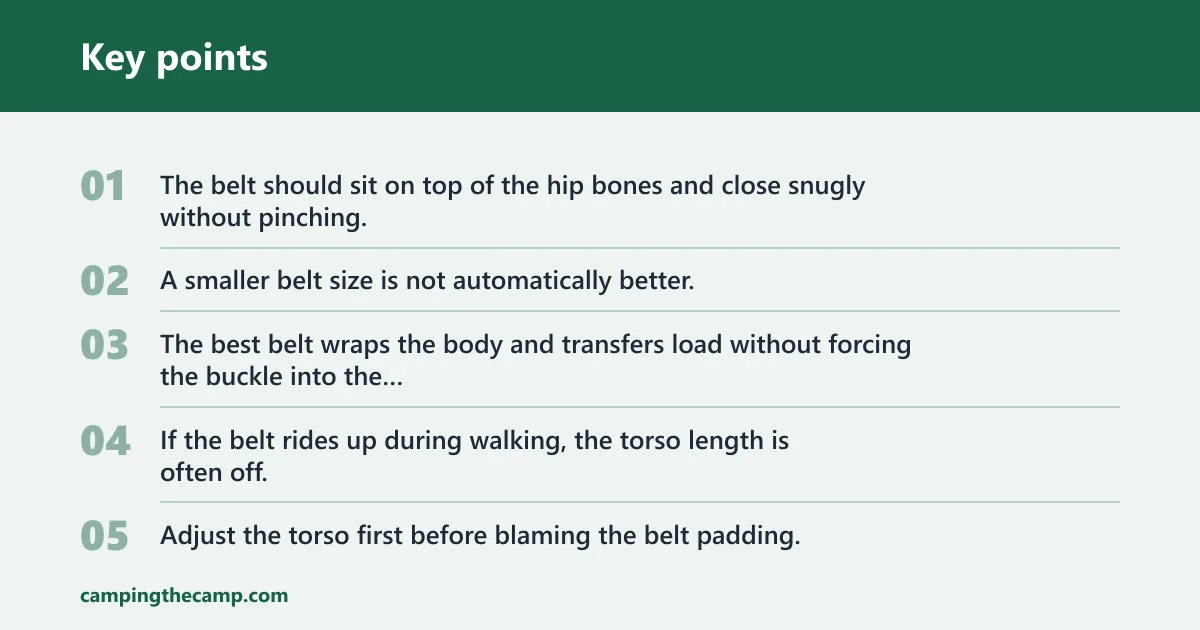
The belt should sit on top of the hip bones and close snugly without pinching. A smaller belt size is not automatically better; the wrong shape can still leave gaps or buckle overlap. The best belt wraps the body and transfers load without forcing the buckle into the stomach.
If the belt rides up during walking, the torso length is often off, the belt is too large, or the load is too high on the back. Adjust the torso first before blaming the belt padding.
Shoulder strap width and curve
Shoulder straps should spread pressure without sliding off the shoulders or cutting into the neck. Women’s-specific packs may use narrower spacing and a different curve, which can help narrower shoulders or a fuller chest. They are not automatically better, and they do not replace a correct back length.
If the straps feel fine in the shop but create pressure after ten minutes on trail, the pack may be too long or too short in the torso. The strap shape can only fine-tune a good fit.
Adjustable back system and sliding yoke
An adjustable back system lets you move the shoulder attachment point to match your torso. A sliding yoke or strap ladder gives more room to dial in fit across different backs. This is useful for shared use, mixed-proportion bodies, and shoppers who cannot try on every size.
If two people share one pack, adjustable range matters more than the gender label. It can let a single pack work for more than one torso length, as long as the hip belt still lands correctly.
Load lifters and suspension system
Load lifters pull the upper pack closer to the body and change the pack angle slightly. They matter most when the pack is heavier. When adjusted well, they help keep weight from drifting backward and improve balance on uneven ground.
The suspension system is the frame and load-transfer structure. It affects how weight moves to the hips, how the pack stays stable, and how it behaves on rough trail. A better suspension can make a heavy load feel steadier, but only if the torso fit is already correct.
Should you choose an internal frame?
An internal frame is the better choice for heavier loads and longer trips because it keeps weight close to the body and improves balance. Frameless packs can work for lighter, simpler loads, but they give less support when the pack gets heavy or the trail becomes uneven. Ventilation changes feel, not fit.
When an internal frame is the better choice
Choose an internal frame when you carry more food, insulation, water, or technical gear. The frame helps the pack hold its shape and keeps the load closer to your center of gravity. That makes a bigger difference on long climbs and rough descents.
Internal-frame packs also support better load transfer to the hips. That is why they suit multi-day use better than frameless designs for most hikers.
When a lighter or frameless pack makes sense
A lighter pack can make sense for short trips, very light loads, or hikers who keep their kit minimal. If the pack holds little weight, a big frame may be unnecessary. The tradeoff is that the carry will usually feel less stable once the load rises.
Do not choose frameless just because it feels soft in the shop. The real question is whether the pack can keep the load close and controlled for your trail and gear.
How ventilation changes feel and stability
Back panel ventilation improves airflow between your back and the pack. It often uses tensioned mesh or perforated foam. The tradeoff is usually a small loss of close-body stability compared with a pack that rides tighter to the back.
If you hike in heat, ventilation matters. If you carry a heavier load on uneven ground, close-body stability matters more. Choose the tradeoff that matches the trip.
Verdict
Choose women if your torso is shorter, your hips are more curved, or your shoulders are narrow enough that standard strap spacing causes pressure points. Choose How to choose a hiking backpack for men if your torso is longer, your hips are straighter, or the women’s fit leaves the belt and straps poorly aligned. When the body is mixed-proportion, the winning pack is the one whose torso range, belt shape, and shoulder geometry line up best.
Frequently asked questions
What is the difference between a men’s and women’s hiking backpack?
The main differences are back length, shoulder strap spacing and curve, and hip belt shape. Women’s packs often assume a shorter torso, narrower shoulders, and a more curved hip structure. Men’s packs often start from a longer torso and a straighter frame shape.
Do women need a different hiking backpack or just a different size?
Sometimes a different size is enough, and sometimes the shape matters too. A woman with a long torso or straighter hips may fit a men’s or unisex pack better than a women’s pack. The right answer comes from torso length first, then belt and strap shape.
How do I know if a hiking backpack fits my torso length?
The hip belt should sit on top of the hip bones, the shoulder straps should start near the top of the shoulders, and the load lifters should angle back from the shoulders without pulling steeply upward. If any of those points miss, the back size is likely off.
What size hiking backpack should I get for day hikes and overnight trips?
Day hikes are recommended at 15-25 L, weekend trips at 35-50 L, and multi-day hikes at 50-70 L. If your route is remote or your gear is bulky, some trips may call for 60-100 L. Choose the smallest volume that still fits your actual load.
Can men use women’s hiking backpacks or vice versa?
Yes. The label does not matter if the torso length, hip belt, and shoulder geometry fit the body better. Many hikers should shop by fit rather than by label, especially when their proportions do not match standard sizing.
How much weight should a hiking backpack carry on the hips?
Gregory says about 70% of the weight should rest on the hips, with the remaining 30% supported by the shoulders. That balance depends on a correct back fit and a belt that sits on the hip bones. If the shoulders carry most of the load, the pack needs adjustment or a different size.
