
How are sleeping bag temperature ratings tested and standardized?

Sleeping bag temperature ratings are commonly tested in labs under EN/ISO 23537, where a heated mannequin in standardized layers measures heat loss to produce comfort, limit, and extreme ratings; for most campers, compare bags by the comfort rating rather than the lowest number. Skip that system, and you can end up with a bag that feels far colder than its tag suggests, which can mean a rough night or a dangerous one. This guide explains the conditioning, mannequin test, rating labels, and where brand claims still diverge from real campsite conditions.
Sleeping bag ratings, explained
Comfort, lower-limit, and extreme ratings are lab numbers, not personal promises. They help you compare bags across brands when the bag was tested under the same standard, but they do not cover every campsite variable. The lowest printed number is the survival side of the scale, not a comfort target.
What comfort, lower-limit, and extreme mean
Under EN and ISO testing, comfort is the temperature where a standard woman is not feeling cold in a relaxed posture. Lower-limit is the temperature where a standard man is fighting the cold while curled up, but still in thermal equilibrium. Extreme is a survival-only figure tied to strong cold stress and hypothermia risk.
That structure matters because the three numbers answer different questions. If you sleep cold, the comfort number is usually the one to compare first. If you sleep warm and want a tighter margin, the lower-limit number can help, but it is still not a comfort promise.
Why the lowest number is not the target number
The extreme number is not for planned use. It marks an emergency threshold, and the gap between comfort and extreme can be large enough to mislead a quick shopper who reads only the smallest figure on the tag.
A common first-timer mistake is seeing a bag labeled 20°F and assuming that means comfortable sleep at 20°F. That number may be the lower-limit rating, while the comfort rating could be much warmer. The label is telling you about different body states, not one universal sleep temperature.
How are sleeping bag temperature ratings tested in a lab?
The test uses a heated manikin in a cold chamber, not a person in a campsite. The bag is usually conditioned first, then placed on a specified sleeping-pad setup and measured in standardized clothing. The lab records heat loss and converts that data into comfort, lower-limit, and extreme values.
How the sleeping bag is conditioned before testing
Before the rating run, the bag is prepared under controlled conditions so the test starts from a known state. EN 13537, introduced in 2005, and ISO 23537 both use a standardized process rather than an informal guess from a factory floor.
The point of conditioning is consistency. A sleeping bag that has been damp, compressed, or handled in a warm room can behave differently from one that has been stabilized before the chamber test, so the lab aims to remove those variables.
What the heated manikin measures in the cold chamber
Therm-a-Rest says the test uses a sensor-rich, heated manikin in a cold chamber on a basic foam mat. EN and ISO tests use a heated manikin wearing long underwear, a hat, and a closed-cell foam sleeping pad. The manikin’s heat loss is the measurable input that becomes the published ratings.
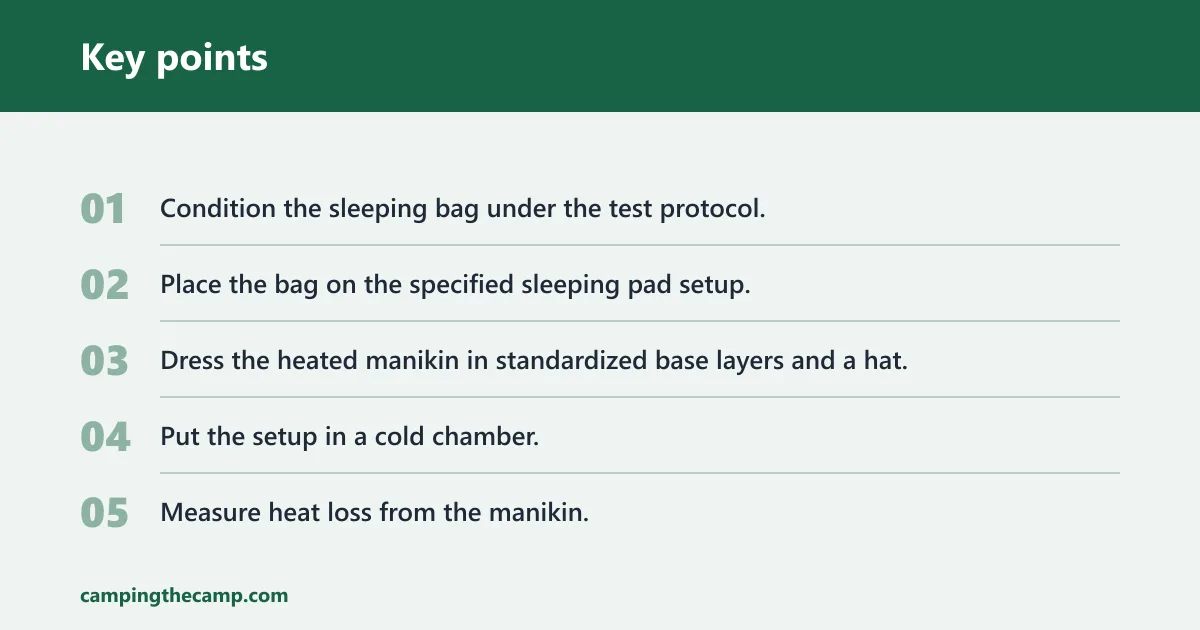
- Condition the sleeping bag under the test protocol.
- Place the bag on the specified sleeping pad setup.
- Dress the heated manikin in standardized base layers and a hat.
- Put the setup in a cold chamber.
- Measure heat loss from the manikin.
- Translate the recorded data into comfort, lower-limit, and extreme values.
This is the lab-to-label chain. The chamber does the cooling, the manikin senses the response, and the standard turns that response into numbers you can compare on a product page.
How the test setup uses a sleeping pad and base layers
The pad is part of the rating system, not an afterthought. EN and ISO testing typically assumes a closed-cell foam sleeping pad or a basic foam mat, and that assumption matters because ground insulation changes how much heat escapes downward.
Base layers matter too. The standardized long underwear and hat mean the rating assumes a specific clothing setup, not a bare body and not a fully layered winter kit. Ground insulation, hood fit, and clothing all change real warmth.
EN 13537 vs ISO 23537
EN 13537 was introduced in 2005 to standardize sleeping bag ratings. ISO replaced EN as the updated sleeping bag testing protocol in April 2017. The broad test logic stayed similar, but the newer ISO label is the current adult recreational standard you should look for on modern bags.
What changed in 2017
The shift from EN to ISO moved the standard into the current international protocol used for adult recreational sleeping bags. ISO 23537 kept the same core idea of standardized manikin testing, but the newer label is the cleaner sign that the bag was rated under the current system.
Older bags may still print EN 13537 because stock and model cycles do not change overnight. That does not make the label useless. It does mean you should read the rating type carefully and check whether the manufacturer is publishing the full set of numbers or only one marketing temperature.
What stayed consistent between the two standards
Both systems use a heated manikin, a cold chamber, a pad, and standardized clothing. Both output comfort, lower-limit, and extreme values. For comparison shopping, that continuity is why EN and ISO ratings can still be read in the same general way.
What stayed similar also explains why the old and new labels can appear side by side in the market. The label family changed in 2017, but the useful comparison logic did not disappear.
What the ratings actually measure
The published numbers translate measured heat loss into use cases. Comfort is the sleeping temperature for a cold sleeper in a relaxed posture. Lower-limit is for a warm sleeper curled up. Extreme is an emergency threshold, not a planned overnight target.
Comfort rating and the cold sleeper profile
Comfort is usually the most useful shopping number for many campers. It is meant to reflect a person who tends to sleep cold and wants a realistic margin before discomfort starts. If you are choosing for shoulder seasons or for a spouse who gets cold easily, start here.
That does not make comfort a guarantee. It is still a lab value based on a standard profile, standard clothing, and a specific pad assumption. Wind, humidity, campsite exposure, and fit can still push a real night colder than the label suggests.
Lower-limit rating and the warm sleeper profile
Lower-limit suits a warmer sleeper who can stay comfortable with less insulation. It is not the same as “safe to this number for everyone.” It is a lower boundary for a particular posture and body type under the test assumptions.
Say your partner sleeps warm and your bag shows a comfort rating of 32°F and a lower-limit rating of 20°F. The 20°F number may sound appealing, but the comfort number is the safer shopping anchor if that person is already prone to chill on cool nights.
Extreme rating and why it is survival-only
Extreme indicates a strong sensation of cold and hypothermia risk. It is for emergency use only. If a bag advertises this number prominently, treat it as a warning about the edge of the test, not a usable camping target.
Start by finding the standard, then identify which rating type the brand is using. Some product pages show all three numbers. Others show only one. The safest comparison comes from labels that clearly state ISO 23537 or EN 13537 and list comfort, lower-limit, and extreme values together.
Where to find the standard and rating type
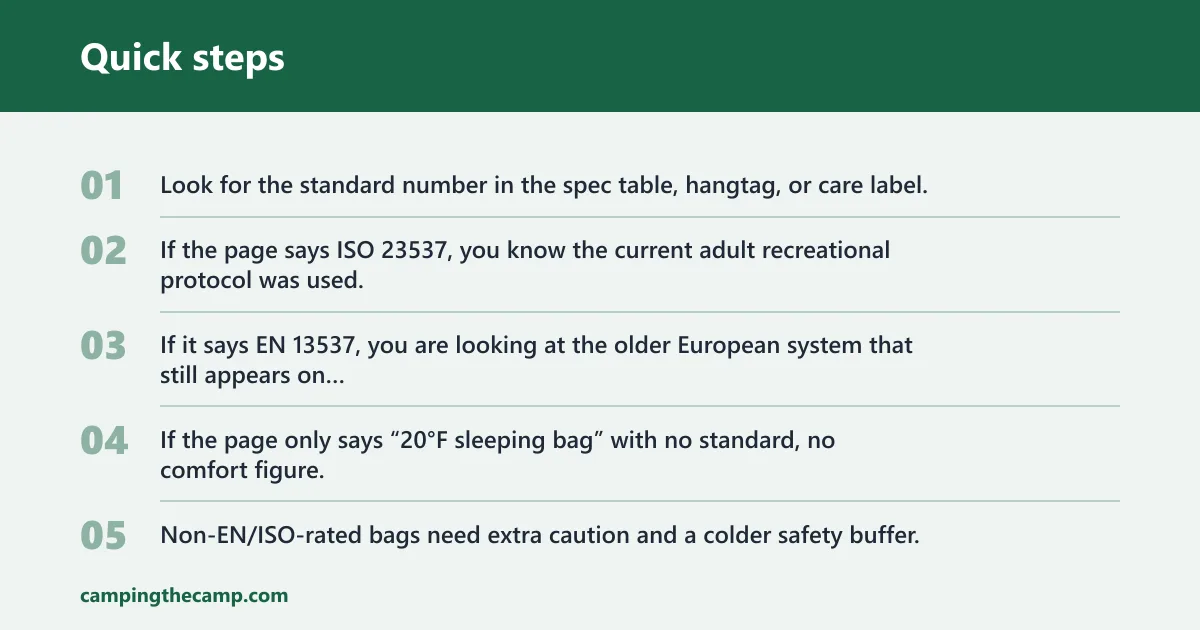
Look for the standard number in the spec table, hangtag, or care label. If the page says ISO 23537, you know the current adult recreational protocol was used. If it says EN 13537, you are looking at the older European system that still appears on many bags.
If the page only says “20°F sleeping bag” with no standard, no comfort figure, and no mention of pad or clothing assumptions, treat that as a marketing temperature until proven otherwise. Non-EN/ISO-rated bags need extra caution and a colder safety buffer.
How brands may round or simplify published numbers
Brands sometimes round figures to clean-looking temperatures or lead with one number while hiding the rest in a spec chart. That can make two bags with the same headline rating feel different on paper before you even compare fill type, fit, or shell design.
CampChap notes that many listings used terminology inconsistently or showed only one of the three numbers. It also reports that the gap between the headline rating and the comfort rating was commonly 8 to 15°F. That is enough difference to change how you plan a trip.
What to check on product pages that omit full test details
Read the full spec block before you trust the headline. If the page does not state the standard, the rating type, the pad assumption, and the clothing assumption, you do not have enough information to compare it cleanly with an ISO-rated bag.
Sleeping bag rating verification worksheet
Use this checklist on any label or product page before you buy. It tells you whether the bag was rated under a standard, what number to compare, and which assumptions may matter at camp. Keep it text-only and complete.
| Check item | What to confirm | Why it matters |
|---|---|---|
| Standard used | ISO 23537, EN 13537, or no stated standard | Tells you whether the rating comes from a standardized lab protocol |
| Rating type | Comfort, lower-limit, or extreme | Shows which number you should compare for your sleep style |
| Test assumptions | Heated manikin, cold chamber, standardized clothing | Explains the conditions behind the number |
| Pad requirement | Closed-cell foam sleeping pad or basic foam mat assumption | Ground insulation strongly affects real warmth |
| Clothing assumptions | Long underwear and hat, or another stated base layer setup | Changes the warmth you can expect at the same rating |
| Size and fit notes | Regular, long, women’s, wide, or mummy fit details | Fit changes dead air space and perceived warmth |
| Full numbers published | All ISO or EN values, or only one marketing temperature | Tells you whether the page gives the full rating picture |
Why two 20-degree bags feel different
Two bags with the same headline rating can still feel different because the rating is only one part of the sleep system. Fit, internal volume, pad insulation, and campsite conditions all change how much heat you keep. The label standardizes the comparison, but it does not erase design differences.
Fit and dead air space
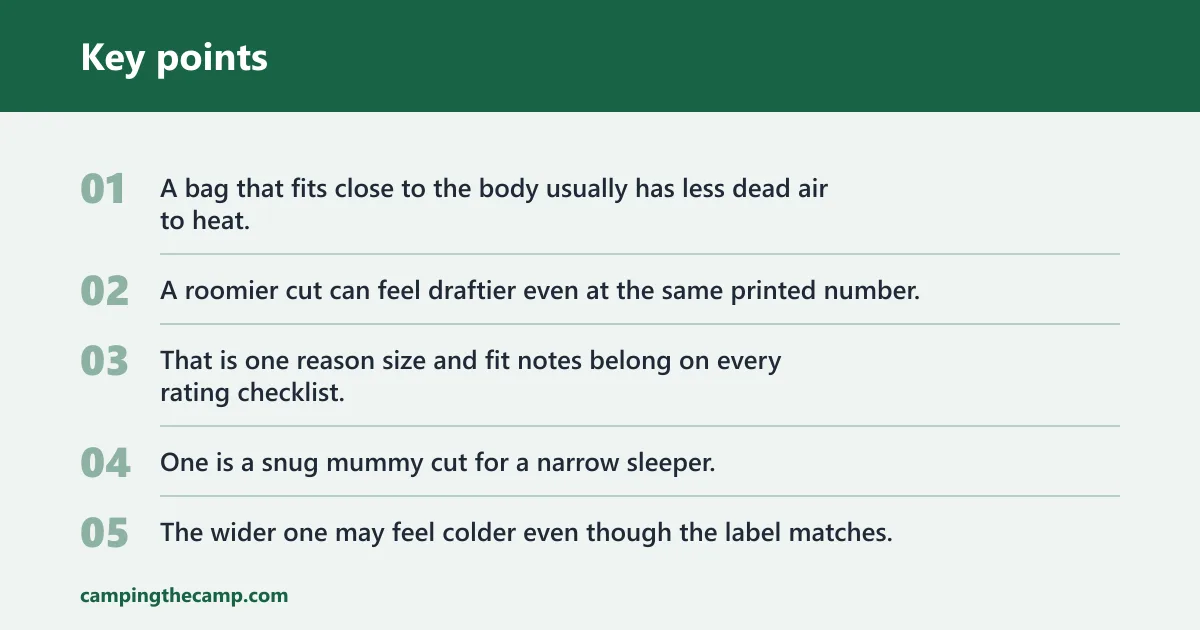
A bag that fits close to the body usually has less dead air to heat. A roomier cut can feel draftier even at the same printed number. That is one reason size and fit notes belong on every rating checklist.
Suppose two bags both read 20°F. One is a snug mummy cut for a narrow sleeper, and the other is a broader cut with more internal space. The wider one may feel colder even though the label matches, because your body has more air to warm.
Shell and lining construction
Shell fabric, baffle design, zipper draft control, and lining feel all affect comfort and heat retention. The EN or ISO number does not tell you whether the hood seals well, whether the zipper leaks, or whether the bag has features that reduce convective loss.
Pad R-value and sleep system effects
The sleeping pad matters because the test assumes a specific level of insulation under the bag. If your real pad is thinner or lower in insulation than the test setup, your body loses more heat to the ground and the bag feels colder than the label suggests.
That is why a 20°F bag can feel different from one campsite to another. A better pad, a warmer layer, and a dry, sheltered site can make the same bag feel much closer to its rating.
Humidity, wind, and campsite conditions
Humidity, wind, and damp ground all change warmth in ways the lab cannot fully model. A sheltered site with dry air behaves differently from a windy ridge or a wet coastal camp. The standard gives you a comparison tool, not a full forecast.
What to look for if a sleeping bag is not EN or ISO rated
If a bag is not EN or ISO rated, treat the printed temperature as a brand claim, not a standardized comparison point. That does not make the bag unusable. It does mean you should add a wider safety buffer and read the rest of the spec sheet with more caution.
How to interpret a brand-set temperature
Ask whether the manufacturer explains how the number was derived. If the page gives only a single temperature and no standard, you cannot assume it matches the lab-based meaning of comfort or lower-limit. Compare it conservatively, and favor a warmer bag than the label suggests.
When to add extra margin
Add more margin if you sleep cold, if the forecast is variable, or if your pad insulation is modest. The colder the campsite and the less complete the spec sheet, the less you should trust the printed number by itself.
Frequently asked questions
What is the difference between EN and ISO sleeping bag ratings?
EN 13537 was introduced in 2005. ISO replaced EN as the updated sleeping bag testing protocol in April 2017. Both rely on a heated manikin, a cold chamber, and the same three rating types, but ISO is the current adult recreational standard you should look for on new bags.
What do comfort, limit, and extreme ratings mean?
Comfort is the temperature where a standard woman is not feeling cold in a relaxed posture. Lower-limit is for a standard man curled up and still in thermal equilibrium. Extreme is a survival-only threshold tied to strong cold stress and hypothermia risk, so it is not a planned sleep target.
Why do two 20-degree sleeping bags feel different?
Same-number bags can differ because fit, dead air space, shell design, zipper sealing, and pad insulation all affect warmth. One bag may be a closer cut, another may assume a better pad or simply manage drafts more effectively. The label helps comparison, but it does not capture every design choice.
Are sleeping bag temperature ratings standardized across brands?
Only if the bag is rated under EN 13537 or ISO 23537. Non-EN/ISO bags may use brand-set temperatures that are less externally verified and can vary more from one company to another. That is why the standard, not just the number, should be checked first.
How does a sleeping pad affect a sleeping bag’s rating?
The pad is part of the test setup, and its insulation affects how much heat escapes into the ground. If your real pad is less insulating than the lab assumption, the bag will feel colder. A strong pad can close part of that gap, but it cannot fully rewrite the rating.
Can I trust a bag’s lowest number as the sleeping temperature?
No. The lowest printed number is usually the extreme or survival side of the scale, not the comfort target. For most campers, start with the comfort rating, then use the lower-limit rating only as a secondary check when you know how warm you sleep and how good your sleep system is.
What should I look for if a sleeping bag is not EN or ISO rated?
Look for any explanation of the test method, the pad requirement, the clothing assumption, and whether the number is a marketing temperature or a measured rating. If that detail is missing, add extra buffer and be cautious. A non-standard bag can still work, but the label deserves more skepticism.
