What is the difference between comfort and limit ratings?

Comfort rating is the temperature most adults should use as the sleep target; limit is the colder threshold where a warm sleeper can survive, not sleep comfortably, and many buyers should choose the lower of the two only with a strong pad and layers. Pick wrong and you get a cold night, poor sleep, and a bag that looks warmer on paper than it feels outside. This guide explains the two labels and how to choose the right one for your sleeping style and sleep system.
How sleeping bag temperature ratings work
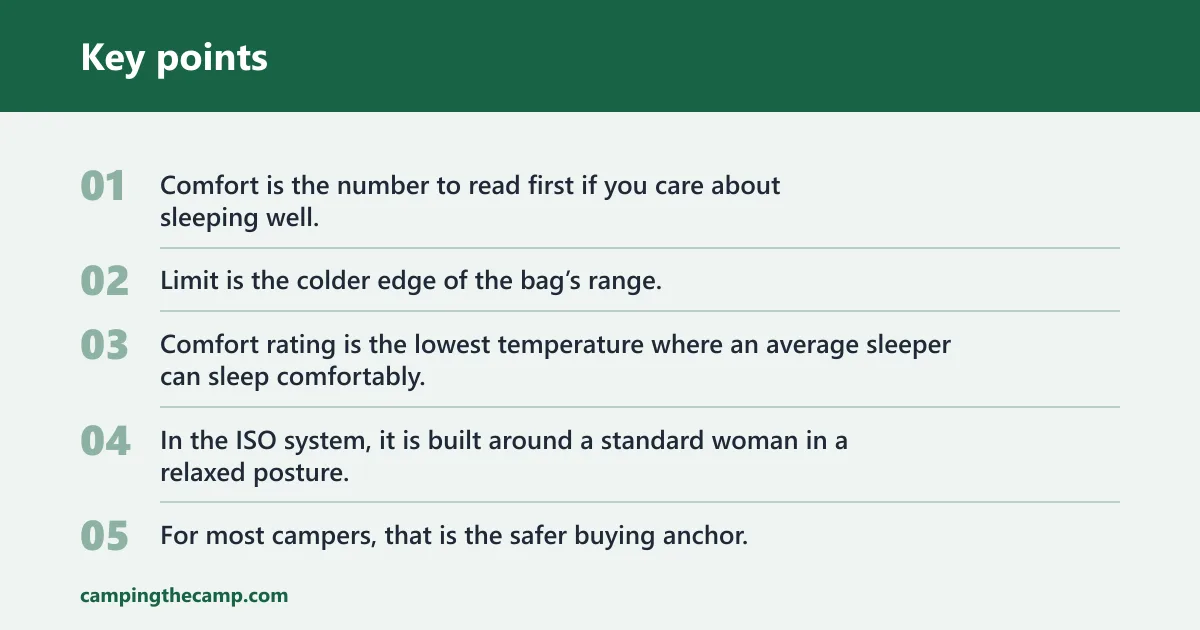
Comfort is the number to read first if you care about sleeping well, not simply enduring the night. Limit is the colder edge of the bag’s range, where a standard man model can remain without shivering, but that is not the same as a restful sleep.
What comfort rating means
Comfort rating is the lowest temperature where an average sleeper can sleep comfortably. In the ISO system, it is built around a standard woman in a relaxed posture, which is why it usually reads warmer than the limit number. For most campers, that is the safer buying anchor.
What limit rating means
Limit rating is the lower limit estimate, based on a standard man curled up and fighting cold. It tells you where the bag may keep a warm sleeper from waking up cold, but it does not promise comfort. On many men’s bags, this is the headline number on the tag.
Where extreme rating fits
Extreme rating is a survival-only threshold. It is not a comfort target, and it should not guide trip planning. If you are choosing a bag for an actual outing, ignore the extreme number except as a warning that the bag has a hard ceiling for risk, not rest.
How sleeping bag ratings are tested
Modern ratings come from lab testing, not marketing copy. ISO 23537 is the current framework for many products, while EN 13537 is the older European standard that was introduced in 2005 and replaced by the newer ISO update in 2017 for many bags. The test uses a heated manikin in a controlled chamber.
ISO 23537 in plain terms
ISO testing is commonly reported to produce comfort, lower-limit, and extreme-temperature ratings. The chamber controls air temperature, and the manikin stands in for a body producing heat. The bag is tested with ground insulation in place, which is why the sleeping pad matters so much in real use.
How EN 13537 differs
EN 13537 is the older label system many shoppers still see in legacy explanations or older product listings. The main idea is similar: one bag can have several published temperature ranges, and those numbers are meant to make products comparable across brands. The newer ISO framework is the current reference point.
Standard woman and standard man models
The lab assumptions are not random. Comfort is tied to a standard woman model, and limit is tied to a standard man model. That difference is why gendered marketing can be misleading if you read only the largest printed number. Two bags marked “20°F” can still feel very different.
Which sleeping bag rating should I trust first for cold nights?
Trust comfort first if you sleep cold, if the trip has wind or damp air, or if your pad is mediocre. Trust limit first only if you sleep warm, know your pad has solid insulation, and can add layers without overcompressing the bag. For most campers, comfort is the better first filter.
Say your forecast low is 32°F, your pad is thin, and you tend to wake up cold. A bag with a 30°F comfort rating is the better fit than one whose 20°F limit looks better on paper. The printed lower number can still leave you chilled once the ground steals heat.
Suppose two unisex bags both say 20°F, but one lists a 30°F comfort rating and the other lists 25°F. The second bag is the warmer sleep target, even though the limit numbers look similar. That is why the comfort line matters more than the headline number for most buyers.
Cold sleepers
If you sleep cold, add a safety buffer to the comfort rating rather than aiming at the limit number. A common buying rule is to choose a bag with a comfort rating about 5 to 10°F below the coldest night you expect, then adjust for pad quality, wind, and humidity.
Hot sleepers
Hot sleepers can often accept a smaller buffer, especially on mild trips where ventilation matters more than maximum insulation. Even then, the comfort rating is still the better starting point because the limit number is a survival edge, not a sleep target. A warm sleeper can still overheat in a bag that is too warm.
Women buying unisex bags
Women buying unisex bags should read comfort before limit, because the comfort number is usually the more realistic sleep target. Many women’s bags lean on comfort ratings for that reason, while many men’s bags lean on limit ratings. That does not make the bags equivalent at the same printed temperature.
Kids and teens
For kids and teens, use the same logic with extra caution. Body size, growth, and sleep patterns vary a lot, so the safer move is to favor comfort and leave a margin. A child who sleeps still and loses heat quickly needs more buffer than the tag alone suggests.
Sleeping bag temperature decision matrix
This table turns the label into a buying rule. Start with sleeper type, then check overnight low, pad R-value, and the buffer to add before you buy. The buffer is the gap between the bag’s comfort number and the night you expect to face.
| Sleeper type | Expected overnight low | Pad R-value | Use this rating first | Recommended safety buffer |
|---|---|---|---|---|
| Cold sleeper | 35°F / 2°C | R 3 to R 4 | Comfort | 10°F / 6°C warmer bag margin |
| Average sleeper | 25°F / -4°C | R 4 to R 5 | Comfort | 5 to 8°F / 3 to 4°C warmer bag margin |
| Warm sleeper | 40°F / 4°C | R 2 to R 3 | Comfort or a light limit margin | 0 to 5°F / 0 to 3°C warmer bag margin |
| Unisex bag for a woman who sleeps cold | 30°F / -1°C | R 4 or higher | Comfort | At least 8°F / 4°C |
| Shoulder-season trip | 20°F / -7°C | R 5 or higher | Comfort | 10°F / 6°C if wind or humidity is likely |
| Winter camping with a strong sleep system | 10°F / -12°C | R 5 to R 7 | Limit only as a backstop | Use comfort if possible; do not plan on limit alone |
The matrix is a guide, not a guarantee. If your pad is thin, move up one step in warmth. If you sleep cold, move up one more. If the trip is windy or damp, add another margin because the printed rating does not fully reflect heat loss from the ground, air movement, or moisture.
Why pads and insulation change the result
Sleeping bag numbers assume a pad, and that is easy to miss. The bag under your body gets compressed, so ground insulation comes from the pad. A high R-value pad can make a modest bag feel much warmer, while a low-R pad can make a strong bag feel weak.
Sleeping pad insulation
Pad R-value matters because the ISO test setup includes ground insulation. In plain terms, the lab does not pretend you are lying on bare ground. If your pad is underbuilt for the season, the bag’s rating will not perform the way the tag suggests.
Down vs synthetic
Down usually gives better warmth-to-weight performance, which is useful when pack size matters. Synthetic insulation is usually less sensitive to moisture and can keep more of its loft when damp, though it often weighs more for the same warmth. That tradeoff matters on wet or humid trips.
Humidity, wind, and shelter
Humidity and wind can pull real-world warmth below the printed number. A drafty shelter, a damp bag, or a poorly sealed hood can all shave comfort off the rating. When those conditions are likely, add buffer instead of trusting the smallest printed figure.
Can you use the limit rating for winter camping?
Yes, but only as a floor, not as the number to aim for. For winter camping, limit can help you compare bags, yet it should not be your only selector. If the trip may dip near the bag’s limit, you need more pad insulation, more clothing, and a bigger margin.
When limit can work
Limit can work when you are a warm sleeper, your pad has a high R-value, and you know the forecast stays well above the bag’s lower edge. In that case, the limit number can help compare two similar bags. Even then, comfort is still the safer number to prioritize.
When to buy warmer
Buy warmer if the forecast low is close to the limit number, if you sleep cold, or if your pad is only suited to mild weather. A sleeping bag that looks adequate on the label can still leave you awake at 3 a.m. if the ground is cold and the air turns damp.
How much buffer to add
A practical buffer is about 5 to 10°F, with the larger end often used for cold sleepers, wind, humidity, or lower-R pads. If the bag is untested against ISO or EN labeling and only shows a manufacturer estimate, be more cautious. Printed temperatures are approximations, not promises.
How far apart are comfort and limit?
The gap is usually 10 to 15°F. That is enough to change a buying decision. A bag can look close on paper, but that spread often separates a bag you sleep in comfortably from a bag you merely endure.
Typical gap in degrees
A common example is a 20°F bag with comfort around 30–35°F. That spread shows why the lower number should not be treated as the sleep target. The gap is often the reason a men’s 20°F bag and a women’s 20°F bag are not equivalent.
Why the gap varies by bag
The gap can change with shape, fill amount, fabric, and how the brand built the bag around the standard models. Some summer bags even list explicit comfort and limit numbers, such as 14°C comfort and 10°C limit. That kind of labeling is clearer than a single headline number.
What the gap means for shopping
Use the gap to decide whether the bag fits your sleep style. If the comfort number already matches your coldest expected night, you are in better shape. If only the limit number lines up, you likely need more bag, more pad, or both.
Frequently asked questions
What is the difference between comfort and limit ratings on sleeping bags?
Comfort is the warmer, more realistic sleep target. Limit is the colder threshold where a standard man model may stay warm enough not to shiver, but not necessarily sleep comfortably. For most buyers, comfort is the number to check first, especially on cold nights.
Which sleeping bag rating should I trust for cold nights?
Trust comfort first, then verify your pad and clothing. If you sleep cold or expect wind, damp air, or a weak pad, add a buffer instead of aiming at limit. Limit can help compare bags, but it is not the best number for sleep planning.
Is the limit rating the same as the temperature I’ll actually sleep comfortably at?
No. The limit rating is the colder edge where a warm sleeper may avoid waking from cold, not a comfort target. Many campers will sleep too cool if they plan trips around limit alone. Comfort is the better guide to actual sleep quality.
Why do women’s sleeping bags often use comfort ratings while men’s use limit ratings?
Because the lab assumptions differ. Comfort is based on a standard woman in a relaxed posture, while limit is based on a standard man curled up and fighting cold. That is why women’s bags often lead with comfort and men’s bags often lead with limit.
How much warmer is a comfort rating than a limit rating?
The gap is often 10 to 15°F. A 20°F bag may have comfort around 30–35°F, which is why the lower number should not be read as the sleep target. The spread is a practical shopping clue, not a fixed rule for every bag.
Can I use the limit rating to choose a sleeping bag for winter camping?
Use it only as a backstop. Winter camping needs a strong pad, extra margin, and a comfort rating that gives you room above the forecast low. If you are close to limit, buy warmer or add insulation rather than trusting the label alone.