
Sleeping pad vs air mattress vs cot: Comfort Compared

Sleeping pads usually make the most sense for backpacking, air mattresses fit plush car-camping sleep, and cots give the firmest off-ground support; side sleepers often do best with thicker air systems. Choose poorly, and you may get hip pressure, cold from the ground, or a bed that is too bulky to carry or set up. This guide compares comfort, support, warmth, packability, and setup so you can choose the right sleep system for your trip.
| Factor | Sleeping pad | Air mattress | Cot | Winner |
|---|---|---|---|---|
| Cushioning | Varies by thickness; foam is firm, inflatable and self-inflating models can feel cushier | Usually the plushest feel | Firm platform feel with limited cushioning | Air mattress |
| Pressure relief | Good when thick enough, especially for hips and shoulders on side sleep | Very good because firmness is adjustable | Moderate; supports the body but can feel hard without a pad | Air mattress |
| Support from below | Depends on thickness and shape; best for even ground contact | Good, but may shift or sag if underinflated | Strongest off-ground support | Cot |
| Insulation | Best insulation in this comparison; R-value matters in cold weather | Poorer insulation unless paired with a pad | Airflow below the sleeper can feel cold in winter | Sleeping pad |
| Packability | Smallest and easiest to carry | Bulkier and heavier than a pad | Heaviest and bulkiest | Sleeping pad |
| Setup complexity | Low to moderate | Moderate to high; pump often needed | Higher; frame must be assembled | Sleeping pad |
| Puncture risk | Low for foam, higher for inflatable models | Higher than the other two | Low | Cot |
| Best use case | Backpacking, cold nights, minimal carry weight | Car camping where plush feel matters most | Base camp, hot weather, off-ground sleep | Depends on trip |
How comfort actually differs
Comfort is easier to judge when you split it into three parts: cushioning, pressure relief, and support from below. A sleeping pad can feel firm and still work well if it blocks hard ground and spreads weight. An air mattress can feel softer, while a cot changes the feel by lifting you off the ground entirely.
Cushioning
Cushioning is the soft layer between your body and the ground or frame. Air mattresses usually win here because they hold a larger air volume and let you tune firmness with inflation. Sleeping pads vary more: foam is simple and firm, inflatable pads feel softer, and self-inflating pads sit in the middle.
Pressure relief
Pressure relief matters most at the hips, shoulders, and heels. Side sleepers usually need more of it because the body concentrates load on fewer contact points. A thicker sleeping pad can help, but air mattresses usually provide the strongest pressure relief because you can soften them without losing support completely.
Support from below
Support from below is different from softness. It is the sleep system’s ability to keep your spine, hips, and shoulders aligned without bottoming out. Cots provide the firmest off-ground support. Sleeping pads follow ground contours more directly, while air mattresses can feel supportive only if they are inflated enough to prevent sagging.
Which option feels best for you?
The best-feeling option depends on sleep position. Side sleepers usually need the most pressure relief, back sleepers need a balance of support and cushioning, and stomach sleepers usually do better with a firmer surface that keeps the pelvis from dipping. The same bed can feel excellent for one position and poor for another.
Side sleepers
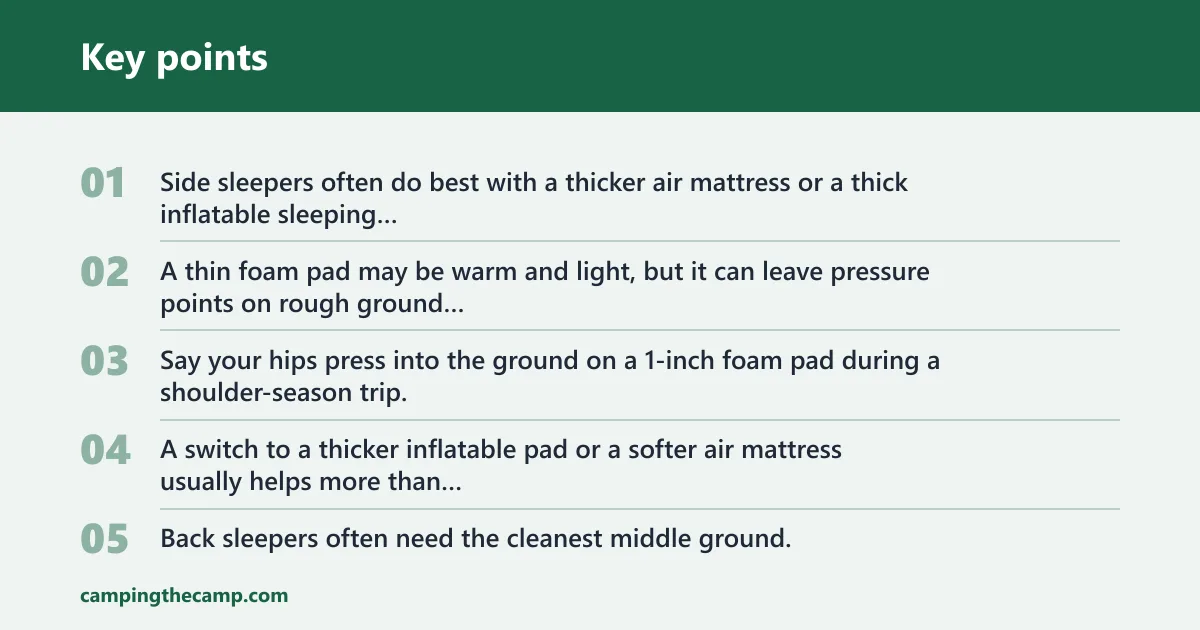
Side sleepers often do best with a thicker air mattress or a thick inflatable sleeping pad because both can reduce hip and shoulder pressure. Extra hip foam helps too. A thin foam pad may be warm and light, but it can leave pressure points on rough ground or hard cot fabric.
Say your hips press into the ground on a 1-inch foam pad during a shoulder-season trip. A switch to a thicker inflatable pad or a softer air mattress usually helps more than adding a pillow, because the issue is load at the hip, not head position.
Back sleepers
Back sleepers often need the cleanest middle ground. A sleeping pad with enough thickness can work well if it keeps the lower back from arching too much. An air mattress can feel more forgiving, but if it is too soft it may let the body sink unevenly and strain alignment.
Stomach sleepers
Stomach sleepers usually need the firmest setup of the three. Too much sink can twist the lower back. A firmer sleeping pad or a properly inflated cot-plus-pad setup often works better than a very soft air mattress, especially if the mattress allows the pelvis to drop lower than the chest.
What sleeps warmer?
Sleeping pads are often reported to sleep warmer than air mattresses because they tend to insulate better from the ground. In cold weather, that difference matters more than cushion alone. Cots can feel airy and pleasant in hot weather, but the open space below them can pull warmth away fast when temperatures drop.
R-value and sleeping pads
For sleeping pads, R-value is commonly used as a guide to warmth. Higher R-value means better resistance to heat loss through the ground, which matters on cold soil, snow, or frozen tent floors. If you camp in shoulder season or winter, the pad’s insulation rating matters as much as its thickness.
Air mattresses in cold weather
Air mattresses can feel warm at first, then less so as the air inside cools overnight. Some campers describe that as the bed “going cold,” but the real issue is heat transfer through the mattress. An air mattress can still work in cold weather if you add an insulating pad under or over it.
Cots and airflow
Cots improve airflow and keep you off damp ground, which is useful in summer. That same airflow becomes a drawback in winter. If the tent floor is cold, a cot can feel colder than a sleeping pad because air moves under the bed instead of trapping warmth beneath it.
How do packability and setup compare?
Packability matters because comfort drops fast when a bed is awkward to carry, inflate, or store. A light sleeping pad fits most backpacks. Air mattresses usually need more space and a pump. Cots are the least portable and can add setup friction that matters after dark, in wind, or after a long drive.
Backpacking carry size
For backpacking, the sleeping pad is often the more practical choice. It is the lightest of the three options, and a sleeping pad can weigh as little as 1 pound. Pads also come in foam, inflatable, and self-inflating styles, with mummy and rectangular shapes for different trade-offs in weight and sleep surface.
Car camping storage
Car campers can tolerate more bulk, but storage still matters. A full-size air mattress averages about 10.5 lbs, and a queen-sized air mattress averages about 12.8 lbs. Camp cots vary widely; the average camp cot weight is about 14.7 lbs, a small camp cot can weigh as little as 2.8 lbs, and a large camp cot can weigh as much as 47 lbs.
Pump, inflation, and repair needs
Air mattresses often need a pump and a repair kit, and those add setup time. They also need enough inflation to stay supportive. If you underinflate them, they can feel saggy; if the temperature drops overnight, they can feel softer by morning. Cots avoid inflation work, but they take more assembly and space.
Sleeping pad comparison table
Sleeping pads are not one product. Foam, inflatable, and self-inflating pads behave differently in comfort, warmth, and carry size. Shape and size matter too. A mummy cut trims weight and can save space, while a rectangular cut gives you more sleeping surface.
| Type or fit | What it changes | Comfort effect | Best use case |
|---|---|---|---|
| Foam | Simple structure, no inflation | Firm, durable, limited cushion | Rough use, fast setup, backup layer |
| Inflatable | Air chambers and adjustable firmness | Most tunable comfort in a pad | Backpacking where weight still matters |
| Self-inflating | Foam plus air for easier setup | Middle ground between foam and full air | Car camping and moderate pack size |
| Mummy cut | Narrows toward the feet | Saves weight, less surface area | Weight-sensitive trips |
| Rectangular cut | Full-width sleeping surface | More room to move, more bulk | Campers who turn a lot at night |
| Small, regular, large, regular-wide | Length and width determine fit | Better fit can improve sleep quality | Choose by body size and sleep style |
Shape and size trade-offs
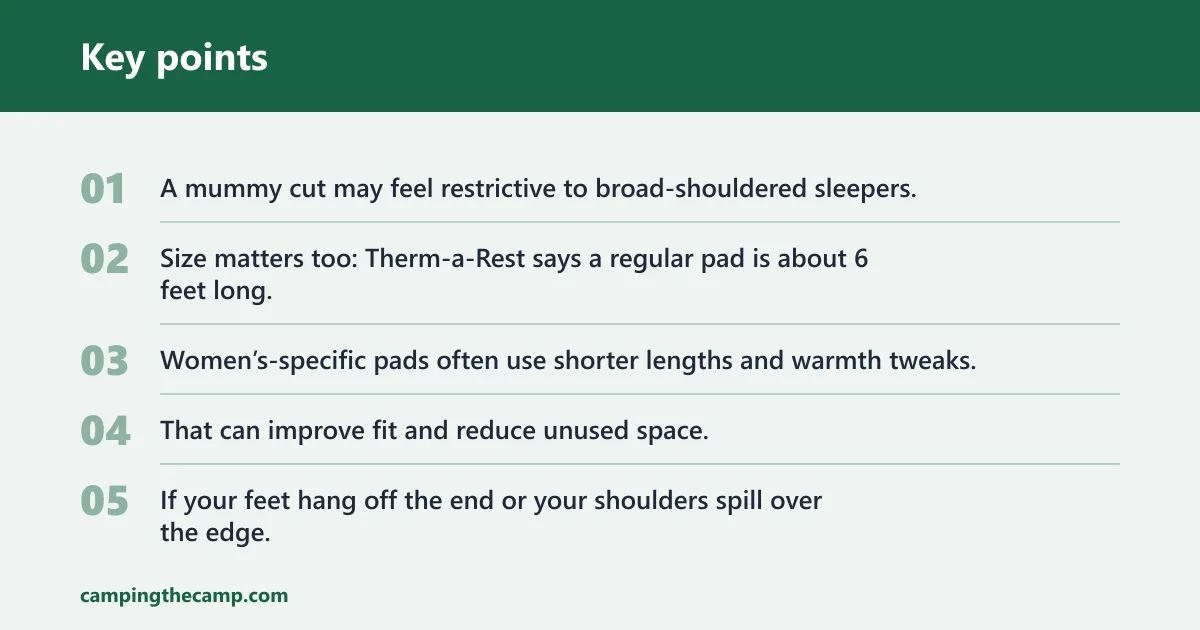
Shape changes both comfort and carry weight. A mummy cut may feel restrictive to broad-shouldered sleepers, but it trims weight and pack size. A rectangular pad feels roomier. Size matters too: Therm-a-Rest says a regular pad is about 6 feet long, a large pad is about 6 feet 5 inches long, and regular pads are about 20 inches wide.
Women’s-specific pads often use shorter lengths and warmth tweaks. That can improve fit and reduce unused space, which matters because extra pad volume can add weight without helping sleep. If your feet hang off the end or your shoulders spill over the edge, the pad is too small for your body and sleep position.
Sleeping pad comparison table
Air mattresses and cots solve different problems. Air mattresses try to mimic a bed with adjustable firmness. Cots solve the off-ground problem first and then trade some plush feel for airflow, durability, and cleaner setup on uneven dirt or damp tent floors.
| Feature | Air mattress | Cot | Winner |
|---|---|---|---|
| Firmness control | Adjustable firmness | Mostly fixed feel | Air mattress |
| Plush comfort | Usually the most comfortable | Comfortable but less cushioned | Air mattress |
| Off-ground sleep | Low profile on the floor | Elevates sleeper above the ground | Cot |
| Hot-weather airflow | Moderate | Better airflow in summer | Cot |
| Cold-weather use | Can lose warmth overnight | Can feel colder in winter | Neither, unless paired with insulation |
| Weight and bulk | Heavier and bulkier than a pad | Heaviest and bulkiest option | Air mattress |
Durability, noise, and repairability
Cots are generally the most durable of the three. Air mattresses are the most failure-prone because punctures, valve leaks, and slow air loss can turn a comfortable bed into a sagging one by morning. Noise also matters: some air mattresses crinkle or squeak when you roll over, while foam pads and many cots stay quieter.
Choose a sleeping pad, air mattress, or cot
Use the sleep system that matches your trip, not the one with the softest showroom feel. A sleeping pad is usually the best pick when weight, warmth, and reliability matter. An air mattress is the better comfort-first choice for car camping. A cot makes sense when off-ground sleep and airflow matter more than compact storage.
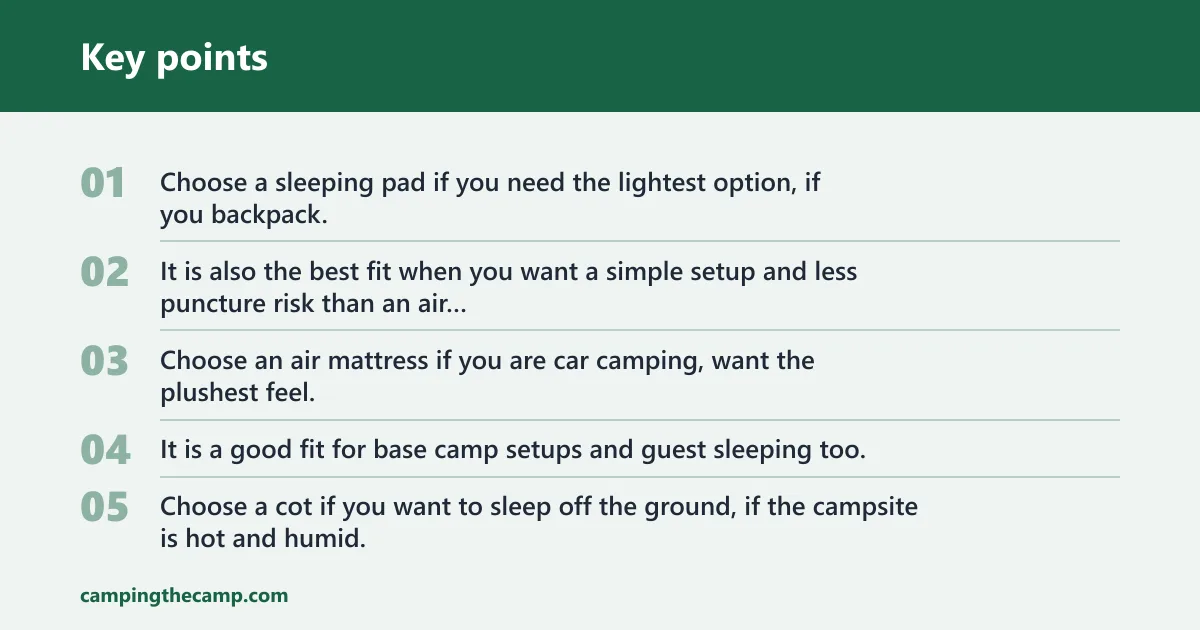
Choose a sleeping pad if…
Choose a sleeping pad if you need the lightest option, if you backpack, if cold ground is part of the trip, or if you want a sleep system that stores small. It is also the best fit when you want a simple setup and less puncture risk than an air mattress.
Choose an air mattress if…
Choose an air mattress if you are car camping, want the plushest feel, or need firmness you can tune for a side-sleeping hip or shoulder. It is a good fit for base camp setups and guest sleeping too, as long as you can handle the extra bulk and the chance of overnight softening.
Choose a cot if…
Choose a cot if you want to sleep off the ground, if the campsite is hot and humid, or if you want a firm surface that keeps dirt, stones, and moisture farther away. It also fits campers who value durability and airflow more than plush cushioning.
A common first-timer mistake is choosing a thin pad for a rocky site because it looks compact enough. The pad packs well, but the sleeper wakes with hip pressure and a colder back. In that case, a thicker pad, better R-value, or a different sleep system would have solved the problem more directly.
Comfort comparison table
This table turns the comparison into use cases. It helps you match comfort to body type and trip style instead of treating comfort as one vague thing. The best answer changes with sleep position, temperature, and how much bulk you can carry.
| Use case | Sleeping pad | Air mattress | Cot | Best fit |
|---|---|---|---|---|
| Side sleeper | Good if thick and wide enough | Very good pressure relief | Only fair without added padding | Air mattress |
| Cold sleeper | Best insulation, especially with higher R-value | Needs extra insulation | Can feel cold from airflow below | Sleeping pad |
| Car camper | Good if you want simpler gear | Best plush feel | Good if off-ground sleep matters | Air mattress |
| Backpacker | Best carry size and weight | Too bulky for most packs | Too bulky for most packs | Sleeping pad |
Frequently asked questions
Is a sleeping pad more comfortable than an air mattress for camping?
Usually not if comfort means plush feel. Air mattresses are generally the most comfortable option in this comparison because they offer more cushion and adjustable firmness. A sleeping pad can still feel better if you need warmth, a firmer surface, or a lighter setup that does not sag overnight.
Which is better for back support: a sleeping pad, air mattress, or cot?
Back support depends on how much the sleeper sinks. Cots give the firmest off-ground support. Sleeping pads can support the back well if they are thick enough and match body size. Air mattresses can help too, but they must stay inflated enough to avoid uneven sagging through the night.
When should I choose a cot instead of an air mattress?
Choose a cot when you want to sleep off the ground, when summer airflow matters, or when you want a durable bed that is less likely to puncture. Pick an air mattress instead if you want a softer, more bed-like feel and can accept more bulk and setup work.
What sleeps warmer: a sleeping pad, air mattress, or cot?
A sleeping pad usually sleeps warmer because it insulates better from the ground. That is why R-value matters in cold weather. Air mattresses lose heat more easily, and cots allow air to move underneath the sleeper, which can be pleasant in summer and cold in winter.
Which option is easiest to carry for backpacking?
The sleeping pad is the easiest to carry for backpacking. It is the lightest option, and some models weigh as little as 1 pound. Pads also pack smaller than air mattresses and cots, which makes them the practical choice when pack space and load weight both matter.
How much does a camping cot or air mattress usually weigh?
The average camp cot weight is about 14.7 lbs, while an oversized camp cot averages about 27 lbs. A small camp cot can weigh as little as 2.8 lbs, and a large camp cot can weigh as much as 47 lbs. A full-size air mattress averages about 10.5 lbs, and a queen-sized air mattress averages about 12.8 lbs.
Which sleep system is best if I want support off the ground?
A cot is the clearest choice if you want support off the ground. It lifts you away from wet soil, rocks, and uneven tent floors. That said, a cot feels less cushioned than an air mattress, so if plush comfort matters more than elevation, an air mattress may fit better.