
Do you need a separate RV water filter for drinking water?

Usually no: a whole-RV filter is enough for plumbing protection, but add a separate drinking-water filter if you want better taste, odor, or finer contaminant reduction at the faucet. Skip the second stage when you want simple upkeep, or you may still dislike the water you cook with and drink. This guide separates hose-and-plumbing filtration from point-of-use drinking filtration and shows when each setup makes sense.
RV water filter basics
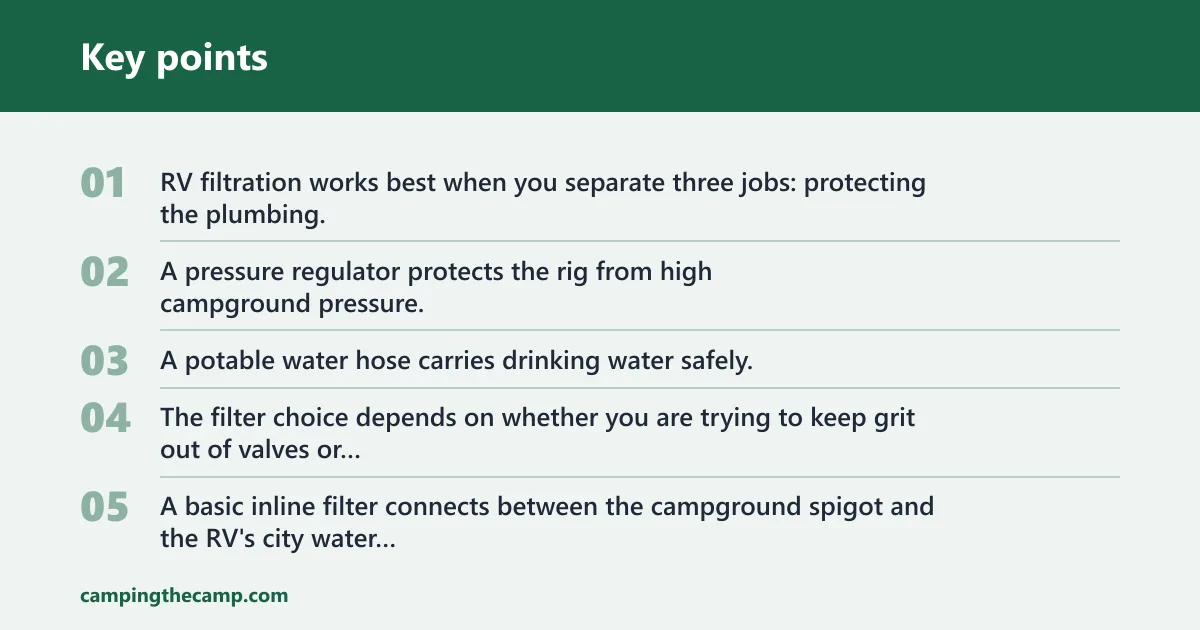
RV filtration works best when you separate three jobs: protecting the plumbing, improving water at the tap, and treating a specific contaminant claim. A pressure regulator protects the rig from high campground pressure. A potable water hose carries drinking water safely. The filter choice depends on whether you are trying to keep grit out of valves or improve what goes into your glass.
Inline RV water filter: where it fits in a setup
A basic inline filter connects between the campground spigot and the RV's city water inlet. That makes it the simplest and most common RV option, and it is usually the most affordable. It usually uses carbon or sediment media, so it offers a lower level of filtration than larger housings, and it needs periodic replacement.
Inline filters are good at two jobs. They can reduce sediment that would otherwise reach the RV plumbing, and carbon can reduce chlorine taste and odor. They are not automatically a purifier or a water softener, so you should not treat them as a fix for every water problem.
Canister RV water filter: when a larger housing makes sense
Canister systems use replaceable cartridges in a larger housing. They cost more and are harder to install than an inline filter, but they can deliver a higher level of filtration. They also allow staged setups, such as sediment first and carbon second, which is common when you want to protect both plumbing and taste.
A two-canister approach often starts with a 5-micron sediment filter and then a carbon block filter. That order makes sense because the sediment stage helps catch sand, rust, and silt before the carbon stage. When the first cartridge clogs, flow drops; that is a sign to inspect the system and replace parts on schedule.
Under-sink drinking water filter: what it does differently
An under-sink drinking-water system is a point-of-use setup. It treats only the water you drink and cook with, so it saves capacity versus filtering every gallon in the rig. Because these systems are dedicated to the kitchen tap, they can use finer treatment or larger cartridges than a simple whole-RV inline filter.
That is why whole-RV filtration and under-sink drinking-water filtration often work best together. The whole-RV side protects plumbing and appliances. The point-of-use side handles the water you actually consume.
Do you need a separate RV water filter for drinking water?
Not always. If campground water is already potable and your main issue is taste, odor, or grit, a whole-RV filter may be enough. Add a separate drinking-water system when you want stronger contaminant reduction at the faucet, when you dislike the taste after whole-RV filtration, or when the source water needs more than basic carbon treatment.
When whole-RV filtration is enough
Whole-RV filtration is usually enough when you are connected to a known potable campground supply and you mainly want to protect hoses, faucets, pump parts, and fixtures. It is also a good fit for short trips, because it keeps the setup simple and avoids filtering water you will never drink.
If your only complaint is sand in the lines or a faint chlorine taste, an inline or canister whole-RV filter often solves the problem. It is not a reason to add another system unless the taste issue continues at the kitchen tap.
When a second drinking-water filter is justified
A separate drinking-water filter makes sense when you want a higher level of treatment for cooking and drinking only. That includes persistent taste issues, a desire for a specific contaminant reduction claim, or a setup where you do not want to spend cartridges on every gallon entering the coach.
Suppose your water hookup is fine for showers and dishes, but the kitchen water still tastes strongly of chlorine after the whole-RV filter. A point-of-use carbon or reverse osmosis system can target the drinking tap without making you pay to treat every gallon in the rig.
Cases where filtration is not enough
Filtration does not turn questionable water into safe water by default. If the source is a private well of unknown condition, a boil advisory is in effect, or the water is visibly dirty, you need a different decision. In those cases, do not rely on taste or smell as a safety check.
Before you drink from the RV system, sanitize the fresh-water tank and plumbing if the rig has been sitting, has had questionable water in it, or shows signs of contamination. A dirty tank, hose, or line can re-contaminate water after the filter, so source quality is only part of the decision.
A common first-timer mistake is assuming clear water and a neutral smell mean the water is ready to drink. That is not a safe assumption. You need a treatment claim that matches the risk, and sometimes you need to avoid the source until it is known safe.
RV water filter decision matrix
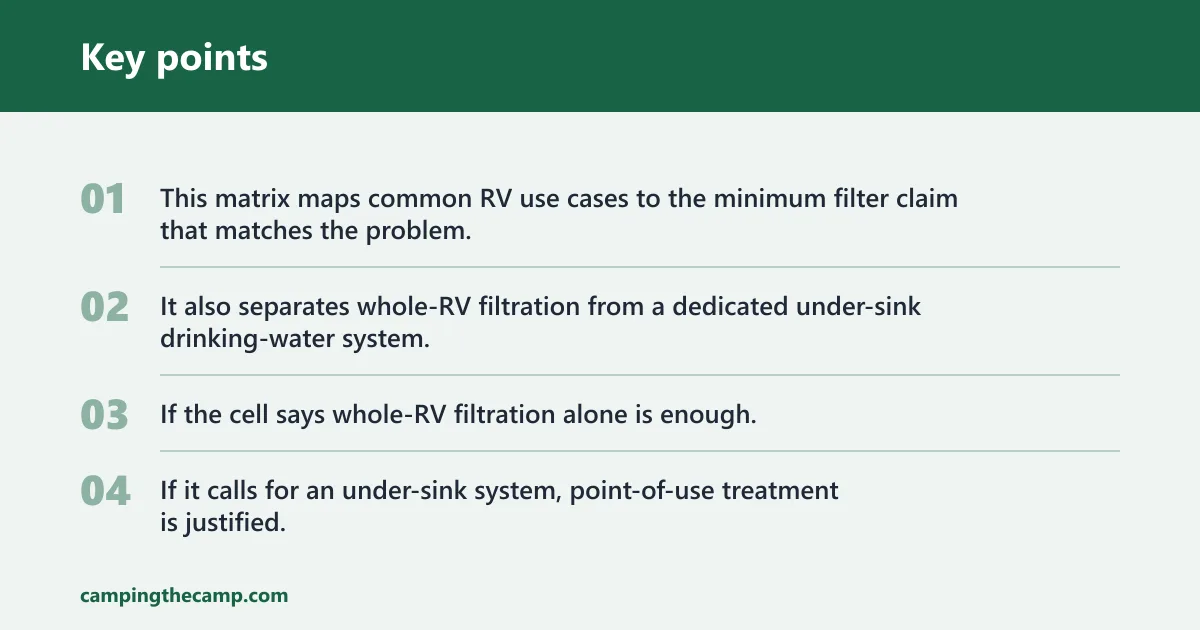
This matrix maps common RV use cases to the minimum filter claim that matches the problem. It also separates whole-RV filtration from a dedicated under-sink drinking-water system. If the cell says whole-RV filtration alone is enough, that means you can usually stay with the simpler setup. If it calls for an under-sink system, point-of-use treatment is justified.
| Traveler type | Water problem | Whole-RV filtration alone enough? | Separate under-sink drinking-water system needed? | Minimum NSF/ANSI claim to look for |
|---|---|---|---|---|
| Weekend camper | Chlorine taste | Yes, often | No, unless taste remains at the faucet | 42 |
| Weekend camper | Sediment | Yes | No | No specific claim needed for basic particle control; look for micron rating and sediment media |
| Weekend camper | Hard water | No | Usually yes if you want softer-tasting drinking water; better yet, use a softener for plumbing and a drinking filter for the faucet | Softener for hardness reduction; 42 for taste improvement only |
| Weekend camper | Health-related contaminants | No | Yes | 53 for the exact listed contaminant claim |
| Weekend camper | Unknown source | No | Yes, if water is still approved for use after source verification | 53 or 58, matched to the stated risk |
| Full-timer | Chlorine taste | Sometimes, but often not enough at the kitchen tap | Yes, if you drink from the RV daily | 42 |
| Full-timer | Sediment | Yes | No | No specific claim needed for basic particle control; use a sediment stage |
| Full-timer | Hard water | No | Often yes for the drinking tap; a softener may help plumbing | Softener for hardness reduction; 42 for taste only |
| Full-timer | Health-related contaminants | No | Yes | 53 or 58, matched to the listed contaminant |
| Full-timer | Unknown source | No | Yes, and avoid drinking until the source is verified | 53 or 58, but only for the contaminant the system is certified to reduce |
| Boondocker | Chlorine taste | Usually not relevant unless filling from treated sources | Yes if you carry treated water and want better taste | 42 |
| Boondocker | Sediment | Yes, if filling from sources with particles | No | Micron-rated sediment filtration |
| Boondocker | Hard water | No | Usually yes for drinking water; a softener may protect fixtures if you have one | Softener for hardness reduction; 42 does not address hardness |
| Boondocker | Health-related contaminants | No | Yes | 53, or 58 if using reverse osmosis for the listed claim |
| Boondocker | Unknown source | No | Yes only after the source is verified, treated, or avoided | 53 or 58, matched to the stated contaminant; filtration alone may still not be enough |
What each filter type can remove
Activated carbon and chlorine taste
Activated carbon improves taste and odor, especially chlorine taste and odor. That is why many RV filters use carbon media. It does not normally remove hardness minerals, and it does not reliably remove bacteria or viruses, so taste improvement is not the same thing as safety.
Sediment filtration and flow protection
Sediment filtration catches sand, rust, silt, and other particles. It protects plumbing and the pump, and it often sits before carbon so the carbon cartridge does not clog too quickly. Micron rating matters because smaller ratings trap finer particles but can slow flow and clog sooner.
What reverse osmosis changes
Reverse osmosis systems reduce more dissolved substances than basic filters, and they can be effective for certain contaminants when the exact system is certified for those specific claims. They also need pressure and maintenance, produce water slowly, and send some water to the drain. If you want stronger point-of-use treatment, RO can fit that role, but it is more complex than an inline filter.
What a water softener does and does not do
A water softener is not a filter. It targets hardness minerals like calcium and magnesium, which can reduce scale and improve feel, but it does not disinfect water and it does not replace contaminant filtration. Use it for hardness problems, not as your only drinking-water defense.
Which NSF/ANSI claim should you look for?
Look for the claim that matches the problem you actually have. NSF/ANSI 42 is for taste and odor. NSF/ANSI 53 is for specific health-related contaminants. NSF/ANSI 58 applies to reverse osmosis systems. Certification matters only when the exact product claim matches the contaminant you want reduced.
NSF/ANSI 42 for taste and odor
If chlorine taste or odor is the issue, NSF/ANSI 42 is commonly the minimum claim to check. That standard covers taste-and-odor reduction. It does not mean the water is safe if the source is unsafe; it only means the product is certified for the taste-and-odor claim it makes.
NSF/ANSI 53 for listed health-related contaminants
If you are worried about a health-related contaminant such as lead or another listed substance, look for NSF/ANSI 53 and the exact contaminant claim on the label. The category alone is not enough. A product that claims 53 for one contaminant may not cover the one you care about.
NSF/ANSI 58 for reverse osmosis systems
If you choose reverse osmosis, look for NSF/ANSI 58. That standard is tied to RO systems, and the exact claim still matters. A certified RO system may reduce several substances, but you should check the listed contaminant reduction claims before you buy.
Why the claim must match the contaminant
Certification is not a blanket promise. A product can be good at taste and odor and still miss the contaminant you are worried about. That is why the label has to match the problem: chlorine taste calls for 42, a listed health concern calls for 53, and RO claims should line up with 58.
Is an inline RV water filter enough to drink from?
It can be, but only for the right source water and the right problem. If the campground water is already potable and the issue is mainly taste or minor sediment, an inline filter is often enough. If the source is questionable, or if you need a listed contaminant reduction claim, inline carbon alone is not enough.
Safe campground water with taste issues only
When the water is already approved for drinking and you just want to reduce chlorine taste, an inline carbon filter is a reasonable choice. It is easy to install and inexpensive to replace. That makes it a good fit for weekend camping and short stays.
Water from questionable wells or unknown hookups
If you are filling from an unknown source, do not assume an inline filter makes that water safe. Carbon filters do not normally remove bacteria or viruses, and they do not automatically cover lead, cysts, or other specific hazards unless the exact product claim says so. In that situation, source verification comes first.
What to do after boil advisories or visible contamination
If there is a boil advisory or the water is visibly contaminated, treat that as a warning, not a filter problem. A basic inline filter is not the right answer by itself. Use a source that is known safe, or use a treatment method that is actually certified for the issue you face.
Setup order and maintenance
A smart RV water setup usually starts at the spigot, not at the faucet. Put the pressure regulator first, then the potable water hose, then the filter before the RV inlet. Many RVers place the filter before the hose instead, which can help keep sediment out of the hose as well. That order protects the plumbing and keeps the filter in the right place to treat incoming water.
- Attach the pressure regulator to the campground spigot.
- Connect the potable water hose to the regulator.
- Install the inline or canister filter after the hose and before the RV city water inlet.
- Flush the filter if the manufacturer calls for it.
- Replace cartridges on schedule or sooner if flow drops.
- Drain and store the system for freezing weather.
Replacement is not optional. Filter media wears out, and pressure drop is one of the clearest signs that a sediment cartridge is loading up. One example from a two-canister setup uses a 5-micron sediment filter first and a carbon block filter second, with replacement filters replaced on schedule based on use and flow.
Picture a full-timer who fills from a campground spigot each week. The water is clear, but the kitchen tap still smells of chlorine after the whole-RV filter. In that case, a point-of-use carbon or RO system can solve the drinking-water complaint without making the entire rig depend on the finer filter.
Frequently asked questions
What’s the difference between whole-RV filtration and under-sink drinking water filtration?
Whole-RV filtration treats all incoming water, so it protects plumbing and appliances. Under-sink filtration treats only the water you drink and cook with, so it can use finer treatment without spending capacity on showers and laundry. The second setup is often the better choice when the kitchen tap is the real concern.
What RV water filter removes chlorine taste best?
Look for activated carbon with an NSF/ANSI 42 claim. Carbon is the common choice for chlorine taste and odor, and it is often the second stage in a canister setup. If chlorine taste remains after whole-RV filtration, a point-of-use carbon filter can give you more contact time at the faucet.
Does an RV water filter make unsafe water safe to drink?
No. A basic RV filter can improve taste and reduce sediment, but it does not automatically make unsafe water safe. For health-related contaminants, you need the exact certified claim, such as NSF/ANSI 53 or NSF/ANSI 58, and some water sources still require avoidance rather than filtration.
Do I need both a whole-RV filter and an under-sink filter?
Many RV owners benefit from both. The whole-RV filter protects the plumbing, while the under-sink filter focuses on drinking and cooking water.