RV water Filter types Explained: How they work

RV water filters are commonly grouped into sediment, carbon, and reverse osmosis types, and they may be used in whole-system, point-of-entry, or point-of-use setups. Pick the wrong type or location, and grit, chlorine taste, odors, or weak tank protection can still slip through. This guide explains what each filter removes, where it fits in the RV water path, and how to choose a setup for campground hookups, tank filling, and drinking water.
RV water filter types at a glance
No single RV filter removes everything. The main choice is not only what the filter media can catch, but where it sits in the water path: at the spigot, on the hose, before the inlet, under the sink, or at the drinking tap. That placement decides whether you are protecting the whole coach, one faucet, or only the water you drink.
For campground hookups, a point-of-entry setup often makes sense because it treats water before it reaches the plumbing. For drinking water only, a point-of-use filter can be smaller, slower, and more selective. For tank fill, filtration at the hose connection can cut sediment and chlorine before water enters the fresh tank.
What each filter type changes in the water path
- Inline filters sit in the hose or at the spigot and are common at the city-water connection.
- Canister filters use a larger housing and can hold one or more cartridges for higher flow or staged treatment.
- Sediment filters catch rust, sand, and other particles before they clog finer media.
- Activated carbon filters reduce chlorine taste and odor, but they do not remove every dissolved contaminant.
- Hollow-fiber membrane filters can reduce bacteria and protozoa when the design and rating support that claim.
- Reverse osmosis systems use multiple stages and a storage tank to remove a broader set of contaminants.
Which RV use cases each type fits best?
Campground hookups often work well with an inline or canister filter at the inlet, especially if the goal is cleaner-tasting water and less sediment at the tap. Well water or older campground plumbing often points toward a stronger sediment prefilter and carbon stage. Boondocking and drinking-water-only setups often call for a point-of-use filter with a smaller footprint.
If your water smells strongly of chlorine at a municipal park hookup, a carbon-based inline or canister filter can improve taste and odor, but it will not turn that water into a full purification system. If the source water is visibly gritty, start with sediment capture first so the carbon cartridge does not clog early.
How inline RV water filters work
Inline RV water filters install directly in the hose or water path, usually at the spigot or hose connection. They are popular because they are simple, compact, and easy to add without major plumbing changes. Most focus on sediment, chlorine taste, and odors, with some units using activated carbon, KDF, or hollow-fiber media.
The tradeoff is flow. A small housing and tighter media can create a pressure drop, which matters if the campground supply is already weak or if you want strong flow at multiple fixtures. A good inline filter balances filtration depth and usable water pressure.
Where inline filters install
Inline filters usually sit before the RV inlet, on the hose between the spigot and the coach, or at the hose connection used for tank fill. That placement treats water before it reaches the fresh tank or plumbing system, which helps keep sediment out of valves, screens, and faucet aerators.
What inline filters usually remove
Most inline filters target suspended particles, chlorine taste, and odors. If the cartridge uses activated carbon, it can improve the water’s smell and flavor, but it does not remove all dissolved contaminants. If the unit includes a hollow-fiber stage, it may also support bacteria and protozoa reduction when certified and rated for that purpose.
Flow rate and pressure drop
Inline filters can be limited by cartridge size and media density. Lower micron media usually traps finer particles, but it also slows flow more quickly. If pressure drop becomes noticeable, water at the shower or sink may slow enough to signal that the cartridge is loaded or the filter is too restrictive for the setup.
Canister RV water filters explained
Canister RV water filters use a larger housing that accepts replaceable cartridges. That format supports multi-stage filtration, so one housing can hold sediment, carbon, or specialty media in sequence. Compared with many inline units, canisters often offer better flow handling and longer service life.
They are often mounted before the inlet or under the sink. That makes them useful when you want whole-RV treatment at the entry point, or when you want a stronger drinking-water stage than a small inline cartridge can provide.
Why canister systems handle multi-stage filtration
The larger housing gives you room for a coarse first stage and a finer second stage. A common setup is a sediment cartridge first, then carbon. That order protects the carbon from early clogging and lets the finer stage work on taste and odor instead of mud, rust, or sand.
Cartridge changes, O-rings, and housing care
Canister maintenance is more than swapping a cartridge. The O-ring needs to seat cleanly and stay lubricated with a product made for potable-water seals. The housing should be opened, rinsed, and sanitized on a schedule, because a wet canister can become a place where trapped water sits for long periods.
- Shut off and depressurize. Close the supply valve and open a faucet to relieve pressure before loosening the housing. That prevents a sudden spray and protects the O-ring from being pinched by trapped pressure.
- Remove and inspect. Take out the cartridge and check the housing for grit, slime, or cracks. Replace a flattened or nicked O-ring rather than reusing it, because a small seal fault can cause leaks later.
- Sanitize and reassemble. Clean the bowl, seat the cartridge, lubricate the seal lightly if needed, and tighten the housing by hand to the maker’s mark. Over-tightening can make the next service harder and can distort the seal.
What sediment and carbon filters do
Sediment and carbon stages do different jobs, and they are often paired. Sediment filters catch physical debris first. Activated carbon then targets chlorine taste and odor. That combination is common because it handles the problems most RV owners notice first: grit in the line and water that smells like a pool.
What these filters do not do matters just as much. They do not reliably remove viruses, and they do not remove every dissolved chemical or mineral. Certification labels matter here more than marketing language.
What a sediment filter removes from RV water
A sediment filter removes rust, sand, silt, and other particulates. It is usually rated by micron size, which tells you how fine the media is. In multi-stage systems, sediment is commonly the first stage because it protects downstream carbon cartridges and other finer media from plugging too soon.
Lower micron numbers catch smaller particles, but they also slow water more. Common sizes include about 1 to 5 micron for general sediment control and about 0.1 micron for very fine filtration. That is not a free upgrade; finer capture usually means a greater pressure drop.
What a carbon RV filter improves in taste and smell
Activated carbon adsorbs chlorine and improves taste and odor. That is why it appears in RV systems, faucet mounts, pitchers, and under-sink units. It can make campground water more pleasant to drink, but it is not a broad solution for every dissolved contaminant in the supply.
Service life depends heavily on water quality. Water with heavy chlorine, sediment, or high organic load uses up carbon faster than cleaner municipal water. Flow slowdown, taste return, and odor returning at the faucet are common signs that the media is spent.
Do RV filters remove bacteria and protozoa?
Some RV filters can reduce bacteria and protozoa, but only when the media, micron rating, and certification support that claim. Hollow-fiber membrane filters are the main category to watch for this purpose. A nominal 0.1 micron class is commonly reported for that type, but performance claims should be checked against the relevant certification and rating.
That does not mean every 0.1 micron filter is equal, and it does not mean it handles viruses or dissolved solids. Virus control usually needs a different treatment approach, and many standard carbon or sediment filters are not designed for that job.
Hollow-fiber membrane filters
Hollow-fiber membranes are used in portable and inline filters when a small package and microbiological reduction are important. Some are built for direct drinking setups or gravity setups, and one example is a 0.1 micron filter used in a lightweight kit. Periodic backflushing or cleaning is often part of their care because trapped particles can build up on the membrane surface.
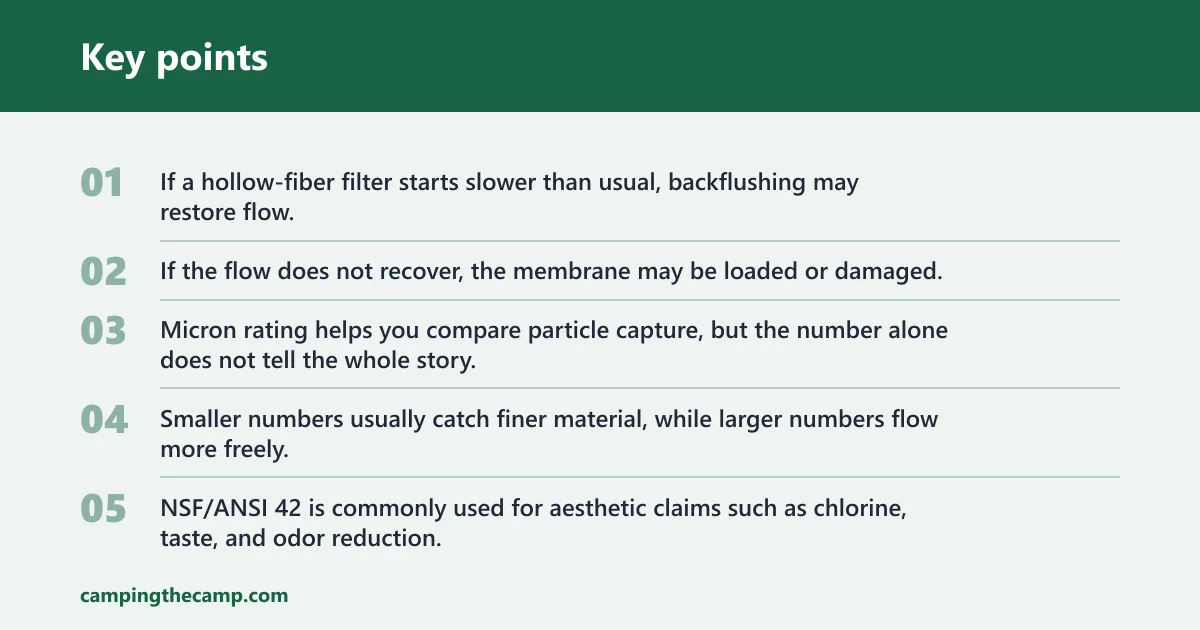
One practical clue is pressure. If a hollow-fiber filter starts slower than usual, backflushing may restore flow. If the flow does not recover, the membrane may be loaded or damaged.
Micron size, nominal ratings, and claims limits
Micron rating helps you compare particle capture, but the number alone does not tell the whole story. Smaller numbers usually catch finer material, while larger numbers flow more freely. For bacteria and protozoa claims, the rating and certification need to match the claim; otherwise the number is only a rough guide.
What certification labels tell you
NSF/ANSI 42 is commonly used for aesthetic claims such as chlorine, taste, and odor reduction. NSF/ANSI 53 is commonly used for health-related contaminant reduction claims. NSF/ANSI 58 applies to reverse osmosis systems. Those labels are more useful than broad packaging claims because they point to verified performance categories.
Reverse osmosis RV systems explained
Reverse osmosis systems give you a broader purification approach than a basic inline carbon filter. They use multiple stages and a membrane to remove a wide set of contaminants, and they typically include a storage tank so treated water is available on demand. That extra capability comes with more cost, more plumbing, and more upkeep.
RO is usually the most complex option in an RV, and it is not the best fit for every rig. It removes water more slowly, wastes some water during operation, and can be awkward if space under the sink is limited.
What RO removes better than basic filters
RO systems are commonly used when you want broader contaminant reduction than sediment and carbon alone can provide. A countertop system may use five stages of activated carbon filtration, while an under-sink system may use six-stage reverse osmosis. Some RO systems are listed as removing 99% of over one thousand contaminants, but that claim should be read alongside the certification mark, such as NSF/ANSI 58 and WQA Gold Seal.
Storage tanks, wastewater, and installation tradeoffs
RO systems need a storage tank because production is slower than faucet demand. They also send some water to waste during the purification process. In an RV, that means more fittings, more space, and more points that need winter care so frozen water does not crack a housing or line.
A common first-timer mistake is choosing RO for a rig with low under-sink clearance and then discovering the tank, drain line, and membrane housing compete for space. In that case, a simpler point-of-use carbon or hollow-fiber setup may fit the plumbing better, even if it removes less.
RV water filter decision table
| Filter type | Placement | Contaminants removed | Flow impact | Maintenance | Replacement triggers | Best RV use case |
|---|---|---|---|---|---|---|
| Inline | At the spigot, hose, or city-water inlet | Sediment, chlorine taste, odors; some units add hollow-fiber or KDF media | Moderate to noticeable pressure drop in tighter media | Swap cartridge; keep fittings clean; protect from freezing | Slower flow, taste return, visible debris load, months/gallons reached | Campground hookups and quick point-of-entry treatment |
| Canister | Before inlet or under sink | Multi-stage sediment and carbon; broader staged setups | Often better than small inline units at the same service level | Cartridge changes, O-ring care, housing sanitizing | Pressure drop, odor return, cartridge age, hard-water scaling | Longer trips, higher flow needs, staged treatment |
| Carbon block | Inline, canister, or point-of-use | Chlorine, taste, odor; limited against dissolved contaminants | Can reduce flow as the block loads | Replace on schedule; avoid channeling; keep wet housings sanitary | Taste returns, chlorine smell returns, pressure drops | Drinking water improvement and taste control |
| Sediment | First stage at inlet or prefilter | Rust, sand, grit, particulates | Usually modest when clean; slows as it loads | Change often in dirty water; flush housings | Visible dirt, lower flow, cloudy feed water | Protecting downstream carbon and valves |
| Hollow-fiber | Portable, inline, or gravity setup | Bacteria and protozoa reduction when rated and certified; not viruses or dissolved solids | Can slow as the membrane loads | Backflush or clean; dry and protect from freezing | Flow stays low after cleaning, membrane damage, contaminated handling | Source water with biological-risk concerns |
| Reverse osmosis | Under sink or dedicated drinking-water system | Broad set of contaminants; verify with NSF/ANSI 58 | Slowest of the group; uses a storage tank | Stage changes, tank care, membrane and O-ring maintenance | Production slows, taste changes, TDS or quality drift, filter age | Dedicated drinking water with broader purification needs |
Frequently asked questions
What are the main types of RV water filters?
Common RV filter types include sediment, carbon, hollow-fiber membrane, and reverse osmosis systems. inline and canister housings used to place them in the water path. The right choice depends on whether you want whole-RV treatment, drinking-water treatment, or protection for a tank fill from grit and odor.
How does an inline RV water filter work?
An inline filter screws into the hose or sits at the spigot, so water passes through it before reaching the RV. Most inline units use sediment or carbon media, and some add hollow-fiber or KDF stages. Flow can drop as the cartridge loads, so pressure matters.
How does a canister RV water filter work?
A canister filter uses a larger housing that holds one or more cartridges, often in a staged layout. That extra space lets you pair sediment and carbon or use a longer-life cartridge. It needs cartridge changes, O-ring inspection, and periodic sanitizing to avoid leaks and wet-housing problems.
What does a sediment filter remove from RV water?
A sediment filter removes rust, sand, silt, and other visible particles from the water. It is usually the first stage in a multi-stage RV system because it protects carbon cartridges and valves from clogging. Micron rating shows how fine the capture is, with smaller numbers trapping finer material.
What does a carbon RV filter improve in taste and smell?
Activated carbon mainly improves chlorine taste and odor. It can make campground or municipal water more pleasant, but it does not remove every dissolved contaminant. Filter life depends on water quality, and a return of chlorine taste or smell often means the carbon is spent.
Do RV water filters remove bacteria and protozoa?
Some do, but only when the filter is designed and certified for that job. Hollow-fiber membrane filters are the main RV-friendly category for bacteria and protozoa reduction, often around a 0.1 micron nominal class. Standard sediment and carbon filters should not be assumed to provide that protection.
Which RV water filter type is best for campground water?
For campground hookups, a sediment-plus-carbon setup is often the most practical starting point because it handles grit, chlorine, and odor at the inlet. If the park water is known to be questionable, a hollow-fiber or RO stage may be added for drinking water, but placement and certification matter.
What size micron filter should I use in my RV?
A common choice is 1 to 5 micron for sediment control, because it catches more debris without choking flow as badly as finer media. A 0.1 micron filter is much finer and is used when bacteria or protozoa reduction is part of the goal. Match the size to the source water and pressure available.
How do I know when an RV water filter needs replacing?
Replace a filter when flow slows, pressure drops, taste returns, odor comes back, or the cartridge is visibly loaded. Many cartridges are listed in months or gallons, and hard water can shorten that service life. Indicator tabs or counters help, but they do not replace a taste-and-flow check.