How many burners do you need on a camp stove for a family?

For many families, a 2-burner camp stove is enough; a 3-burner setup may be more practical if you often cook breakfast, sides, and a main at the same time, or if one pot often has to wait on another. Too few burners force shifts, cool food fast, and waste fuel. This guide shows how to match burner count to meal style, cookware size, and campsite setup.
How many burners do you need?
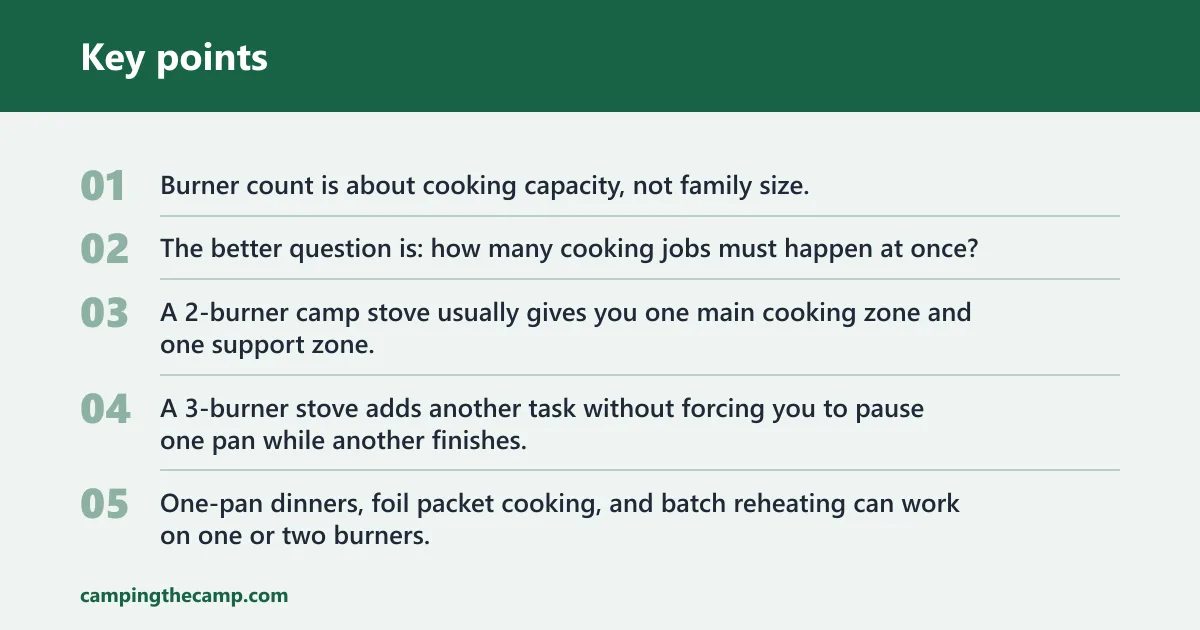
Burner count is about cooking capacity, not family size. Two burners can handle a lot of family cooking when the meal is simple, while three burners matter when separate dishes need heat at the same time. The better question is: how many cooking jobs must happen at once?
What burner count means in practice
A burner gives you one heat zone. That can be a boil zone, a simmer zone, or an active sauté zone, but not all three at once. A 2-burner camp stove usually gives you one main cooking zone and one support zone. A 3-burner stove adds another task without forcing you to pause one pan while another finishes.
That difference matters more than family size alone. Two adults and two children who eat one-pan tacos may need less stove than two adults and one child who want eggs, bacon, oatmeal, and coffee at the same time.
Why meal complexity matters more than headcount
Meal style drives burner choice. One-pan dinners, foil packet cooking, and batch reheating can work on one or two burners. Multi-part breakfasts, boil-plus-simmer meals, and recipes with side dishes need more separate heat. The stove that fits a family of four on pasta night may feel cramped on pancake morning.
Cookware footprint also changes the answer. Two medium pans side by side need width and burner spacing. A large skillet or griddle can take up most of a 2-burner top, leaving little room for a pot of beans or coffee. Handle clearance matters too, especially with long pan handles and Dutch oven lids.
Choose 1, 2, or 3 burners
Use this table to match burner count to the actual cook pattern, not just the number of seats at the picnic table. The key columns are meal type, cookware count, and campsite space, because those three usually decide whether a stove feels roomy or cramped.
| Family size | Meal type | Cookware count | Camp setup space | Recommended burner count |
|---|---|---|---|---|
| 2 to 3 people | One-pan meals, simple boil-and-serve cooking | 1 to 2 pieces | Small picnic table or limited counter space | 1 to 2 burners |
| 2 to 3 people | Breakfast with eggs and coffee, or a pot plus skillet | 2 pieces | Standard table space | 2 burners |
| 4 people | One-pan dinner, soup, pasta, simple breakfast | 1 to 2 pieces | Moderate space, easy access to fuel and prep area | 2 burners |
| 4 people | Multi-part breakfast, boil-plus-simmer, side dishes | 2 to 3 pieces | Room for wider stove and serving area | 2 to 3 burners |
| 5 to 6 people | Full meals, side dishes, batch cooking, reheating | 3 pieces or more | Large table or dedicated camp kitchen space | 3 burners |
A common first-timer mistake is assuming a single burner is enough just because the family is eating simple meals. A family of five that eats sandwiches, pasta, and reheated chili may be fine with two burners. A family of four making bacon, eggs, hash browns, and coffee may feel under-equipped on two burners if a griddle takes up both grates.
- List the dishes. Write down what needs heat at the same time, not just what you will serve. If breakfast means eggs, bacon, potatoes, and coffee, that is four jobs even before toast enters the picture.
- Count cookware pieces. Count pans, pots, and griddle surfaces that must sit on the stove at once. Two medium pans fit many family meals; a wide griddle or Dutch oven changes the space requirement fast.
- Measure your setup space. Check table width, safe clearance from edges, and room for fuel bottles. A stove that fits the meal but hangs off the picnic table is the wrong stove.
- Match the burner count. Choose the smallest stove that lets you cook without stacking tasks in a line. If one pot must always wait for another, size up.
Is a 2-burner camp stove enough for 4 people?
Yes, a 2-burner camp stove is enough for many four-person trips, especially if you cook one-pan meals, pasta, soup, or a simple breakfast. It gets tight when you want eggs, meat, and a side at once, or when one burner has to stay on coffee duty while the other handles dinner.
Best-fit meal styles for 2 burners
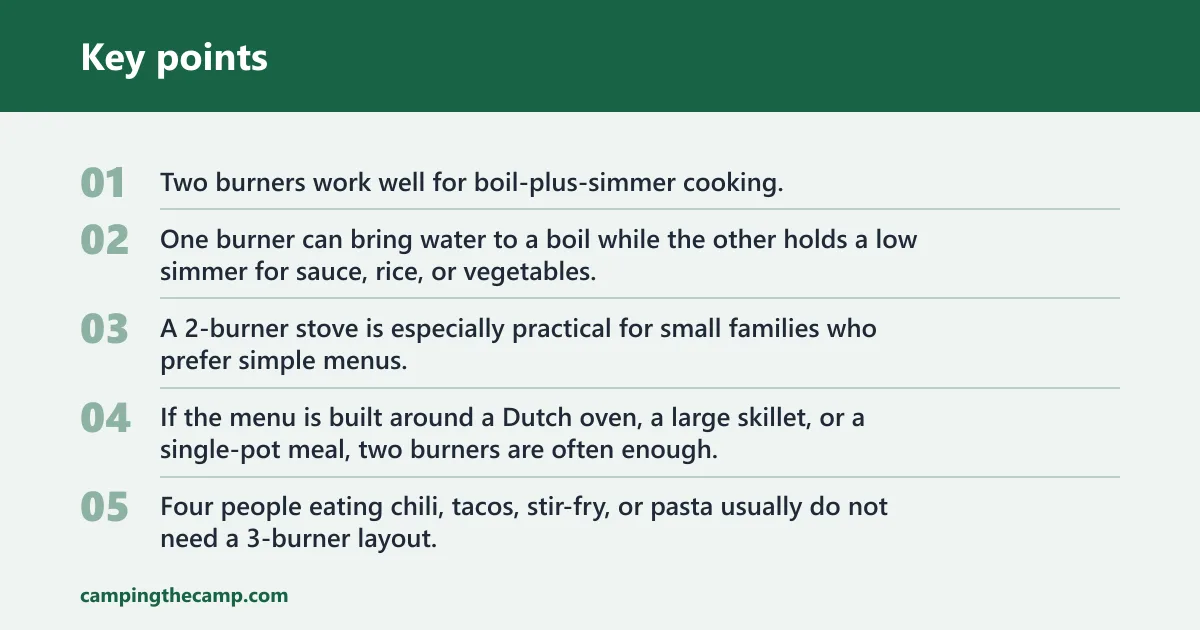
Two burners work well for boil-plus-simmer cooking. One burner can bring water to a boil while the other holds a low simmer for sauce, rice, or vegetables. They also suit batch cooking and reheating, where you cook one item, move it aside, and use the second burner for the next pot.
A 2-burner stove is especially practical for small families who prefer simple menus. Side-by-side burners usually let you run one boil zone and one active cooking zone, which is enough for many camping breakfasts and most dinners built around a single main skillet or pot.
When 4 people still need only 2 burners
If the menu is built around a Dutch oven, a large skillet, or a single-pot meal, two burners are often enough. Four people eating chili, tacos, stir-fry, or pasta usually do not need a 3-burner layout. In those cases, cookware size matters more than burner count.
Say your four-person breakfast is eggs in one pan and coffee in a pot. A 2-burner stove handles that easily. The second burner becomes valuable when the potatoes need their own pan and the griddle is too small to share.
When 4 people need more cooking space
Move up from 2 burners when meals regularly split into separate parts. If you want bacon, eggs, hash browns, and coffee all hot at once, a 2-burner stove can feel crowded. If you cook for picky eaters, separate sauces, or side dishes that finish at different times, the third burner saves time and keeps food from cooling off.
Think about cleanup too. A stove that forces you to juggle pans often creates more spills and more wash-up. If your campsite is tight, a second stove can sometimes be smarter than a larger stove, because you can spread the cooking across two smaller units instead of buying one wider platform.
When a 3-burner stove is worth it
A 3-burner camp stove is worth it when you often cook full meals with side dishes or when several items need separate temperatures at the same time. It gives you more simultaneous cooking space, but it also adds footprint, weight, and complexity. For many families, that tradeoff makes sense only if the menu is ambitious.
Full meals with side dishes
Three burners help when dinner includes a main, a vegetable, and a starch. They also help with sauces that need a low simmer while another pan stays hot. That extra burner can keep one dish moving while the others wait on their own heat zone.
Availability is another practical point. Three-burner models are less common than 2-burner stoves, so selection is usually narrower. The tradeoff is that you gain flexibility, but you give up some portability and usually pay for a larger stove body.
Bigger family breakfast setups
Breakfast is where 3 burners often earn their keep. Eggs, bacon, potatoes, and coffee are easier to manage when each item has its own heat source. That matters even more if one pan needs a gentle simmer while another needs steady medium-high heat.
Family size matters most here at 5 to 6 people, but not because the burner count matches the headcount exactly. It is the volume of food and the number of separate cooking tasks that pushes you toward three burners.
Why footprint and weight go up
More burners mean a wider cooking top, more frame material, and more packed bulk. That affects table space, storage, and how easy the stove is to carry with fuel. For car camping, that may be fine. For tighter camp setups, it can be a real limitation.
Check the folded dimensions before you buy. A wider stove can crowd a picnic table and leave little room for prep boards, utensils, or a cooler side tray. If the stove will live in a hatchback or RV compartment, packed size matters almost as much as burner count.
Cookware and stove fit
Cookware fit often decides whether a stove feels easy or frustrating. Two burners on paper can behave like one cramped cooking zone if the pan handles collide, the griddle blocks access, or the grates do not support the pot size you actually use. Burner spacing and handle clearance matter every time.
Two pans side by side
A 2-burner camp stove usually uses a side-by-side layout, which is good for standard family cooking. The layout works best when two medium pans can sit without touching, and when each handle has room to point away from the flame and the table edge. Narrow burner spacing limits that flexibility.
If you routinely cook with two 10-inch pans, check the stove width and grate width before buying. Some 2-burner stoves fit one large pan and one small pot comfortably, but get crowded with two wide skillets.
Griddles, Dutch ovens, and large skillets
Griddles are useful for pancakes and sandwiches, but they can take over both burners on a 2-burner stove. That means you lose a separate pot space for coffee or sauce. Large skillets also demand a stable grate and enough width so the pan sits flat.
Dutch ovens need especially solid support. Their weight, plus the lid and food inside, stresses the grate and base. If you plan to use cast iron often, look for a stove with a stable top and a wide base, not just high burner output.
Handle clearance and burner spacing
Handle clearance affects safety and comfort. Long skillet handles can crowd the next burner, and pot handles can overhang the edge of a picnic table if the stove body is too wide. Keep the handles turned away from walk paths and fuel containers.
Suppose a family wants pancakes on a 2-burner stove with a 16-inch griddle. The griddle may cover both burners, which leaves no room for coffee. In that case, the stove is not really a 2-zone cooking setup anymore; it is a single flat cooking surface with one task at a time.
BTUs, control, and fuel
BTU rating tells you heat output, either per burner or as a total number, but it is not the only measure of cooking performance. Higher BTUs can shorten boil time, yet they do not automatically improve control. Wind resistance, burner design, and flame adjustment matter just as much for family cooking.
What BTU rating does and does not tell you
Use BTUs as one comparison point, not the decision maker. A high-output burner can boil water faster, but a weak low setting makes sauces and eggs harder to manage. For family meals, you want usable range more than maximum heat alone.
Some manufacturers list BTU per burner, while others list total output. Compare those numbers carefully so you are not judging a 2-burner stove against a combined output figure for a 3-burner model. The useful question is whether the stove can simmer well and recover heat after a pan is added.
Propane canisters, 1 lb bottles, and hose kits
Fuel type changes runtime, cost, and convenience. Small propane canisters and 1 lb bottles are easy to carry and swap, but they can run low faster on longer family trips. Bulk propane adapters or hose kits connect a camp stove to a larger tank, which usually improves runtime and reduces bottle changes.
Availability matters too. Propane is common, but the setup you choose should match your trip length and what fuel you can reliably find. If you cook every meal at camp, bulk propane is often more practical than carrying several small bottles.
Why low-simmer control matters for family meals
Independent flame controls let you run one burner hot and the other low. That is important for sauces, oatmeal, rice, and reheating. Matchless ignition is convenient, but manual lighting is fine if the stove gives you stable control at the low end.
A stove with strong BTUs but poor low-simmer control can make family cooking harder, not easier. You can boil quickly and still burn the eggs. Good family stoves need a usable flame range, not just a big number on the box.
Stability, wind, and camp setup
Stability is a safety feature and a cooking feature. A stove with a wide base or folding legs is easier to use on a picnic table, and it is less likely to wobble under a full pan. Wind shielding also matters because flame consistency drops fast when gusts hit an open burner.
Base design and table safety
Use the stove only on a flat, stable surface that can handle the weight of the stove, cookware, and fuel. Picnic tables are common, but they are not always level. If the stove rocks or sits too close to the edge, move it before lighting anything.
Grate stability matters under heavy cookware. Cast iron and full pots should sit flat without sliding. A broader stance is often better for family cooking because it reduces tipping risk when someone stirs a pan or reaches for a lid.
Wind shielding and flame consistency
Wind shields help preserve flame and reduce fuel waste. They also make low simmering easier, which is useful when you need to hold food warm while another dish finishes. On exposed sites, a stove that controls wind well can outperform a hotter stove with poor shielding.
Wind does not just slow boil time. It can make flames uneven and cook one side of a pan faster than the other. That matters with pancakes, eggs, and sauces, where even heat is more useful than maximum heat.
Packed size, weight, and storage
Weight and packed size affect whether the stove is practical for your vehicle and storage space. A 2-burner stove usually packs smaller than a 3-burner model, which is one reason it fits family camping so well. If the stove must fit beside chairs, bins, and a cooler, dimensions matter as much as burner count.
For car camping, a larger stove can be fine if you have room to spare. For RV camping, the storage question may be less about carrying weight and more about cabinet depth, fold-flat size, and how quickly you can set it on the outdoor table.
Frequently asked questions
How many burners do you need on a camp stove for a family?
Most families should start with a 2-burner camp stove. It handles one boil-and-simmer setup or two simple dishes at once, which covers many meals for 2 to 4 people. Choose 3 burners when breakfast, sides, and a main regularly need separate heat zones.
When is a 3-burner camp stove worth it?
A 3-burner stove is worth it when you cook full meals with side dishes, run multiple pans at once, or want more flexibility for breakfast. It is most useful for 5 to 6 people, though some four-person families prefer it for frequent multi-part meals.
Should I choose a camp stove or separate single-burner stoves?
Choose a 2- or 3-burner stove when you want one stable cooking surface and predictable burner spacing. Separate single-burner stoves can work if you need more flexibility in setup, but they usually take more table management and can feel clumsier for coordinated family meals.
What cookware fits on a 2-burner camp stove?
Two medium pans often fit best on a 2-burner stove, along with a standard pot or small skillet. A large griddle or wide Dutch oven can crowd the space, especially if the handles need clearance. Always check grate width and burner spacing before you buy.
How many BTUs do I need for a family camp stove?
BTUs matter, but they are not the only number to watch. A family stove needs enough heat to boil water in reasonable time and enough low-end control to simmer sauces, eggs, and oatmeal. Compare per-burner output, wind resistance, and flame control together.