How to choose the right camp stove fuel for your trip

Choose camp stove fuel by trip conditions: use canister fuel for most 3-season trips, white gas for cold or high-volume cooking, alcohol for simple short trips, and wood only where rules and weather allow. The wrong fuel can mean slow boil times, unreliable flames, extra weight, or no resupply when you need it. This guide shows how to match fuel to temperature, meal style, trip length, and fuel availability.
Choose fuel by trip scenario
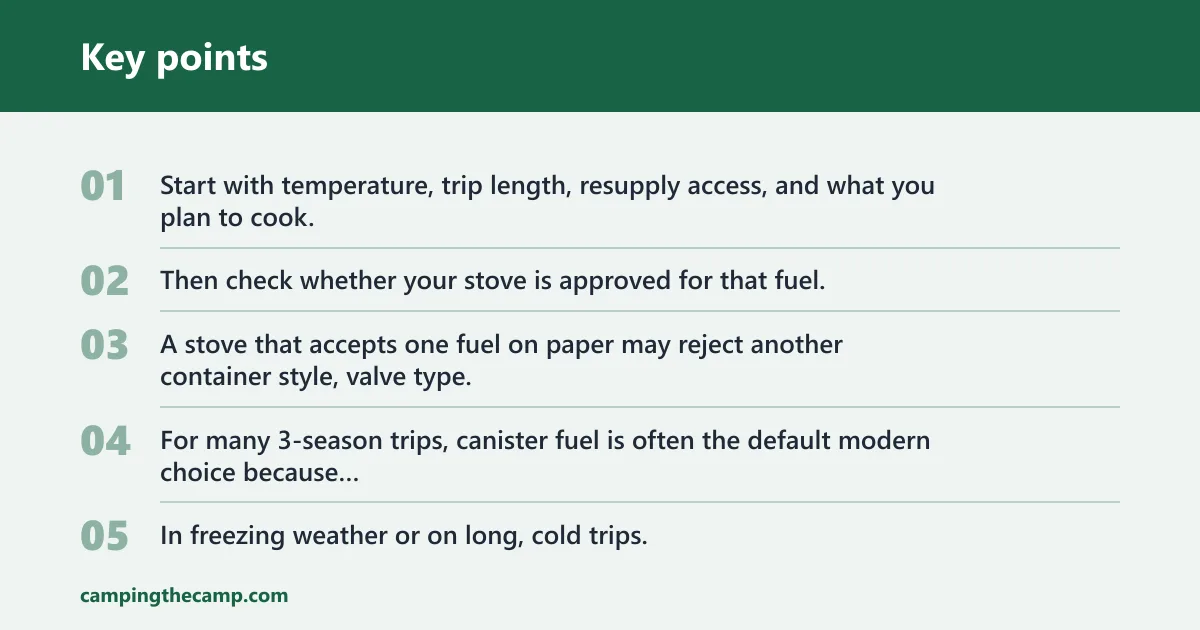
Start with temperature, trip length, resupply access, and what you plan to cook. Then check whether your stove is approved for that fuel, because physical fit alone is not enough. A stove that accepts one fuel on paper may reject another container style, valve type, or pressure range.
Start with temperature and altitude
For many 3-season trips, canister fuel is often the default modern choice because upright threaded-canister stoves are compact and quick to set up. In freezing weather or on long, cold trips, liquid-fuel stoves are the safer pick because they stay dependable when canister pressure drops. Higher elevations can make stove performance more demanding, so wind, temperature, and stove design matter at least as much as altitude.
Match cooking style to fuel demand
If your menu is quick boil-and-soak meals, a small canister stove is usually enough. If you are cooking separate dishes, using a wider pot, or feeding a group, propane is the practical car-camping option. Alcohol and solid fuel can work for minimalist meals, but both are slower and less forgiving when you need a rolling boil fast.
Use stove approval as the final check
Do not buy fuel first and hope the stove will follow. Read the stove manual for approved fuel types and container interfaces, then confirm the connector type and any approved adapters. A threaded canister, a bayonet-style butane cartridge, and a propane cylinder may all look “close enough,” but they are not interchangeable systems.
Camp stove fuel decision matrix
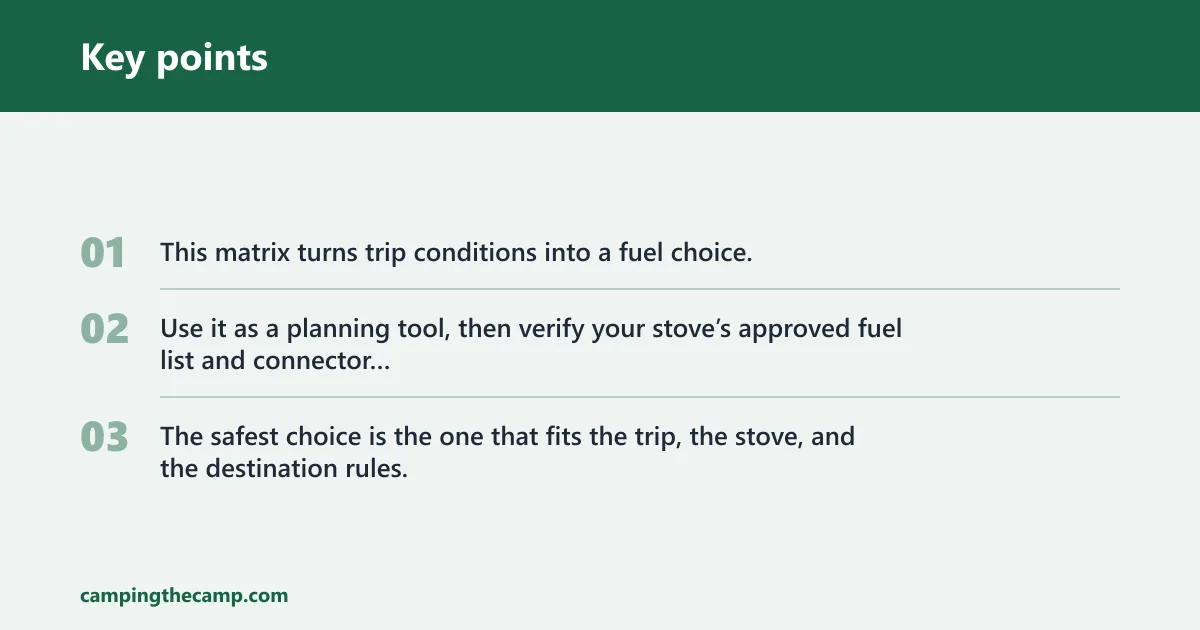
This matrix turns trip conditions into a fuel choice. Use it as a planning tool, then verify your stove’s approved fuel list and connector type before you pack. The safest choice is the one that fits the trip, the stove, and the destination rules.
| Trip type | Safest fuel choice | Avoid if | Compatibility checks |
|---|---|---|---|
| Three-season backpacking | Threaded canister fuel with an isobutane-propane blend | Nighttime temperatures are dropping below the stove’s comfortable operating range, or you expect heavy wind and long simmers | Stove must accept EN 417/Lindal valve canisters; confirm threaded-canister compatibility and any windscreen rules |
| Winter backpacking | Liquid fuel, usually white gas | You want instant ignition with no priming, or your stove is not built for liquid fuel | Check that the stove is approved for white gas and, on multi-fuel models, for kerosene or diesel only if the manual lists them |
| Car camping with larger pots | Propane cylinders | You need to keep pack weight low or carry the stove far from the vehicle | Match the stove to the 1-pound cylinder connection; do not use adapters unless the manufacturer approves them |
| Ultralight short trip | Alcohol or solid fuel tablets | You need fast boil times or frequent simmer control | Confirm the stove is designed for denatured alcohol or solid fuel tablets; do not mix fuels in a stove that is not built for them |
| Backcountry area with fire restrictions | Canister or liquid fuel, depending on weather and stove approval | Wood-burning is the only plan | Check local fire rules and whether the area allows open combustion or solid-fuel tabs |
| Minimalist backup kit | Solid fuel tablets | You need efficient primary cooking for more than one simple meal | Use only with a stove or pot setup approved for tablet fuel |
Which fuel is best for backpacking?
For most backpacking trips, a pressurized canister stove is the best balance of weight, ease, and reliability. In shoulder-season or summer conditions, it is compact, fast to boil, and simple to use. For winter or high-altitude trips, liquid fuel is the stronger choice. Alcohol and solid fuel fit short, light kits, not demanding menus.
Three-season backpacking: canister fuel
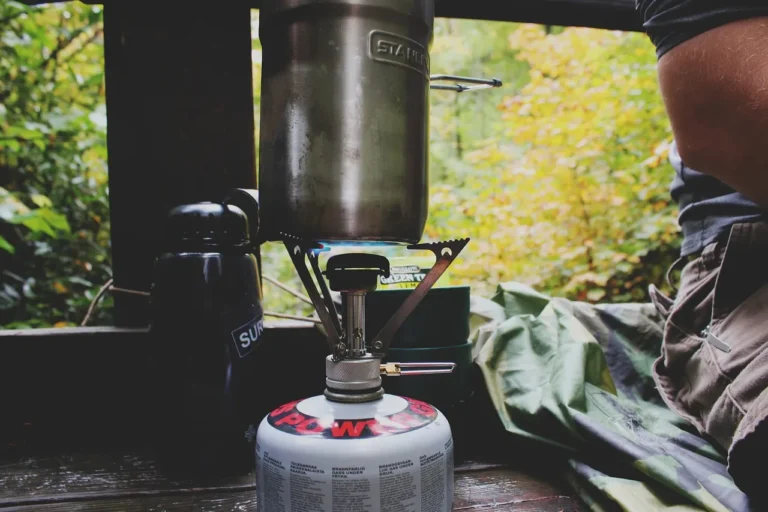
Canister stoves work well for short to medium backpacking trips when temperatures stay above freezing or near it. The fuel is light, the setup is simple, and the stove usually lights quickly. Common blends use isobutane and propane, which gives better cold-weather performance than plain butane, but the canister still loses pressure as temperatures fall.
Winter backpacking: liquid fuel
Liquid-fuel stoves are recommended for freezing weather and high altitude. They can work in very cold conditions, depending on the stove model, fuel, maintenance state, and user skill, but they need priming and regular maintenance. That tradeoff matters on cold trips: you gain reliable output, yet you also take on more setup steps, moving parts, and cleanup.
Ultralight backup use: alcohol or solid fuel
Alcohol stoves are ultralight and simple, but performance varies widely by stove, fuel, pot, and weather. Solid-fuel tablets are backup-only, useful when you need a compact reserve system rather than a daily cooking platform. Both suit stripped-down kits better than multi-course camp meals.
Canister fuel, propane, or liquid fuel?
Choose canister fuel for simple, fast setups, propane for car camping and larger pots, and liquid fuel for cold weather or long trips. The right answer depends less on brand and more on how much cooking you will do, how cold it will be, and whether you can carry or resupply fuel easily.
Canister fuel for simple, fast setups
Threaded canister fuel is the default modern choice for many backpackers. It is compact, quick to set up, and common in 3-season use. A common first-timer mistake is assuming all threaded canisters are identical; only EN 417/Lindal valve canisters fit stoves built for that interface.
Propane for car camping and larger pots
Propane in a 1-pound cylinder is often practical when weight and bulk matter less than cooking volume. It works well for car camping, larger pots, and separate dishes. The tradeoff is obvious: cylinders are heavier and bulkier than backpacking canisters, so they fit vehicle trips better than long carries.
Liquid fuel for cold weather and long trips
Liquid fuel shines when temperatures stay low for long periods or when you need dependable output on extended trips. White gas is the common choice, and some multi-fuel stoves also burn kerosene or diesel on approved models. Plan for priming, soot or odor on some fuels, and more maintenance than canister systems.
Picture a two-person winter trip with a 2-liter pot and snowmelt duty at 10,000 feet. Canister fuel may start strong, then fade as the canister cools. A liquid-fuel stove keeps steadier output, which matters more than the extra priming step when every boil depends on the stove staying hot.
How do you check stove compatibility?
Check the stove manual first. Then match the fuel container, valve type, and any adapter to what the stove is actually approved to burn. A snug physical fit is not enough if the stove maker does not list that fuel system as accepted.
- Read the fuel section in the stove manual.
- Identify the approved fuel types, not just the connector size.
- Match the container type: threaded canister, bayonet-style butane, propane cylinder, or refillable liquid bottle.
- Confirm whether the stove accepts an inverted canister setup, if you need cold-weather performance.
- Use only adapters listed by the manufacturer.
- Check the seal, valve, and thread before every trip.
Threaded canister and Lindal valve
Threaded canisters use the EN 417/Lindal valve standard, which is common on backpacking stoves. If the stove is built for threaded canisters, that is the system to buy. Brands vary, but the approval and valve type matter more than the logo on the canister.
Bayonet-style butane connections
Bayonet-style butane cartridges are common on tabletop stoves built for mild-weather cooking. They are a different connector family from threaded canisters. Do not force a near-match connection, and do not assume a simple adapter makes the system safe unless the stove maker specifically approves it.
Propane cylinder fittings and approved adapters
Propane cylinders need a stove designed for that connection. Some adapters exist, but physical fit does not equal approval. If the stove manual does not list the adapter and fuel combination, leave it out of your kit. That rule is especially important when you move between backpacking gear and car-camping burners.
Cold weather and wind limits
Canister stoves often lose performance as temperatures fall because internal pressure drops. Wind also steals heat, which lengthens boil times and can make a stove seem weak even when the fuel is fine. In freezing weather, propane content helps, and an approved inverted-canister setup can improve performance on some stoves.
Canister pressure drop in freezing conditions
As the canister cools, pressure falls and flame output can weaken. That is why a stove that feels lively at dusk may struggle before dawn. A windscreen can help, but only if the stove and fuel setup allow it safely. Many canister systems need careful spacing to avoid overheating the canister.
Why propane content helps
Isobutane-propane blends hold up better than straight butane in the cold because propane vaporizes at lower temperatures. That makes them the preferred canister choice for chilly shoulder-season trips. Still, they are not a winter substitute for liquid fuel when the temperature stays well below freezing.
When inverted canister use is allowed
Some stoves are approved to run with an inverted canister, which can improve cold-weather output. Only use that setup if the stove manual says it is allowed and shows how to do it. An inverted arrangement on the wrong stove can turn a promising cold-weather solution into a safety problem.
What fuel should I pack for a 3-season weekend trip?
For a typical 3-season weekend, a threaded canister with an isobutane-propane blend is a common choice unless the stove manual says otherwise. That choice is light, quick to set up, and easy to use for simple meals. If you plan to resupply, confirm destination availability before you leave.
Suppose your weekend menu is two dinners, coffee, and oatmeal for one person. A canister stove is the cleanest fit if the nights stay mild. If the same weekend turns into freezing mornings or a windy ridge camp, move toward liquid fuel or adjust the trip plan rather than hoping the canister will keep pace.
Fuel transport and disposal rules
Camping fuel is generally prohibited in checked or carry-on airline baggage, so you usually need to buy fuel after arrival. Empty canisters still need proper disposal, and some destinations have limited fuel availability, so plan your purchase window before you travel.
Airline carry-on and checked baggage limits
Do not pack fuel in your luggage and assume it will pass. Camping fuel is generally prohibited in checked or carry-on airline baggage. If your destination requires a specific fuel type, buy it locally or arrange pickup after you land.
Empty canister disposal and hazardous waste rules
Empty canisters should be handled according to local disposal guidance, not tossed blindly into a camp bin. If a canister is not truly empty, treat it as fuel waste. Some areas require hazardous waste handling or a designated drop-off point, so check before you leave town.
Destination availability and resupply planning
Fuel choice also depends on what you can actually find where you are going. Canister fuel is common in many outdoor towns, but not universal. White gas, propane cylinders, and solid fuel tablets may be easier or harder to replace depending on the destination, so check availability before a long trip.
Use a camp stove by matching the stove to the fuel you plan to carry, then confirming the container type, valve, and any adapter are approved for that system. For backpacking trips, canister fuel is usually the simplest choice; for freezing weather or long trips, liquid fuel is the more dependable option.
- Choose the fuel type that fits the trip conditions.
- Confirm the stove manual lists that fuel system as approved.
- Match the container type: threaded canister, bayonet-style butane, propane cylinder, or refillable liquid bottle.
- Check whether an inverted canister setup is allowed if you expect cold-weather use.
- Verify the seal, valve, and thread before every trip.
- Pack only the fuel needed for the menu and trip length.
Frequently asked questions
How do I choose the right camp stove fuel for my trip?
Start with temperature, trip length, cooking style, and resupply access. Then check your stove’s approved fuel list and connector type. For most 3-season trips, a canister stove is the simplest fit. For freezing weather or demanding cooking, liquid fuel is usually the better choice.
What fuel is best for backpacking in cold weather?
Liquid fuel is the safest general answer for cold backpacking because it keeps working in freezing conditions and at high altitude. Canister fuel can still work in shoulder-season cold if your stove is approved for it, but performance drops as the canister cools.
Is propane or isobutane better for camping stoves?
Propane performs better in cold weather, while isobutane-propane blends are lighter and more common for backpacking canisters. For car camping, propane is a strong choice. For backpacking, an isobutane-propane threaded canister usually makes more sense unless your stove is built specifically for propane.
Can I use a liquid fuel stove for winter camping?
Yes, if the stove is approved for liquid fuel and you are prepared for priming and maintenance. White gas is the usual winter choice, and some multi-fuel stoves can also burn kerosene or diesel on approved models. That versatility is useful, but it comes with more setup work.
Are solid fuel tablets good for camping stoves?
Solid fuel tablets are good as backup fuel, not as a main cooking plan. They are compact and simple, but they are slow and often smoky or odorous. Use them when space is tight or as an emergency backup, not when you need efficient cooking for multiple meals.