What makes a camp stove good for family camping trips?

A family camp stove has to do three jobs at once: stay steady, hold enough cookware for a full meal, and let you control the flame without fuss. For many families, a two-burner stove with wind protection and easy ignition is a strong starting point. Miss that mix, and you get spills, cold food, and a stove that is awkward around kids and tight campsites. This guide covers the features that matter most and how to judge them fast.
What matters most in a family camp stove?
A family camp stove should be judged on safety, cooking capacity, and campsite use together. The right stove stays steady on uneven ground, gives you enough burner space for real meals, and remains easy to light, adjust, and clean when kids, cookware, and wind all show up at once.
Safety around children and hot cookware
Safety starts with a stable base, low tipping risk, and clear flame control. Look for wide legs or feet, flame guards, and an off-switch or fuel shutoff that you can reach without leaning over the burners. Keep the stove outside high-traffic areas so children do not brush past hot pans or open flame.
Grate and pan stability matter just as much. A good family stove holds wide skillets, stock pots, and smaller saucepans without wobble. If the grate is narrow or slick, overfilled cookware can slide, tilt, or spill.
Enough cooking space for real meals
Family cooking usually needs more than one pot at a time. Two burners let you boil pasta and simmer sauce together, or make breakfast while heating water. One burner can work for short trips with simple food, but it slows meal timing when several people are waiting to eat.
Capacity is not only about burner count. Burner spacing, grate width, and the stove’s ability to fit a large pan all affect whether you can cook for about 4 to 6 people without juggling cookware.
Stable, easy setup at the campsite
A family stove should set up fast and stand flat with little adjustment. Folded size and carry handle matter because the stove still has to move in and out of a vehicle, store cleanly, and fit where you cook. A compact case is useful, but not if it forces a cramped burner layout.
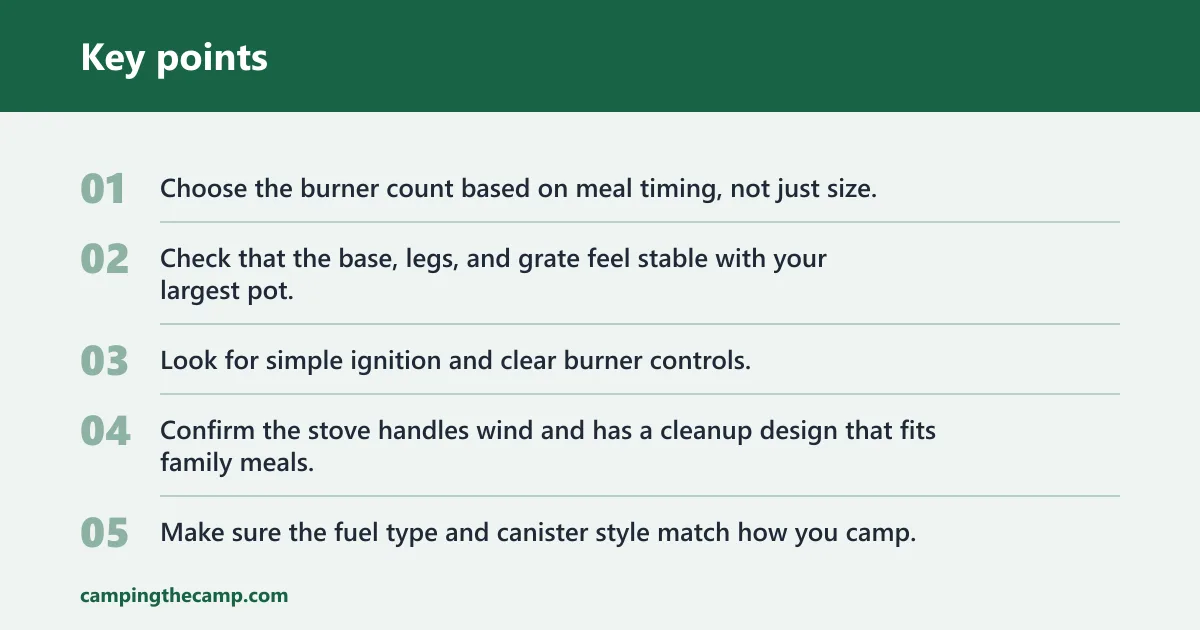
- Choose the burner count based on meal timing, not just size.
- Check that the base, legs, and grate feel stable with your largest pot.
- Look for simple ignition and clear burner controls.
- Confirm the stove handles wind and has a cleanup design that fits family meals.
- Make sure the fuel type and canister style match how you camp.
How many burners do you need?
For many family camping trips, two burners are a strong fit because they let you cook two dishes at once without making the stove bulky or hard to control. One burner suits small, simple meals for two people. Multi-burner stoves make sense when you regularly cook for six or more and need several pots going at the same time.
One burner for small, simple trips
A one-burner stove works if your meals are basic: hot drinks, one-pot dishes, or reheating. It is lighter and easier to pack, but it slows down breakfast and dinner for a family. If everyone needs food at once, a single burner forces you to cook in sequence.
Two burners for most family meals
Two burners let you split tasks. You can simmer one pan while boiling water in the other, or keep one side low for eggs and the other high for pasta. That balance usually fits 2- to 4-person trips well and can still work for 6 people if the menu is simple.
When multi-burner stoves make sense
Three or more burners are useful when a group cooks multiple sides, uses large pans, or wants shorter meal delays. The tradeoff is bulk, more setup, and more fuel use if several burners run at once. For many families, the extra size helps only when the cooking style truly needs it.
BTU range and simmer control
BTU output matters, but only as part of the whole picture. Higher BTUs can boil water faster, yet they can also waste fuel and make low-heat cooking harder to manage. A family stove is better when it gives you a useful heat range, from quick boil to steady simmer, without scorching food.
Fast boiling versus low-heat cooking
Boil speed helps with pasta, oatmeal, and dish water. Simmer control matters for sauces, rice, and anything that burns easily. A stove that jumps from weak flame to roaring heat is frustrating in camp because family meals usually need both ends of that range.
Why higher BTUs can waste fuel
High BTU numbers are not automatically better. A strong burner may heat fast, but it can also burn through fuel more quickly, especially in wind or cold weather. If the flame cannot be turned down smoothly, you may end up using more fuel than the meal requires.
Even heating for family-sized pans
Even heating matters when you use a large skillet or griddle. Uneven burners can leave the center too hot and the edges undercooked. For family cooking, check that each burner offers clear low, medium, and high control rather than a narrow usable range.
Fuel types and ignition
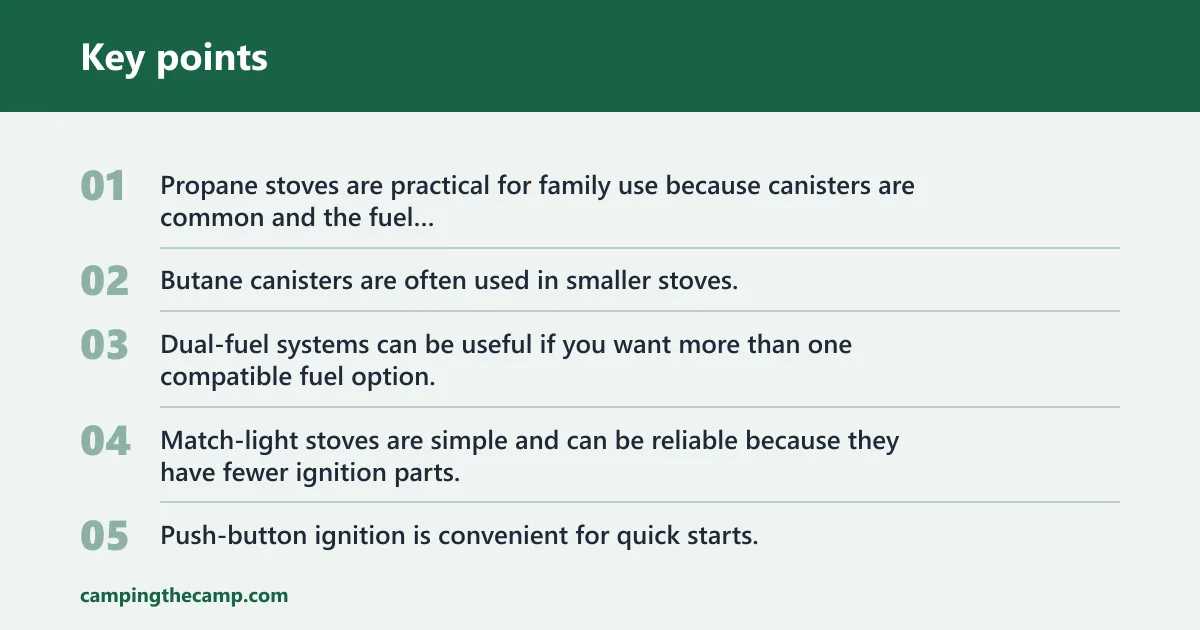
Fuel choice affects convenience, compatibility, and performance in cooler conditions. Propane is a common choice for family camp stoves because it is often available and easy to connect. Butane can work for lighter cooking setups, while dual-fuel systems offer more flexibility if you camp in different conditions.
Propane, butane, and dual-fuel options
Propane stoves are practical for family use because canisters are common and the fuel performs well in typical camp cooking. Butane canisters are often used in smaller stoves, but they are less forgiving in cooler weather. Dual-fuel systems can be useful if you want more than one compatible fuel option.
Match-light versus push-button ignition
Match-light stoves are simple and can be reliable because they have fewer ignition parts, but they require a lighter or matches. Push-button ignition is convenient for quick starts, though it adds another component that can fail. Around kids, the best choice is the one that lets you light the stove cleanly without loose flame handling near the burners.
Canister compatibility and cold-weather limits
Fuel canister compatibility matters because not every stove accepts every fuel format. Check whether the stove uses small threaded canisters, bulk propane cylinders, or a specific adapter. In cooler weather, propane generally holds up better than butane, which can lose pressure faster as temperatures drop.
Suppose your campsite sits in a cool valley and dinner is late. A butane-only stove may struggle to keep a steady flame, while a propane setup is more likely to keep boiling water and simmering sauce without constant adjustment.
How important is wind protection?
Wind protection is an important factor for family camp stoves because gusts can weaken flame strength, slow cooking, and waste fuel. Side panels or an integrated windscreen help the burner stay steady, especially at exposed campsites where open flame needs more shielding.
Side panels and integrated windscreens
Side panels block crosswind from hitting the burner directly. Integrated windscreens can improve boil times and reduce flame blowout, though they should not trap heat too tightly around the stove body. Good wind protection supports steadier cooking without making controls hard to reach.
Open sites versus sheltered sites
If you often camp in exposed areas, wind protection moves from nice-to-have to essential. In a sheltered site, a simpler stove may still perform well. In open terrain, a weak windscreen can make a strong burner behave like a much smaller one.
Flame stability and fuel efficiency in wind
Wind makes stoves burn less efficiently because heat escapes before it reaches the pot. That means longer cook times and more fuel used per meal. A family stove that resists wind can save both time and fuel, especially when you are cooking multiple dishes.
Family stove decision matrix
This table gives a practical way to compare stove traits by trip size. Scores run from 1 to 5, where 5 means the trait matters most for that family size and stove category. Use it as a decision guide, not a rigid ranking, because cookware size and campsite conditions still matter.
| Trip size | Burner count | BTU range | Simmer control | Wind protection | Stability | Cleanup effort | Setup time |
|---|---|---|---|---|---|---|---|
| 2 people | 3 | 3 | 4 | 3 | 4 | 4 | 5 |
| 4 people | 4 | 4 | 4 | 4 | 5 | 4 | 4 |
| 6 people | 5 | 4 | 5 | 5 | 5 | 3 | 3 |
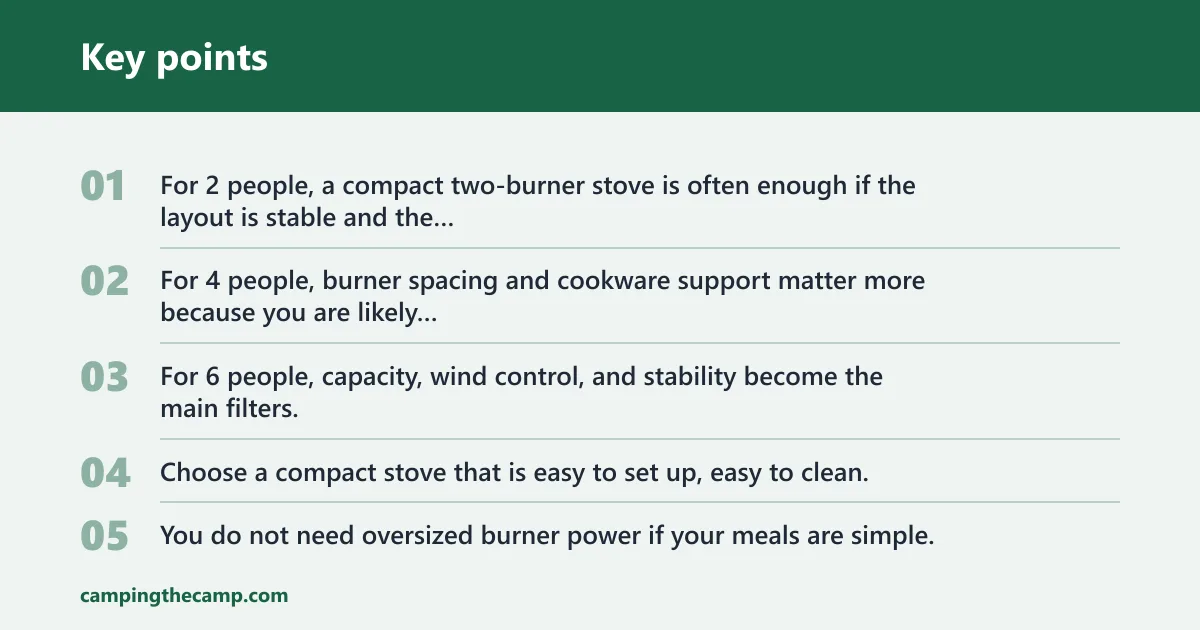
For 2 people, a compact two-burner stove is often enough if the layout is stable and the burners simmer well. For 4 people, burner spacing and cookware support matter more because you are likely cooking two items at once. For 6 people, capacity, wind control, and stability become the main filters.
2-person trip priorities
Choose a compact stove that is easy to set up, easy to clean, and stable enough for one pot and one pan. You do not need oversized burner power if your meals are simple, but you still want a flame that stays steady in light wind.
4-person trip priorities
Four people usually need a true two-burner layout with decent simmer control and enough grate space for family-sized cookware. This is the point where stove stability, wind protection, and cleanup design matter more than shaving a little weight.
6-person trip priorities
For six campers, look for broader burner spacing, stronger support for large pots, and reliable wind shielding. The stove should let you cook in parallel without crowding the burners. A small stove can still work, but only if the menu is simple and meal timing is flexible.
Picture a family cooking breakfast on uneven ground with a full skillet on one burner and a pot of oatmeal on the other. If the legs are narrow and the grate is slick, the skillet can shift when someone reaches for the spatula. A wider base and better cookware support reduce that risk.
How do cleanup and portability affect daily use?
Cleanup and portability matter every day, not just at packing time. A stove with removable drip trays, smooth surfaces, and easy grease management is faster to wipe down after family meals. Portability still matters too, because vehicle camping works best when the stove moves cleanly and stores without hassle.
Removable drip trays and grease control
Grease trays catch spills before they harden on the stove body. Smooth surfaces are easier to wipe, and removable parts make cleanup less tedious after breakfast or dinner. The less residue you leave behind, the easier it is to keep burners lighting cleanly on the next meal.
Weight, folded size, and carry handles
Weight and folded dimensions affect whether the stove feels manageable in and out of a vehicle. A carry handle or fitted case improves transport and protects burner parts. Even a family camp stove should still store neatly if it travels with coolers, chairs, and food bins.
Vehicle camping and pack-in distance
For vehicle camping, portability means convenience and storage, not ultralight design. If you must carry the stove farther from the vehicle, every extra pound and inch becomes more noticeable. A compact stove with a stable carry handle can make a real difference when the campsite is not right beside the car.
A common first-timer mistake is choosing a large stove with good burner count but poor cleanup design. After a greasy dinner, the surface may need extra scrubbing, and if the drip tray is fixed in place, you spend more time cleaning than cooking.
Frequently asked questions
What features make a camp stove good for family camping trips?
The best family stove has a stable base, enough burner space for real meals, steady simmer control, and wind protection. It should also be easy to light, simple to clean, and safe to use around children. Portability still matters because the stove needs to move, store, and set up without frustration.
How many burners do you need for a family camp stove?
Two burners are the most practical choice for many families because they let you cook two dishes at once without making the stove bulky. One burner works for very simple meals. Three or more burners make sense when you regularly cook for six people and want several pots going together.
Is a larger camp stove always better for family camping?
No. A larger stove only helps if you truly need the extra burner space or cookware support. Bigger models can be harder to move, slower to set up, and more awkward to clean. For many families, a stable two-burner stove is a better fit than a larger one.
What camp stove is safest around kids?
The safest family stove has a wide, stable base, clear flame guards, good burner control, and easy access to the shutoff without reaching over hot cookware. It should sit well away from foot traffic. A stove that wobbles, tips easily, or crowds the burners is a poor choice around children.
How important is wind protection on a family camp stove?
Very important. Wind can weaken flame stability, slow cooking, and waste fuel, especially at exposed campsites. Side panels or integrated windscreens help the stove hold heat where it belongs. If you often cook in open areas, wind protection should be treated as a core feature, not an extra.
What fuel type is best for family camping stoves?
Propane is usually the most practical choice because it is widely available and works well for family cooking. Butane can be fine for smaller, lighter-duty setups, but it is less reliable in cooler weather. Dual-fuel systems are useful if you want flexibility across different camping conditions.
How easy should a camp stove be to clean after family meals?
It should be easy enough to wipe down quickly after each meal. Removable drip trays, smooth surfaces, and simple grease control reduce cleanup time and keep burners working well. If a stove has hard-to-reach corners or fixed grease traps, daily cleaning becomes a nuisance fast.
What size camp stove works for 4 to 6 people?
For 4 people, a two-burner stove with good pan support is usually enough. For 6 people, you may want larger burner spacing, stronger wind protection, and a more stable base. The right size depends on whether you cook one-pot meals or need several dishes at once.