What size hiking backpack do I need for day hikes?

For many day hikes, 15–25 liters is enough for water, snacks, layers, and a small first-aid kit. For one-night trips, 30–40 liters can work with compact shelter and sleep gear, and some weekend trips in colder weather or with bulkier equipment may fit better in 40–50 liters. A pack that is too large adds dead space and extra weight. This guide sorts pack volume by trip length, kit size, season, and carry load so you can buy the smallest pack that still holds your gear.
| Decision factor | What size hiking backpack do I need for day hikes | overnight trips | Winner |
|---|---|---|---|
| Typical volume band | Usually 10–30L, with a common sweet spot of 15–25L | Usually 25–50L, with many weekend kits landing near 40–50L | tie |
| Best-fit kit | Water, snacks, layers, and a small first-aid kit | Shelter, sleeping bag, pad, food, and clothing | tie |
| Season flexibility | Best for summer or light shoulder-season layers | Better when winter layers, extra food, or bulkier sleep gear add volume | overnight trips |
| Load support | Often fine without a frame for light loads | More likely to need a frame as weight rises | overnight trips |
| Risk of oversizing | Lower if you keep the kit compact | Higher if you pack a light overnight kit into an oversized bag | What size hiking backpack do I need for day hikes |
Backpack sizes by trip type
Backpack capacity is measured in liters, and the right range depends on what you carry, not just how long you are out. Day hikes are often in the 10–30L range, overnight trips commonly fall in 25–50L, and multi-day trips often need about 50–65L.
The shortest trip is not always the smallest pack. It is usually the easiest one to keep compact. If your kit stays small, buy the smallest volume that still closes cleanly without strapping gear outside.
Day hikes: 10–30L
Daypacks usually land in the 10–30L range, and 15–25L is the common sweet spot for water, snacks, layers, and a small first-aid kit. Gregory’s day hiking range starts at about 14 liters and goes up to 28 liters, which lines up with that narrow, practical band.
Overnight trips: 25–50L
Overnight backpacks usually sit in the 25–50L range because they need to carry shelter, sleeping gear, food, and a clothing layer or two. For most three-season overnight trips, 40–50L is the sweet spot when your sleep system and shelter are not ultra-compact.
Multi-day trips: 50–65L
Multi-day backpacks often run from about 50–65L, since food volume can grow quickly across 3–7 days. That range becomes more relevant when you need extra room for bear canisters, colder-season insulation, or bulkier shared gear.
What size backpack do I need for a day hike?
For a day hike, 15–25L is the most practical range for most people because it handles water, snacks, a layer, and a small first-aid kit without extra bulk. A 30L daypack can work, but it is usually the upper edge of what makes sense for a simple day kit.
What fits in 15–25L
This range fits the core day-hike load: one or two water bottles or a reservoir, food, a rain shell, and small essentials. PackLite Life puts day hiking at 10–30L, so a 20L or 22L bag often lands in the center of the range instead of near its edge.
Gregory lists Arrio 22L as a dayhiking backpack, which is a useful real-world anchor for this size band. For many trail days, that is enough room without leaving empty space that invites overpacking.
When 30L makes sense
A 30L daypack makes sense when your day kit grows beyond the usual water-and-snacks load. Think rain gear, extra insulation, lunch for a child, a camera kit, or a longer shoulder-season outing where you want more clothing flexibility.
Say your day hike includes a camera body, one lens, a shell, and a lunch bag. A 22L pack may feel tight, while a 30L gives the boxier items room without crushing your food or forcing them into side pockets.
When to size down
If your day kit is only water, snacks, a thin layer, and a tiny first-aid kit, a smaller pack around 15–20L is usually cleaner to carry than a 30L bag. Too much empty volume can make the load shift, and the pack may feel floppy instead of tidy.
A large daypack can tempt you to bring extra layers, extra food, and extra gadgets you do not need.
What size backpack do I need for an overnight hike?
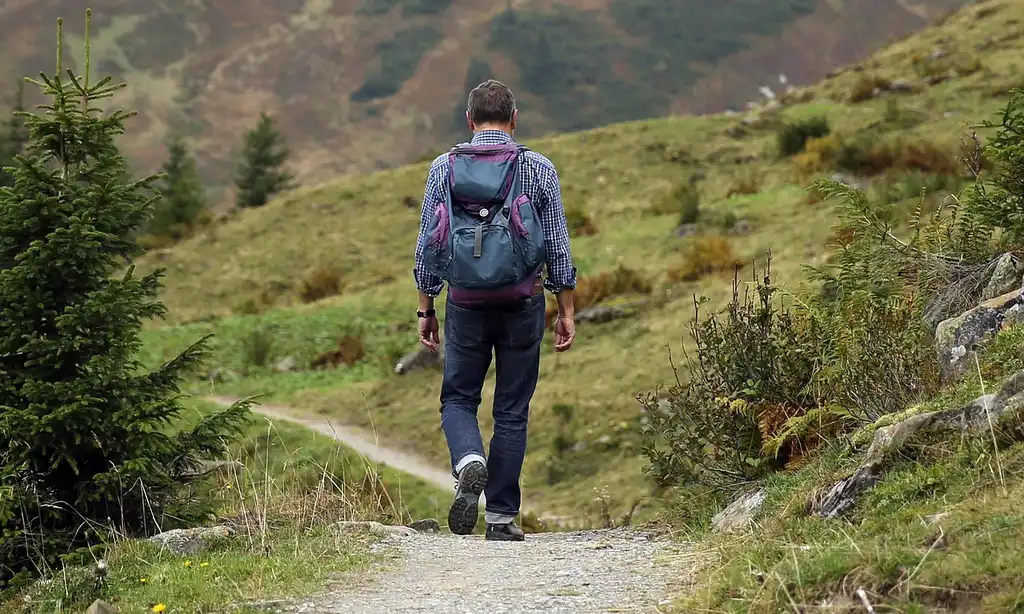
For an overnight hike, 30–40L is often enough for a compact summer kit, but many weekend trips fit better in 40–50L. The right answer depends on how bulky your sleep system, shelter, clothing, and food really are.
Weekend trips and the 40–50L sweet spot
The same source says 30–50L is for overnight or weekend trips, and 40–50L is the sweet spot for most three-season overnight trips. That range gives you enough room for shelter, a sleeping bag, a pad, food, and a spare layer without forcing tight compression or external lash points.
Gregory’s Zulu 40L is listed as an all-around backpack for men, which shows how a 40L pack sits near the center of the overnight range rather than at the edge. For many one- or two-night trips, that size is the practical starting point.
When 30–40L is enough
Choose 30–40L when your shelter and sleep system are compact, your food load is modest, and you are not carrying heavy extras. A small tent or tarp, a compressed quilt, and a minimal clothing system can fit here if you pack deliberately.
Picture a summer overnighter with a compact tent, a low-bulk quilt, one meal, and two liters of water. A 35L pack can be enough if you do not bring spare shoes, a big chair, or a camera insert.
When 50L is the safer choice
Move toward 50L when your sleep system is bulkier, your food bag is larger, or you expect extra clothing for colder nights. That extra room also helps if you need a bear canister, which can quickly eat the space that a 35L pack seemed to offer on paper.
A 50L pack is often the safer pick when you do not want to pack and repack your gear every trip. It is still small enough for many weekend trips, but it gives you breathing room for shoulder-season packing and less-compressible items.
How many liters do you need for a weekend backpacking trip?
Most weekend backpacking trips land around 40–50L if you want a normal margin for shelter, sleep system, food, and a clothing layer. If your kit is especially compact, 30–40L can work; if food, cold-weather layers, or bear storage are involved, 50L is often the safer floor.
Typical weekend kit volume
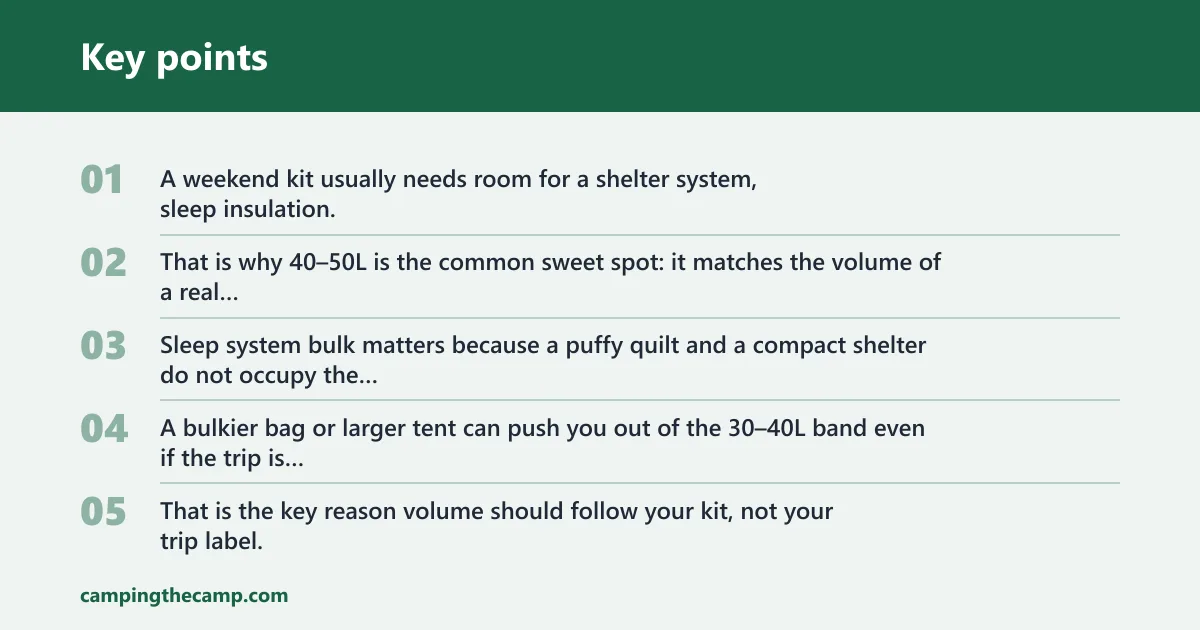
A weekend kit usually needs room for a shelter system, sleep insulation, cooking or no-cook food, and a change or two of clothing. That is why 40–50L is the common sweet spot: it matches the volume of a real three-season weekend load, not just a stripped-down spreadsheet.
Sleep system bulk and shelter size
Sleep system bulk matters because a puffy quilt and a compact shelter do not occupy the same space as a synthetic sleeping bag and double-wall tent. A bulkier bag or larger tent can push you out of the 30–40L band even if the trip is only one night.
That is the key reason volume should follow your kit, not your trip label. Two people on the same weekend route may need different pack sizes if one carries a small tarp setup and the other carries a bulkier freestanding tent.
Food and water carry changes
Food volume rises with trip length, and water carry can push the pack choice even on a short weekend. If your route has limited water, you may need extra room for more bottles or a larger reservoir, plus a capacity margin for dry food.
Emergency layers and winter food can add a meaningful amount of space too. A colder shoulder-season weekend often needs more insulation and a larger food bag than a mild summer trip, which is why the same route can call for 40L in July and 50L in November.
Pack size decision matrix
This matrix ties trip length, season, sleep system bulk, water carry, and food carry to a practical volume band. Use it to choose the smallest pack that still closes cleanly with your exact kit.
| Trip type | Season and kit traits | Typical load | Recommended volume band | Borderline case guidance |
|---|---|---|---|---|
| Day hike | Summer, light layers, short water carry | Water, snacks, shell, first aid | 15–25L | Size up to 30L if you carry camera gear, child gear, or a bulky jacket |
| Day hike | Cold morning, extra insulation, longer route | More water, more layers, more food | 25–30L | Drop to 20–22L only if the kit stays compact and you skip extra clothing |
| Overnight trip | Three-season, compact shelter, compact sleep system | Shelter, sleep kit, one night of food | 30–40L | Size up if your pad is bulky or your food bag stays large after compression |
| Overnight trip | Three-season, standard shelter, moderate food, spare layer | Normal weekend backpacking load | 40–50L | Size down only if every major item is compact and you pack without loose space |
| Overnight trip | Colder weather, bulkier insulation, extra food, or bear canister | Heavier, less compressible load | 50L | Choose 50L or larger if the canister must fit inside the pack |
| Multi-day trip | 3–7 days of food, heavier base load | Food, shelter, sleep system, clothing | 50–65L | Go larger if your food carry, winter insulation, or bear canister needs more room |
Frameless or internal-frame pack?
Frame choice matters because capacity alone does not tell you whether the pack can carry the load well. Frameless packs are often a better fit for loads under about 25 lbs and base weights under about 10 lbs, while internal-frame packs are commonly preferred when loads are closer to 25–45+ lbs.
When a frameless pack fits
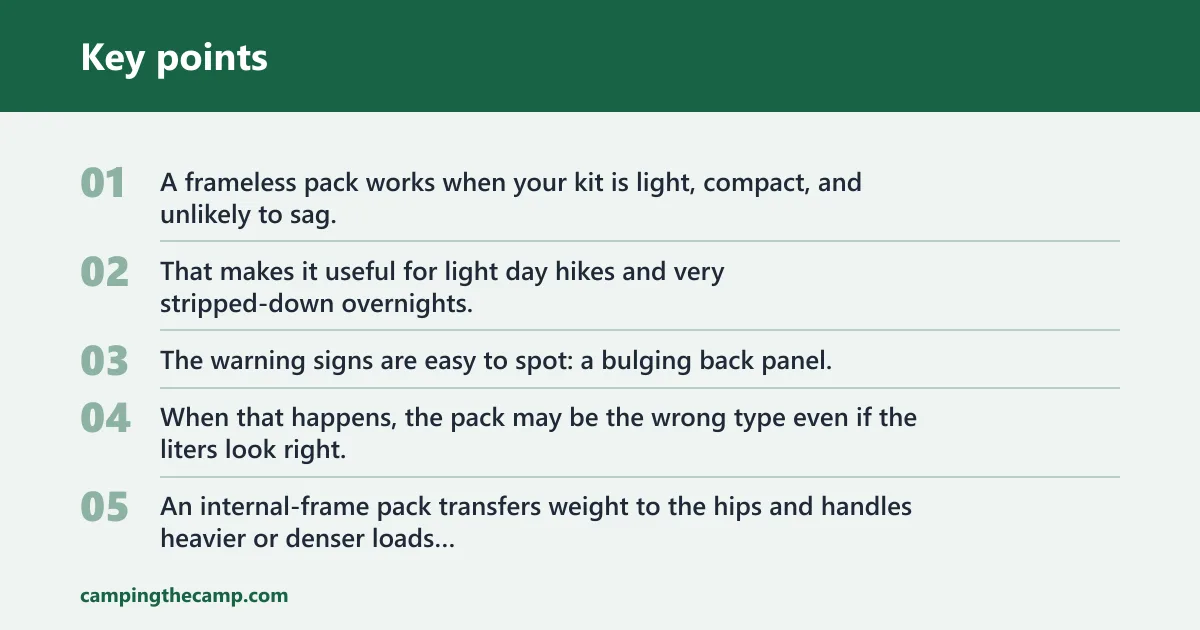
A frameless pack works when your kit is light, compact, and unlikely to sag. That makes it useful for light day hikes and very stripped-down overnights, especially when your total load stays low and your pack contents compress well.
The warning signs are easy to spot: a bulging back panel, a load that slumps to the bottom, and shoulder straps doing more work than they should. When that happens, the pack may be the wrong type even if the liters look right.
When an internal frame is the better choice
An internal-frame pack transfers weight to the hips and handles heavier or denser loads better. If you are carrying a week’s worth of food, extra water, or more structured gear, internal support makes the load feel more controlled.
That support is especially useful when your kit pushes above about 25 lbs. It also helps when the pack needs to hold a firmer shape, such as with a bear canister or a dense winter sleep system.
Bear canisters and heavier loads
Bear canisters often change the answer fast. Even if your trip is only one or two nights, the canister can force you into a larger pack or a more structured frame because the canister occupies space that soft gear would otherwise fill.
Internal-frame packs are usually the safer choice in that case. The extra structure helps you manage both the canister’s shape and the added weight of food and hard-sided storage.
How fit changes the size you need
Pack fit depends on torso length, not height, and the hip belt needs to sit on the iliac crest to carry most of the load. A pack can be the right volume and still feel wrong if the torso length or belt placement is off.
Torso length, not height
Torso length is measured from the C7 vertebra to the iliac crest, and that measurement is what guides small, medium, and large size bands. Two people with the same height can need different pack sizes because their torso lengths differ.
Height alone is a poor fit guide. If the torso is too short or too long for the pack, the load will not ride where it should, no matter how many liters the bag holds.
Hip belt placement
The hip belt should sit on the iliac crest, not float above it. When it is placed correctly, it should carry most of the load instead of letting the shoulders do all the work.
The same source says about 80% of the weight should ride on your hips, which is a useful target for heavier overnight and multi-day loads. If the belt sits too high or too low, the pack will feel less stable and more tiring over distance.
Should you buy bigger just in case?
Usually no. Buy the smallest pack that fits your exact kit, because oversized packs encourage overpacking and can make a light load feel sloppy. The safer move is to size for the trip you actually take most often.
Oversized pack problems
A too-large pack can carry unnecessary weight in the pack itself, and the empty space invites you to add extra items. That can turn a clean day hike into a cluttered one, or a tidy weekend kit into a heavier load than needed.
Underfilled pack problems
An underfilled pack can be awkward too, especially when the load shifts around inside the bag. You may feel the contents pull away from your back, which can hurt stability and make the carry less efficient.
The goal is not the biggest pack that might someday work. It is the smallest pack that fits your present kit without leaving essentials outside.
A better rule for buying once
Choose the size that matches your most common trip, then check the borderline cases. If your kit regularly moves between 25L and 30L for day hikes, or between 40L and 50L for overnights, buy the size that leaves room for the bulkier version of your normal load.
That rule keeps you from buying too much volume. It also keeps you from forcing a frameless pack to do a job that belongs to a more supportive frame.
Suppose your summer day-hike kit fits cleanly in 22L, but your fall kit adds a puffy jacket and extra water. Moving to 30L makes sense only if those additions are routine; otherwise, the smaller pack is the better daily carry.
Choose What size hiking backpack do I need for day hikes if…
It is the better pick for short outings, lighter summer kits, and anyone trying to avoid carrying unused volume.
Choose overnight trips if your pack must hold shelter, sleep gear, food, and clothing, or if winter layers and a bear canister push the load higher. It is the better pick whenever your kit stops fitting cleanly in the day-hike range.
For borderline cases, use the bigger option only when the extra items are regular, not occasional. A 30L daypack beats a stuffed 22L pack, and a 50L overnight pack beats a cramped 35L load if your real kit includes bulkier insulation or hard-sided storage.
Frequently asked questions
Is a 30L backpack big enough for a day hike?
Yes, but it is often larger than necessary for a basic day kit. A 30L pack makes sense for cooler weather, photography, child gear, or longer hikes that need more food and clothing. For simple summer outings, 15–25L is usually a cleaner fit.
Can I use a 40L backpack for overnight trips?
Yes. A 40L pack sits right in the overnight range and is a strong choice for many one- and two-night trips, especially in three-season conditions. It works best when your shelter, sleep system, and food are reasonably compact and you do not need a lot of extra room.
What changes the backpack size I need in winter versus summer?
Winter usually needs more volume because insulation, bulkier sleep gear, and emergency items take up more space than summer layers. A summer overnight may fit in 35–40L, while the same route in colder weather may need 45–50L or more. Food and water carry can also rise in winter conditions.
Do I need a frame for a daypack or overnight pack?
Not always for a daypack, especially if the load stays under about 25 lbs. For overnight packs, an internal frame becomes more useful as weight rises into the 25–45+ lb range, or when you need better hip transfer, a firmer pack shape, or room for a bear canister.