
What is a dry bag and how is it used for hiking?

A dry bag is a waterproof roll-top bag used to keep gear dry in wet hiking conditions. Choose it for items that may get splashed or briefly exposed; a pack liner is better for keeping a whole backpack’s contents dry. Use the wrong system and rain, river spray, or a wet pack can soak clothing, insulation, and electronics. This guide explains dry bags, dry sacks, and pack liners, plus when each one fits a hike.
What is a dry bag?
A dry bag is a bag made to keep water out with a roll-top closure. Hikers use it for rain, splashes, stream crossings, and wet ground, and for sorting items inside a pack. Some versions are built for brief submersion, while others are meant mainly to shed rain and spray.
How the roll-top closure works
The roll-top is the main seal. Flatten the top, roll it down several times, then clip it shut so the folded material forms the barrier. If you under-roll it, overfill the bag, or leave grit in the closure, the seal weakens.
Materials and waterproof limits
Dry bags use coated fabrics such as nylon, ripstop nylon, or CORDURA with polyurethane or TPU coatings. That build affects both weight and durability. A thicker fabric can resist abrasion better on rocky ground, but it usually adds bulk and mass.
Waterproof claims are not all the same. Some products are rated for splash exposure such as IPX6, while others are listed as submersible at IPX7. For hiking, that difference matters because a bag used in wet brush or on a damp tent floor faces a different risk than one carried through a stream crossing.
Dry bag vs dry sack
A dry sack is usually the lighter, more packable version, and many hikers prefer it for clothing and sleeping layers. A dry bag is often tougher and more structured. The practical split is simple: dry sack for low-bulk waterproof organization, dry bag for harsher exposure or more abrasion.
Weight and packability
Competitor summaries describe dry sacks as better for hiking because they are lightweight and compressible. That fits a puffy jacket, spare socks, or a sleeping bag that needs to fit smaller. A heavier dry bag takes up more room, but it is less likely to feel flimsy on rough trail surfaces.
Submersion resistance
The Trail Flower says dry bags can be brief-submersion proof, but dry sacks are for rain only. That distinction is useful on trail. If you may set a bag down in a shallow puddle, drag it through wet brush, or expose it to stream spray, a true dry bag is the safer pick.
When should hikers use one?
Use a dry bag when water exposure is predictable: storm days, wet campsites, stream crossings, or a pack that gets set on damp ground. Use a dry sack when the goal is to protect soft goods from rain and keep the pack organized. Use a pack liner when the whole pack needs one waterproof barrier.
Rain and wet ground
Rain can soak through a pack body, especially at seams, zippers, and panel fabric. A dry bag protects the items inside even if the outside of the pack stays wet. It is also useful when you need to place gear on muddy or damp ground during breaks.
Stream crossings and splash exposure
On stream crossings, splash and brief dunking are the main risks. A properly rolled dry bag gives you a better margin than a loose stuff sack or ordinary pouch. It is still smart to keep the closure out of standing water and avoid assuming every bag is submersible.
Electronics, clothing, and sleep systems
Electronics, dry clothing, and sleep insulation are the items most worth isolating. Water in a jacket is annoying. Water in a sleeping bag can end a night quickly. First-aid kits, maps, and paper permits also belong in a sealed container if the forecast turns wet.
Say your day hike includes a phone, paper map, spare layer, and lunch in a 10L dry sack. That works well for rain and organization, but it is a poor choice if you plan to ford a chest-deep crossing. In that case, a better-sealed dry bag or liner gives more margin.
How waterproof are they?
Dry bags are only as waterproof as their construction, closure, and condition. Some are rainproof or splash-resistant, while others are rated for submersion. On trail, that means you should match the bag to the exposure instead of assuming every “dry” label means the same level of protection.
IPX6 and IPX7 in plain terms
Product summaries often use IPX6 for splashproof or water-jet resistance, and IPX7 for submersion resistance up to about 1 meter for around 30 minutes. Those numbers are useful, but they are not a guarantee that the bag will survive every real-world use. Abrasion, bad sealing, and damaged fabric still matter.
What ratings do and do not mean on trail
A higher rating does not cancel poor packing. If the bag is overfilled, the roll-top cannot make full contact. If the closure is worn or contaminated with grit, water can creep in. If a seam leaks, the rating on the tag does not stop moisture from entering through a weak point.
Hiking loadout matrix
This matrix maps common trail items to a sensible container choice. Use the size as a planning range, not a fixed rule. The right answer depends on pack size, weather, and whether the item needs rain protection, compression, or brief-submersion resistance.
| Item | Recommended dry bag size | Dry bag or dry sack? | Failure risks |
|---|---|---|---|
| Phone, keys, wallet, map, permit | 1L to 3L | Dry sack | Overfilling, loose roll-top, seam leakage |
| Spare socks, hat, gloves, headlamp | 3L to 5L | Dry sack | Poor roll count, puncture from sharp objects |
| Rain jacket and light insulation | 5L to 10L | Dry sack | Compression leaves less room for a proper seal |
| Lunch, snacks, stove kit | 3L to 10L | Dry bag | Food contamination from wet gear, abrasion from hard items |
| Overnight clothing set | 10L to 20L | Dry sack | Overpacking, uneven closure, odor transfer from wet layers |
| Sleeping bag or quilt | 15L to 20L | Dry sack | Compression stress, seam leaks if the sack is strained |
| Sleeping bag plus clothes for a solo overnight | 20L | Dry bag | Poor roll-downs, puncture from tent stakes or cookware |
| Multi-day clothing and insulation set | 20L to 30L | Dry bag | Too many small bags, wasted pack space, closure wear |
| Large multi-day backpack interior | 80L liner | Backpack liner | One tear affects the whole load, liner can shift if undersized |
| When not to use one | None | Neither | Sharp tools, hot cookware, or anything needing instant access |
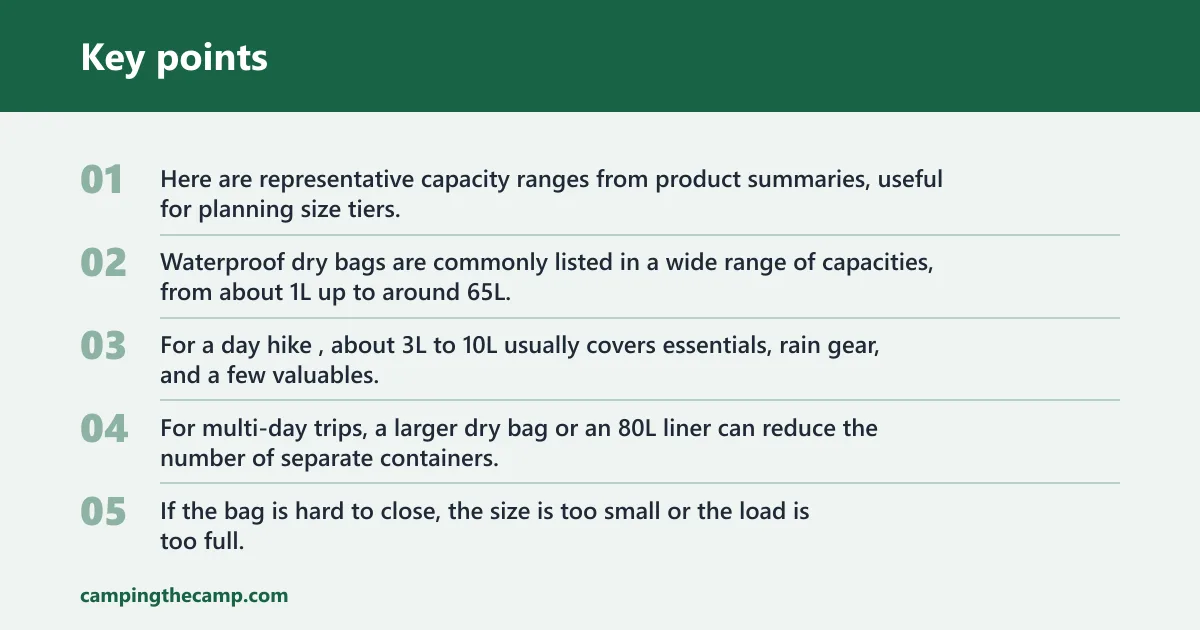
Here are representative capacity ranges from product summaries, useful for planning size tiers. Waterproof dry bags are commonly listed in a wide range of capacities, from about 1L up to around 65L. Those ranges help frame what sizes tend to fit real hiking kits.
Capacity planning by trip length
For a day hike, about 3L to 10L usually covers essentials, rain gear, and a few valuables. For an overnight trip, about 10L to 20L usually works for clothes or a sleep system, while a second bag can hold food or electronics. For multi-day trips, a larger dry bag or an 80L liner can reduce the number of separate containers.
A common first-timer mistake is packing a 20L bag to the brim with a sleeping bag, socks, and a puffy jacket, then rolling the top only once or twice. That can leave too little material for a real seal. If the bag is hard to close, the size is too small or the load is too full.
When a pack liner works better
A pack liner is the smarter choice when you want one waterproof barrier for the whole backpack. Instead of sealing several small items separately, you line the pack, place dry gear inside, and close the liner above the load. That can be simpler for large multi-day packs and extended rain.
Whole-pack waterproofing
A competitor example recommends an 80L dry pack liner for large multi-day backpacks. That makes sense when you want every item inside the pack to sit behind one barrier. It also helps if you do not want to sort gear into several small bags every time you break camp.
When multiple bags make less sense
Multiple dry sacks are useful for organization, but they are not always the cleanest system. If a storm is expected all day, a liner can protect everything at once. That leaves smaller dry bags for valuables, wet items, or gear that needs extra protection from abrasion.
- Choose the outer barrier. Decide whether your trip needs a pack liner, one or two dry bags, or a dry sack system. Use a liner for whole-pack protection and small bags for sorting items that need separate access.
- Group items by risk. Put electronics, sleep insulation, and dry clothing into the most protective container. Keep food, maps, and first-aid items in a size that matches their bulk so the closure can roll fully.
- Close the bag correctly. Push out excess air if needed, flatten the top, and roll it down several times before clipping. This creates the seal and also compresses the contents enough to fit inside the pack.
Common mistakes to avoid
Most dry-bag failures on hikes come from packing errors or wear, not from the idea of the bag itself. Overfilling, poor roll-downs, punctures, worn closures, and seam leaks are the main problems. Abrasion matters too, especially on rocky trails, in brush, or when a bag rides loose outside the pack.
Overfilling and poor roll-downs
If the contents press hard against the top, the rolls get shallow and the seal weakens. Leave room for several full rolls. If the bag is packed so tightly that you cannot roll the closure without strain, move to a larger size.
Punctures, seams, and abrasion
Not all dry bags are equally tough. A heavy-duty bag such as the Sea to Summit Big River Dry Bag uses 300D Ripstop CORDURA with PU coating, which is aimed at abrasion resistance. By contrast, lighter options such as the Osprey Ultralight Dry Sack use 40D ripstop nylon with PU coating, which saves weight but asks for more care on abrasive trail use. Matador FlatPak Waterproof Bag uses 210D TPU-coated ripstop nylon, and Peak Designs Waterproof Dry Bag uses 420D nylon with TPU coating and an IPX7 rating.
Use tougher fabric when the bag may rub against rock, pack frames, or brush. Use lighter fabric when low weight and packability matter more than hard use. Never drag a dry bag over stone if you can avoid it.
Frequently asked questions
What is a dry bag used for?
A dry bag keeps trail gear dry in rain, splashes, wet ground, and short water exposure. Hikers use it for clothing, electronics, food, maps, and first-aid kits. It also helps separate wet items from dry ones so damp gear does not spread moisture or odor through the pack.
Why is a dry bag needed?
You need one when rain, spray, or ground moisture could ruin essential gear. It is especially useful for insulation, spare clothing, and electronics. On a long day or an overnight trip, a single wet item can spread moisture through the rest of the pack if it is not isolated.
What is a dry bag in kayaking?
In kayaking, a dry bag is the same basic sealed bag, but it often faces more direct water exposure than hiking gear does. That means brief submersion, splash, and spray matter more. Hikers can borrow the same idea, but trail use usually focuses more on rain and wet ground than continuous immersion.
What bag is best for hiking?
The best bag depends on the job. Use a dry sack for lightweight, compressible protection of clothing and sleep gear. Use a dry bag when you need more abrasion resistance or splash protection. Use a pack liner when the whole backpack needs to stay dry through steady rain.
How does a dry bag work?
A dry bag works by combining waterproof fabric or coating with a roll-top seal. Load the bag, press out excess air, roll the top several times, and clip it shut. The folds create a barrier that blocks water when the bag is used correctly and kept in good condition.
What is the difference between a dry bag and a dry sack?
A dry bag is usually the tougher, more protective option. A dry sack is usually lighter, more compressible, and better for hiking when you mainly need rain protection and organization. If submersion resistance or abrasion matters more, choose the dry bag. If packability matters more, choose the dry sack.
Can you use a dry bag as a backpack liner?
Yes, if the bag is large enough and shaped to line the pack. An 80L liner is a common example for large multi-day backpacks. The advantage is whole-pack waterproofing. The downside is that one liner carries the protection burden for everything inside the pack.
Are dry bags waterproof if submerged?
Sometimes, but not always. Some bags are rated for submersion, such as IPX7 examples listed in product summaries, while others are only splashproof at levels such as IPX6. On trail, do not assume a rainproof bag will survive a full dunk unless the construction and rating support that claim.