Best small camp stove for families with limited space

A compact two-burner tabletop model with about 10,000 to 12,000 BTU per burner, a slim carry case, and a footprint that fits one camp box works well for families with limited space. Go too small and you cook in shifts, waste fuel, and make a cramped setup harder to live with. This guide compares the smallest practical stove formats, the size specs that matter, and the tradeoffs for tight vehicles and crowded campsites.
Quick picks by space and meal style
| Need | Best stove format | Key spec to look for | Tabletop or freestanding? |
|---|---|---|---|
| Smallest packed size | Two-burner tabletop | Fold-flat body, slim carry case, about 20 x 12 x 4 inches packed | Yes, tabletop |
| Best for one camp table | Tabletop camp stove | Low profile, carry handle or case, stable wide feet | Yes, tabletop |
| Rough ground or no table | Freestanding compact stove | Legs or stand, locked base, wind shielding | No, freestanding |
| Fast family breakfasts | Two-burner compact stove | Separate simmer control, 10,000 to 12,000 BTU per burner | Usually tabletop |
| Very tight storage | Small tabletop single-burner or mini two-burner | Narrow packed width, but less meal flexibility | Yes, tabletop |
Which stove format fits your family?
For most families with limited space, a compact two-burner camp stove gives the best mix of packed size and meal flow. It lets you boil pasta water while simmering vegetables, or cook eggs on one side while warming tortillas on the other. A single burner saves space, but family meals slow down fast.
Two-burner compact camp stove
This is a practical format to target if you cook for 3 to 5 people. The useful traits are a tabletop footprint, a folding windscreen or lid, and enough burner spacing for two real pots or a skillet and a saucepan. Most family-friendly models also include a lid or case that keeps the burner grates from snagging bins and soft bags.
Tabletop camp stove
A tabletop camp stove fits on a picnic table or camp table and usually packs small enough for a gear box or SUV side cubby. The common propane version connects quickly, and the low stance helps with loading and unloading. For limited storage, this is usually the safest first choice if you have a stable surface. Compact butane models can also be small and easy to store, while dual-fuel compact models add flexibility at the cost of extra bulk.
Freestanding compact stove
Choose freestanding only if your campsite often lacks a solid table or your cooking area is already crowded with coolers and tubs. The stand adds height and flexibility, but it also adds bulk and more setup space. That tradeoff matters in tight vehicles, where long legs can be harder to place than the stove body itself.
Camp stove decision table
This table turns family size and storage limits into a format choice. Packed dimensions matter here because a stove that seems “compact” can still block cooler lids, sit awkwardly on top of a tote, or force you to rearrange tents and kitchen bins every time you load the car.
| Family size | Vehicle storage limit | Meal style | Best stove format | Packed size target | Burners | Tabletop? | Freestanding? |
|---|---|---|---|---|---|---|---|
| 2 adults | Very tight trunk or hatch corner | Simple boils and one-pan meals | Small tabletop single or narrow two-burner | About 18 x 12 x 4 inches or smaller | 1 to 2 | Yes | No |
| 2 adults + 1 to 2 kids | One camp box plus cooler | Breakfast and dinner at the same time | Two-burner compact tabletop | About 20 x 12 x 4 to 5 inches | 2 | Yes | No |
| 3 to 5 people | SUV cargo area with bins | Main dish plus side dishes | Two-burner compact tabletop with lid | About 22 x 13 x 5 inches | 2 | Yes | No |
| 3 to 5 people | Room for stand and gear spread | Mixed cookware, rough ground | Compact freestanding stove | Body plus legs, often taller and longer than tabletop | 2 | No | Yes |
How many burners do you really need?
For family camping, two burners are often the practical minimum. One burner can cook one item at a time, so the side dish waits while the main dish cools. Two burners let you manage breakfast, dinner, and kid timing with less guesswork, especially when someone needs food before the rest of the meal is ready.
Cooking for two adults and kids
If your meals include a skillet, a pot, and maybe a griddle, two burners are usually enough. That setup gives you simultaneous boil-and-simmer use, which is the main family-cooking advantage. You can keep one burner at a low simmer for rice or beans while using the other for a faster boil.
When one burner is not enough
A single burner becomes frustrating when you need hot water, a side dish, and a breakfast item all in the same window. It also slows cleanup because you keep moving cookware on and off the heat. A family stove should reduce turns at the burner, not add them.
Burner spacing for family cookware
Burner count alone is not enough. If the burners sit too close together, two full-size pans bump into each other, or a griddle overhang blocks the knobs. Look for spacing that keeps both burner controls usable while leaving enough room for common family cookware. Narrow layouts are a common weak point on small stoves.
Say your family uses a 10-inch skillet and a 2-quart pot. On a stove with tight burner spacing, the pot handle can clash with the skillet rim, and one pan may sit partly off-center. The stove still has two burners, but the usable cooking area acts smaller than the spec sheet suggests.
What features matter most in tight spaces?
Storage space should shape the purchase more than weight alone. A stove can be light and still awkward if its lid sticks out, its legs do not lock, or its burners sit too high for easy packing beside coolers and bins. Check packed size first, then the parts that affect cooking control.
Packed dimensions and storage case
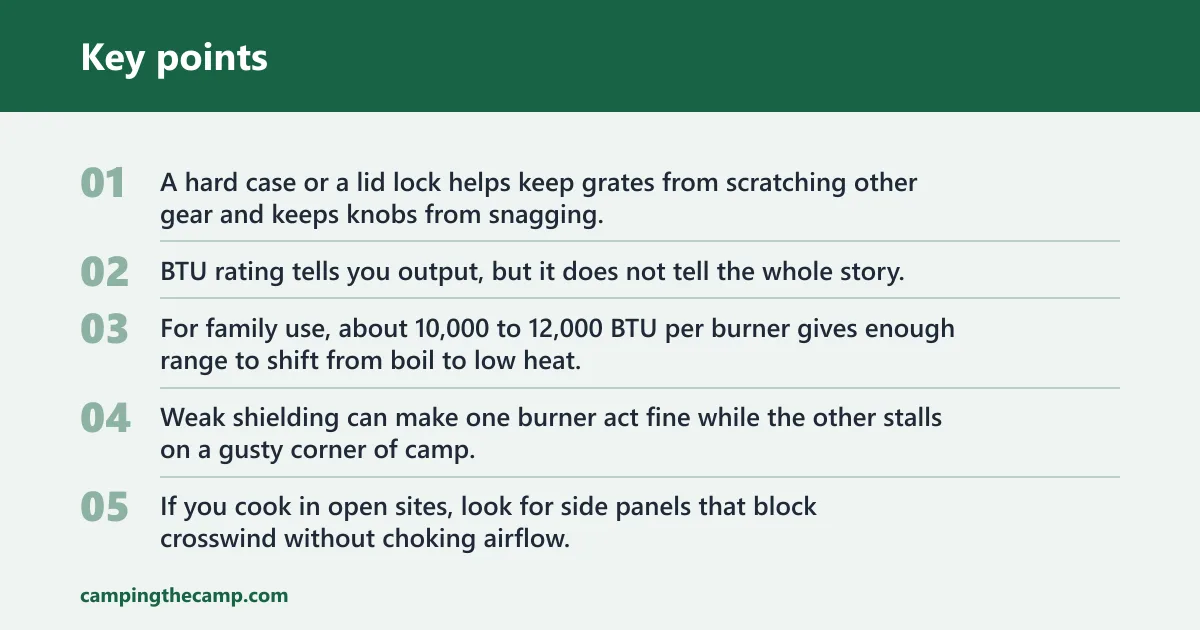
Check the packed length, width, and height. The useful question is whether the stove slips beside a cooler, under a cargo cover, or into the same bin as fuel and cookware without forcing a reshuffle. A hard case or a lid lock helps keep grates from scratching other gear and keeps knobs from snagging.
BTU rating and boil performance
BTU rating tells you output, but it does not tell the whole story. Higher BTU can shorten boil time, yet it can also burn through fuel faster and make simmer control harder on thin cookware. For family use, about 10,000 to 12,000 BTU per burner gives enough range to shift from boil to low heat.
Wind protection and flame stability
Built-in windscreens or side panels matter more on compact stoves because a small flame loses stability faster in a breeze. Weak shielding can make one burner act fine while the other stalls on a gusty corner of camp. If you cook in open sites, look for side panels that block crosswind without choking airflow.
Propane connection and ignition
Many compact family stoves use propane, often with 1 lb cylinder compatibility. Some also accept a bulk tank hose, which is useful for longer trips and better fuel runtime. Check whether the regulator is included, since some stoves need a separate hose or adapter. Push-button ignition is convenient, but a match-light setup can be simpler to keep working after exposure to dirt or moisture.
Safety and cleaning
For cramped campsites, a stable base or locking legs matter as much as flame control knobs. You want a stove that resists tipping and keeps hot cookware away from kids’ reach. Removable grates, a drip tray or catch pan, and wipe-clean surfaces make pack-out faster and reduce food buildup that can attract rust or smell later.
How to choose the right compact stove
Start with the car, not the catalog. If the stove has to fit beside a cooler, water jug, and tent bag, packed dimensions decide the short list. If the stove is going on a picnic table or camp table, its open footprint and leg width matter just as much as burner count.
-
Measure your storage space.
Check the longest available flat area in your trunk, hatch, or cargo bay, then compare it with the stove’s packed length and height. Leave room for fuel, because a stove that fits alone may fail once you add a cylinder and hose.
-
Match the stove to your cooking flow.
If breakfast means eggs and oatmeal together, or dinner means pasta and sauce, choose two burners. If your meals are mostly reheats and one-pot dishes, a smaller tabletop setup can work, but it should still leave enough pot support for family cookware.
-
Check the campsite surface.
Make sure the stove footprint fits your table or cooking platform with space around the edge. A compact stove that overhangs a flimsy picnic table is less safe than a larger stove on a stable camp table, especially when kids move around the site.
-
Confirm fuel and ignition details.
Look for 1 lb cylinder compatibility, a regulator listing, and the option to use a bulk tank if runtime matters. Decide whether you want push-button ignition for convenience or match-light simplicity for easier troubleshooting in wet or windy conditions.
A common first-timer mistake is choosing the smallest stove body without checking burner spacing. The stove looks tidy in the gear closet, then the first breakfast exposes a narrow cooktop, weak wind shielding, and no place for a griddle. Compact should still mean usable.
Frequently asked questions
What is the best small camp stove for a family with limited space?
The best choice is usually a compact two-burner tabletop stove with a slim carry case, stable base, and about 10,000 to 12,000 BTU per burner. That format gives you enough room for a main dish and a side without taking much more storage than one large camp box.
How many burners do I actually need for family camping?
Two burners are the practical minimum for most families. One burner forces you to cook in shifts, which slows breakfast and dinner and can leave kids waiting. Two burners let you boil and simmer at the same time, which is the real advantage in a cramped campsite.
Will a two-burner stove fit in a small car or SUV?
Often yes, if the packed size is compact and the case is flat enough to slide beside cooler lids or tote bins. Check the stove’s length, width, and height, not just the weight. A stove that is easy to carry can still be awkward to load.
What size camp stove works best for two adults and kids?
A compact two-burner tabletop stove is usually the best size for two adults and kids. It handles eggs, oatmeal, pasta, and side dishes without taking over the whole table. Smaller single-burner models can work, but they slow the whole meal flow.
Are compact camp stoves powerful enough for family meals?
Yes, if the stove has enough burner output and decent flame control. A useful range is about 10,000 to 12,000 BTU per burner. That is enough for family cooking, but wind protection and burner spacing matter just as much as raw output.
How do I clean and pack a compact camp stove after a trip?
Let the stove cool fully, remove grates or drip trays if they come off, and wipe the cooktop with a damp cloth before packing. Dry it before it goes into the case. That helps limit rust, food buildup, and smell, especially if the stove rides in a sealed vehicle bin.