What features make camp cookware kid-friendly and safe?

Kid-friendly camp cookware needs cool-touch handles, stable bases, short handles or grip points, tight-fitting lids, wide openings, and nonstick or easy-clean surfaces to cut burns, spills, and cleanup. Poorly chosen cookware can tip, hold heat, and turn a simple meal into a burn or mess. This guide explains the features to check so you can judge which pots, pans, and cups are safer for kids to handle on family camping trips.
Key safety features to look
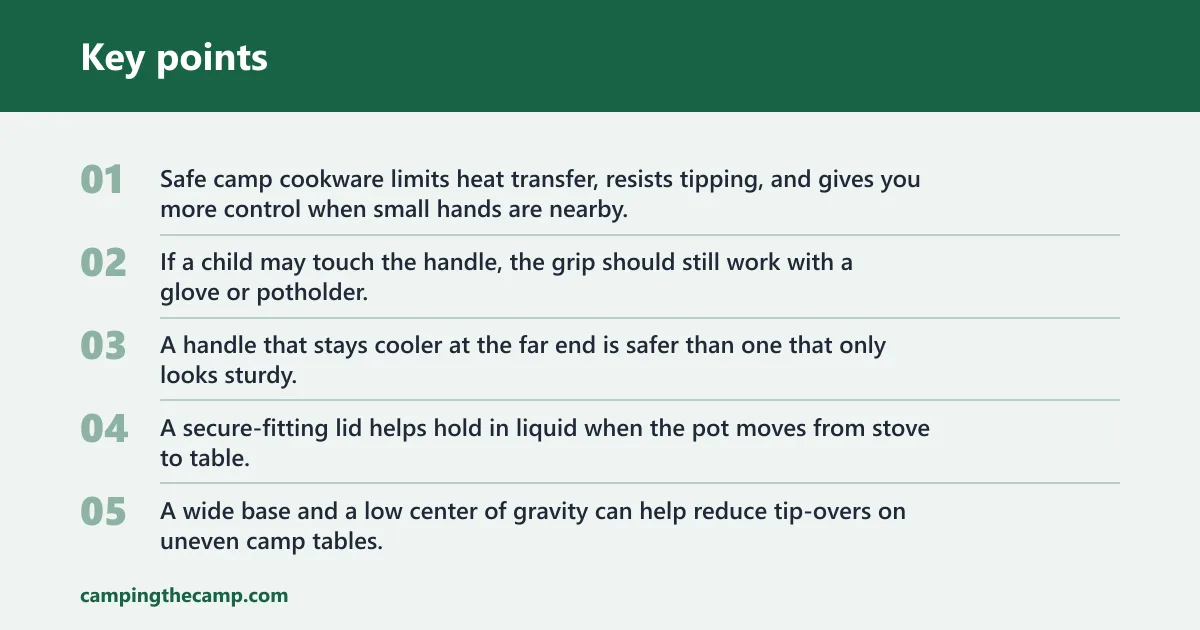
Safe camp cookware limits heat transfer, resists tipping, and gives you more control when small hands are nearby. The main checks are handle temperature, lid fit, base width, weight, and how easily the surface cleans after greasy food. Those features matter more than brand claims.
Burn risk reduction
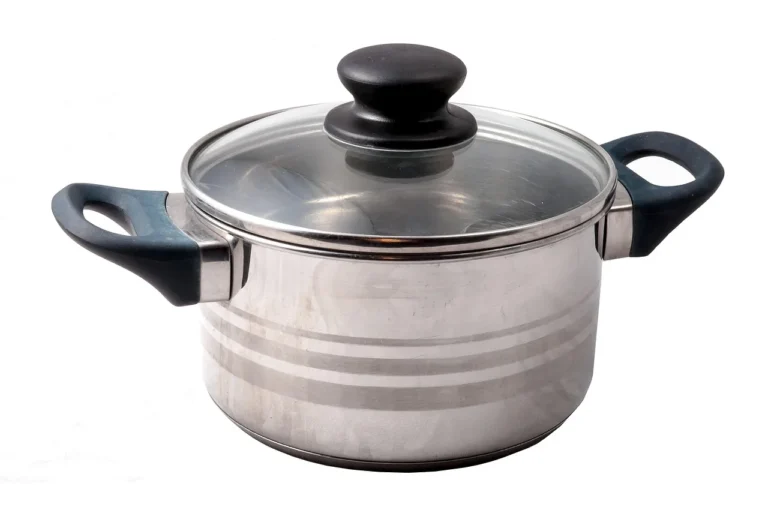
Choose cookware with cool-touch handles, insulated grips, or a handle long enough to keep hands farther from flame and hot metal. If a child may touch the handle, the grip should still work with a glove or potholder. A handle that stays cooler at the far end is safer than one that only looks sturdy.
Spill control
A secure-fitting lid helps hold in liquid when the pot moves from stove to table. A wide base and a low center of gravity can help reduce tip-overs on uneven camp tables. Deep, narrow pots can be harder for children to manage because sloshing starts sooner.
Cleanup and handling
Easy-to-wash surfaces matter when kids help with sauce, oatmeal, or scrambled eggs. Smooth interiors release residue faster, so less scrubbing is needed at camp and the cookware is less slippery in hand. Kid-friendly cutlery and simple eating sets also reduce cleanup stress around the meal site.
Kid-safety decision checklist
Use this checklist to score each cookware option for the person who will actually handle it. Parent-only cooking can tolerate more heat and weight. A supervised child helper needs lower handle temperature, stronger lid control, and simpler cleanup. A teen helper can manage more size and weight if the stove setup is stable.
| Check | Parent-only cooking | Supervised child helper | Teen helper |
|---|---|---|---|
| Handle heat | Medium risk is acceptable if adults use gloves or potholders | Best if cool-touch or insulated grip stays farther from flame | Good if grip remains comfortable with a glove and short lifts |
| Lid security | Secure-fitting lid helps during transport and pouring | Very important to reduce slosh and steam release | Important for draining and moving food safely |
| Base stability | Wide base preferred, especially on camp tables | Wide base and low center of gravity are strongest priorities | Wide base still matters during stirring and serving |
| Weight | Moderate weight is fine if adults carry it | Lighter is better so a child can help carry or set down | Moderate weight is acceptable if the grip is secure |
| Material | Stainless steel or hard-anodized aluminum work well | Stainless steel or hard-anodized aluminum is easier to trust than fragile coatings | Any family-safe material can work if heat and cleaning are controlled |
| Cleanup ease | Easy-to-wash interior saves time after greasy meals | Simple surfaces are safer for a child to rinse or wipe | Residue-resistant surfaces help when the teen is cleaning after cooking |
| Stove compatibility | Best on a propane stove for most family meals | Propane stove is safer than open flame for close supervision | Propane stove still preferred; campfire use needs more spacing |
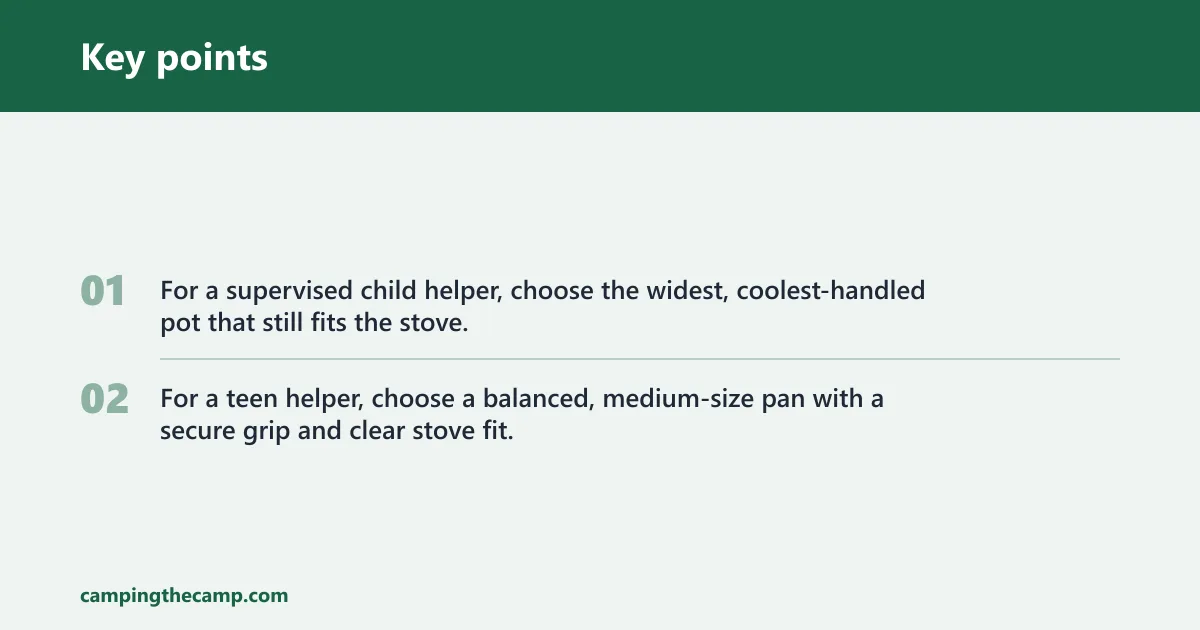
Safest setup recommendation: for parent-only cooking, choose a stable pot or pan with a secure lid and easy-clean interior. For a supervised child helper, choose the widest, coolest-handled pot that still fits the stove. For a teen helper, choose a balanced, medium-size pan with a secure grip and clear stove fit.
What handles and lids are safest for kids?
Handles and lids do the most to reduce burns and spills. The safest options keep hands farther from the flame, stay cooler longer, and fit tightly enough that steam and liquid do not move unpredictably. A handle that feels comfortable with a glove or potholder is better than a bare-metal grip.
Cool-touch handles
Look for stay-cool or insulated grips that slow heat transfer from the pot body into the handle. Handle length matters because a longer reach creates more safe handling distance from flame. On family trips, the handle should still allow a steady lift without forcing fingers under the hot rim.
Secure lids and stable bases
A lid should sit firmly enough that it does not rattle off during a short move from stove to table. A wide base lowers the chance of tipping on a folding camp table, and a lower center of gravity helps when a child bumps the edge. Rounded bottoms are usually less stable on uneven surfaces.
Picture about a 2-quart pot with a loose lid and narrow bottom on a slanted picnic table. A small push can send hot soup toward the rim. The same meal in a wider pot with a snug lid and broad base is easier to set down and safer to stir.
Which cookware materials work best for families?
Stainless steel and hard-anodized aluminum are often practical family choices because they tend to hold up to repeated use and do not depend on a fragile coating for basic structure. Nonstick can be useful for cleanup, but it needs more care around heat, scratching, and utensil choice. The best material depends on who will cook and wash.
Stainless steel
Stainless steel is a strong option for food-contact durability and repeated scrubbing. It tolerates rough camp use well and is a good match for family meals that need steady heat and predictable cleanup. It can run hotter at the handle and body, so the grip design matters more.
Hard-anodized aluminum
Hard-anodized aluminum is often lighter than many steel pieces and may heat fairly evenly, which can help reduce hot spots that can scorch food. That can make stirring easier for a child helper who is watching the pot. It still needs careful handling because the metal body can get hot quickly.
Nonstick tradeoffs
Nonstick surfaces are easy to clean, which helps after eggs, pancakes, or melted cheese. The tradeoff is that the coating can scratch if you use metal tools, and heat limits matter more. For family camping, nonstick makes the most sense when adults control the heat and children use only kid-sized utensils or silicone tools.
Suppose a family wants a pan for pancakes and eggs. A nonstick skillet makes cleanup easier, but a stainless pan is more durable if older kids may scrape it with a metal spatula. The safer choice depends on whether the priority is easy washing or long-term toughness.
How size and weight affect kid safety
Size affects both control and cleanup. A family-of-four pot should hold enough food for one meal without forcing overfilling, since overfilled cookware can splash more easily. Smaller pans are easier for child helpers to lift and stir, and they fit better on compact camp stoves.
Family-of-four capacity
For a typical family meal, choose a pot or pan that matches the group instead of trying to stretch a small skillet. Overcrowding the pan slows cooking and increases spill risk when food is stirred. The right volume also reduces the need to transfer hot food between containers.
Smaller pans for helpers
A smaller pan diameter can be better for a child helper because the reach is shorter and the weight is lower when food is inside. That matters when the child is stirring eggs, warming tortillas, or helping with a side dish. The pan should still fit the burner with some edge support.
Nesting and transport
Nesting cookware helps maximize space in family camping packs, and stacked pieces are easier to keep together. Packing matters because loose lids, lids that slide, or handles that snag can create a messy setup before cooking starts. Easy-grip transport also matters when you carry cookware from car to site or from table to stove.
A common first-timer mistake is choosing a very large stockpot for a small family meal because it can feel safer. Extra empty space can make the pan feel stable, but it also adds bulk and weight without helping control. A better fit is the one that matches the meal and the person lifting it.
What makes camp cookware safe for kids to use?
The safest setup is one that pairs cookware with the right heat source, cleanup routine, and tools. Families should consider portable stoves or grills for outdoor cooking because they are easier to control than open fire. Cookware and utensils should be durable and lightweight, with kid-friendly cutlery included if children help eat or prepare food.
Heat source compatibility
For five or fewer people, a two-burner stove is recommended, and a larger group may need two stoves or a bigger unit. That gives more room for a pot and a pan without crowding handles near flame. A backpacking stove can be used for two-person meals, but it is a tight fit for family cooking.
Campfire cooking can work with a fire ring, a dutch oven, and a grill grate, but it gives less control than a propane stove. If kids are helping, a stove or grill is usually the safer default because flame position is easier to judge. Use a windscreen only when the stove design allows it, and keep hands and sleeves clear of the burner zone.
Cleanup and hygiene
Easy-to-wash surfaces matter when grease or starch dries on the pan. If the cookware is dishwasher-safe at home, that can help after the trip, but camp cleaning still needs a surface that releases residue without heavy scrubbing. Use a soft sponge, a non-scratch scraper, or a kid-friendly brush with short bristles.
-
Sort by handler.
Put the pots and pans into three groups: adult-only, supervised child helper, and teen helper. This keeps the safest pieces available for the person who will actually lift, stir, or pour. -
Check the hot points.
Feel for handle length, grip texture, lid fit, and base width before cooking starts. If the handle sits too close to the flame or the lid shifts easily, move that piece to adult-only use. -
Match the stove.
Use cookware that fits the burner footprint and does not crowd other gear. Keep handles turned away from walk paths so a child does not bump them while reaching for utensils. -
Set out safer tools.
Keep kid-sized utensils, tongs or spatulas with enough length, and heat-resistant gloves within reach. Short tools near heat should be adult-only; longer tools reduce the chance of hand-to-flame contact. -
Clean while warm.
Wipe residue once the cookware is safe to touch, but before grease hardens. That lowers scrubbing force, keeps the surface less slippery, and helps prevent a child from using too much pressure on a hot pan.
Safety accessories
Kid-sized utensils should be short enough to control but long enough that fingers stay away from hot food. Tongs or spatulas should be long enough to reach the food without putting a hand over steam. Heat-resistant gloves are useful when adults need to move a lid, drain a pot, or reposition cookware near flame.
Basic burn prevention still matters. Keep hot pans on a stable surface, turn handles inward, and teach children to ask before touching any lid, handle, or burner. Store food safely in sealed containers, and keep raw meat separate from ready-to-eat food to reduce contamination during camp prep.
Frequently asked questions
Which camp cookware materials are safest for family camping?
Stainless steel and hard-anodized aluminum are the most practical family choices because they are durable and hold up to repeated use. Stainless steel is strong for rough handling. Hard-anodized aluminum is lighter and often heats evenly. Nonstick helps cleanup, but it needs more careful heat control and softer utensils.
Are nonstick camp cookware sets safe around kids?
They can be, if adults manage the heat and children do not use metal utensils. Nonstick is useful for easy cleanup, but the coating can scratch and may be less forgiving of high heat. It works best for simple family meals where the pan is watched closely from start to finish.
What cookware handles stay cool enough for children?
Look for stay-cool or insulated grips, and favor handles that keep the child’s hand farther from the flame. A longer handle can help, especially with a glove or potholder. No handle should be treated as cool without checking it near the end of cooking, since heat migrates through the metal.
What size pots and pans are easiest for kids to help with?
Smaller pans are easier for kids because they reduce reach, weight, and the amount of food that can slosh out. A pot or skillet should still match the meal size, though, so it is not overfilled. For family meals, choose a piece sized for the group and a separate smaller helper pan if needed.
How do I reduce burn risk when kids help cook at camp?
Use a propane stove or grill instead of an open fire when possible, keep handles turned away from the edge, and choose cookware with a secure lid and stable base. Give kids long tools, not short ones near heat. Set clear touch rules for lids, burners, and handles before cooking starts.
Should family camp cookware have nesting or collapsible parts?
Nesting cookware is useful because it saves pack space and keeps lids with their matching pots. Collapsible parts can be fine, but only if they lock firmly and do not wobble when hot. For kid use, simpler nesting systems are usually easier to manage and less likely to shift in transit.
What cookware is easiest for kids to clean at camp?
Smooth interiors with residue resistance are easiest because they need less scrubbing. Nonstick can be simple to wipe, while hard-anodized and stainless pieces clean well if food does not bake on. Give kids soft sponges or brushes, not abrasive pads, so they can help without damaging the surface.