Best camp cookware for families: Top picks

For most families of 4 to 6, the best camp cookware is a nesting set with one 5- to 8-quart pot, one 10- to 12-inch skillet, and durable stainless steel or hard-anodized aluminum. Pick a set that is too small or made from thin, flexy metal, and dinner takes multiple rounds, scorches sooner, and creates more cleanup and more campsite friction. This guide compares full sets, modular setups, and Dutch-oven options by group size, cooking style, materials, and kid-friendly use.
The clearest overall pick is the Stanley Adventure Base Camp Cook Set for 4 because it is positioned for family camping, includes a complete dining set for four people, uses stainless steel pots, pans, and prep pieces, and has 21 pieces; its limit is capacity, since a true four-person family that cooks pasta, pancakes, or sauce-heavy meals may still want a larger pot or wider pan alongside it.
Quick picks
| Need | Pick | Why it fits | Watch for |
|---|---|---|---|
| Best overall family camp cookware set | Stanley Adventure Base Camp Cook Set for 4 | Built around family camping with stainless steel and a complete dining set for four. | Add capacity if your family cooks full-pan breakfasts or big pasta dinners. |
| Best budget set for family car camping | MalloMe Camping Cookware Mess Kit plus separate larger pot or skillet | Budget-friendly entry point if you only need basic boil-and-serve duties from the kit itself. | Low-cost kits often save money by shrinking pot size and pan diameter too far for four. |
| Best easy-clean set for kid helpers | GSI Outdoors Pinnacle Camper Cookset | Hard-anodized aluminum responds quickly on camp stoves and spreads heat better across the pan bottom, and the Teflon non-stick cooking surface cuts scrubbing after eggs, oatmeal, and sticky rice. | Coated cookware needs gentler utensils and more care around high heat. |
| Best durable setup for campfire use | Stainless nesting set plus cast iron skillet or Dutch oven | Stainless tolerates rough use better than many coatings; Walmart’s camping cookware category includes an Ozark Trail 10.5 in pre-seasoned cast iron skillet and an Ozark Trail 5-Quart pre-seasoned cast iron Dutch oven. | Heavier to pack, slower to clean, and soot gets everywhere. |
| Best setup for 6 to 8 campers | Modular setup with large pot, wide skillet, serving ware, and kettle | Large groups outgrow many boxed sets long before they run out of plates and cups. | Piece count can look generous while cooking capacity stays too small. |
| Best choice for RV and base-camp trips | Stainless full set with stackable storage case | Weight matters less, washability matters more, and dishwasher-safe components are easier to live with when the trip includes hookups or an RV sink. | Check cabinet height and handle shape before buying. |
Camp cookware matrix
| Campers | Pot volume | Pan diameter | Bowls/plates | Recommended material | Cleanup difficulty | Best trip type | Decision rule |
|---|---|---|---|---|---|---|---|
| 2 | 2- to 3-quart pot | 8- to 9-inch skillet | 2 bowls, 2 plates | Hard-anodized aluminum for stove trips; stainless for fire use | Low to medium | Weekend tent or short car-camping trips | Choose this only if meals stay simple: soup, noodles, oatmeal, and one-pan breakfasts. |
| 4 | 5- to 6-quart pot | 10- to 12-inch skillet | 4 bowls, 4 plates | Stainless for rough use; hard-anodized aluminum for easier stove cooking | Medium | Family car camping and base camp | Start here for a family camp set for 4, especially if dinner includes pasta, rice, chili, or pancake breakfasts. |
| 6 | 6- to 8-quart pot | 12-inch skillet | 6 bowls, 6 plates | Stainless main pot plus non-stick or hard-anodized skillet | Medium to high | Long weekends, scout-style group meals, mixed-age families | Move up when second helpings are normal or when one batch must feed everyone at once. |
| 8 | 8-quart or larger pot | 12-inch skillet plus second pan or Dutch oven | 8 bowls, 8 plates | Stainless plus cast iron for fire cooking; aluminum only for stove-heavy trips | High | Base camp, RV sites, group camps | Do not buy by piece count alone; use a modular kitchen so breakfast and dinner can run on two heat sources. |
Best overall family camp cookware set
Who it fits
The Stanley Adventure Base Camp Cook Set for 4 is the strongest single-box answer for many family campers. It is positioned for family camping, includes a complete dining set for four people, uses stainless steel pots, pans, and prep pieces, and has 21 pieces. That mix matters more than a flashy piece count because the set is built around actual family dining, not just tiny nesting pots and cups.
It fits families using a camp stove, picnic table, and car trunk rather than ultralight packs. Stainless steel also makes sense when cookware may get knocked around, scrubbed hard, or packed damp for the drive home because it resists rust and usually tolerates rough cleanup better than delicate coatings.
The pot and pan sizes that make it work
A common family-size sweet spot is a 5- to 6-quart pot and a 10- to 12-inch skillet. Those dimensions handle boxed pasta, rice for four, soup, taco filling, and a first breakfast round without forcing two cooking sessions. If a family set comes with plenty of bowls and plates but undersized cookware, the dining ware is doing more work than the actual kitchen.
For four people, a realistic set needs at least one large pot, one usable frying pan, plates, bowls, and utensils. Foldable or locking handles help storage, but they still need enough stiffness to stay steady when you lift a full pot off a stove grate. Loose handles are annoying on solo trips and risky around kids.
Where it struggles
Stainless solves many durability problems, but it does not release eggs like a fresh non-stick pan. It is also heavier than hard-anodized aluminum. Families who cook sticky oatmeal, scrambled eggs, or creamy sauces every morning may prefer a hybrid setup: stainless pot for boiling and a separate non-stick skillet for breakfast.
Picture a family of four making pancakes and sausage in an undersized skillet. Breakfast turns into three rounds, the first batch cools, grease builds between rounds, and cleanup gets worse. Pan diameter is often the first spec that decides whether camp mornings feel manageable.
Best budget set for families
What to keep and what to ignore in low-cost sets
MalloMe Camping Cookware Mess Kit is presented as budget-friendly, which makes it a fair starting point for price-conscious buyers. The catch is that many low-cost kits look generous because they stack neatly or include extra utensils, while the real cooking pieces stay small. For family use, ignore inflated piece count until pot volume and pan width pass the minimum useful threshold.
Odoland 15pcs Camping Cookware Mess Kit is described as having 15 pieces and is aimed at couples and small groups. That is useful context: a set built for couples can be perfectly fine for coffee, instant noodles, and oatmeal, yet still miss the mark for feeding four hungry campers dinner in one round.
Minimum useful capacity for four campers
For car camping with four people, the floor is simple: aim for a 5- to 6-quart pot and a 10- to 12-inch skillet. If the budget set falls short, treat it as the core of a modular kitchen and add one larger pot or skillet rather than forcing every meal into a cramped system. A travel bag or storage case helps only if the cooking pieces inside are large enough to do the job.
When budget sets become a false economy
Cheap non-stick coatings wear quickly under metal utensils, sand, rough stacking, and high campfire heat. Once the coating scratches, food release drops and cleanup gets slower. A false bargain often shows up on day two: burnt starch stuck to the pot, sticky sauce welded around the rim, and a long wash session at a cold spigot.
Suppose dinner is rice and curry for four in a small thin pot. The center gets hotter than the edges, rice catches at the bottom, and the next morning someone is still scraping starch before breakfast. Spending a little more on thicker hard-anodized aluminum or plain stainless often cuts that repeat hassle.
Best easy-clean setup for kid helpers
Why cleanup behavior matters more than piece count
Families do not only buy cookware for cooking. They buy it for the whole cycle: carrying, serving, washing, drying, and packing. Kid helpers change the recommendation because lighter pots are easier to carry to the sink, but coatings scratch faster if utensils or scrubbers are rough. Cleanup speed matters most after sticky meals, not after boiling water.
Non-stick versus stainless for messy family meals
The GSI Outdoors Pinnacle Camper Cookset uses hard-anodized aluminum, and GSI’s cookset includes Teflon non-stick cooking surface. That combination usually heats faster than stainless, spreads heat more evenly across the cooking surface, and releases eggs and pancakes with less sticking. For stove-based family trips, it is a practical easy-clean choice.
Non-stick camp cookware is safest and most useful when you keep heat moderate, use wood, silicone, or other coating-safe utensils, and avoid abrasive scrubbers. The tradeoff is lifespan. In family camp use, kid helpers may stack bowls inside pans, drag spoons across the surface, or overheat an empty skillet while setting the table.
Stainless is slower to forgive cooking mistakes, but it takes harder washing and is often dishwasher-safe if the manufacturer says so for those components. For RV and base-camp trips, dishwasher-safe bowls, plates, and lids can matter as much as the main pot material.
Handle, lid, and utensil details that reduce frustration
Look for foldable or locking handles that save space without wobbling under load. Heat-resistant grips help, though no grip should be treated as cool by default. Lid design matters too: a lid that fits only one way and stays with the pot in storage gets packed more often than a loose lid with no home.
Utensil count can mislead. Four forks and four bowls are useful. Three tiny serving tools are not a substitute for one stable spatula and one ladle sized for family portions.
Best durable setup for campfire cooking
What direct flame changes
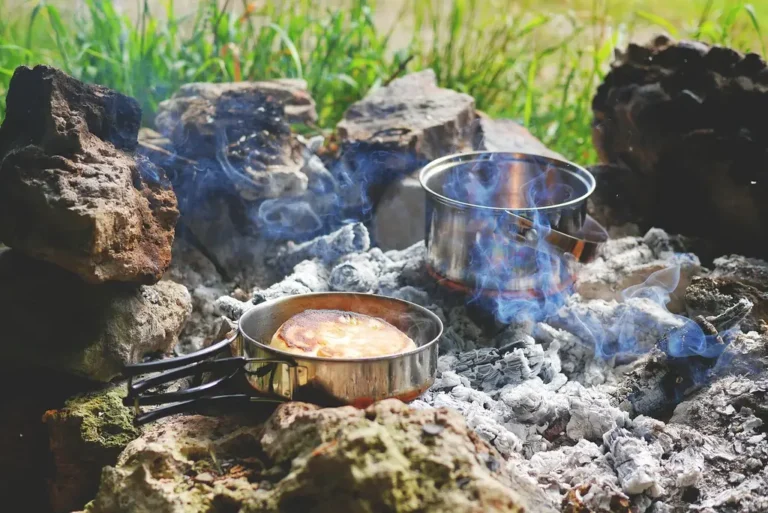
Direct flame changes the cookware math. Soot coats everything, hot spots get harsher, and handles see more heat. Many camp stove sets are poor choices over a fire because thin metal warps more easily and non-stick coatings have tighter care limits. Campfire cooking rewards plain materials and wider safety margins.
Why stainless often beats coated pans here
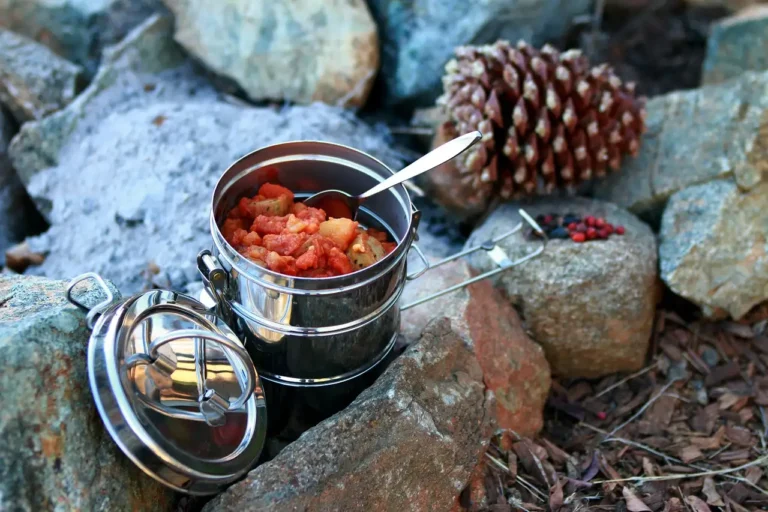
Stainless steel is a strong pick for families using fire rings and grate cooking because it resists rust, shrugs off rough washing, and tolerates abrasion better than many coated pans. The weight penalty is real, but families in cars, trailers, or RVs can usually afford it. Stainless also handles burnt sauce cleanup better than a damaged coating does.
For heavier fire cooking, add cast iron rather than forcing a thin nesting skillet to act like a griddle. Walmart’s camping cookware category includes an Ozark Trail 10.5 in pre-seasoned cast iron skillet and an Ozark Trail 5-Quart pre-seasoned cast iron Dutch oven. Those pieces make more sense for searing, baking, cobblers, and deep one-pot dinners over coals.
When to add a kettle or coffee pot
A camp kettle or coffee pot earns its spot when mornings involve cocoa, tea, pour-over coffee, instant oatmeal, or dishwater heating for several people. For family use, useful capacity usually starts where one boil can cover at least breakfast drinks for the group. For six or more campers, a dedicated water boiler keeps the main pot free for food and cuts breakfast bottlenecks.
What size camp cookware set do families really need?
Most families need more cooking volume than boxed sets suggest. For four campers, a common rule of thumb is to start with a 5- to 6-quart pot and a 10- to 12-inch skillet; for six, move to about a 6- to 8-quart pot; for eight, a modular setup is commonly used. Meal style matters as much as head count because pancakes and pasta demand wider, larger cookware than soup or boil-only meals.
Families of 4
A family camp set for 4 should cover realistic portions, not just four plates. The right baseline is one large pot for pasta, chili, soup, or rice; one skillet wide enough for four grilled sandwiches or a first round of pancakes; and four plates, four bowls, and four utensil sets. If breakfast is mostly oatmeal and dinner is boil-and-serve, the pan can be less central.
Families of 6
Six people expose weak cookware geometry fast. Rice, macaroni, and one-pot stews need more headroom than many “family” labels provide, and a small skillet slows breakfast. A 6- to 8-quart pot with a 12-inch skillet is a better fit, especially if older kids eat adult-size portions.
Families of 8 or mixed-age groups
At eight campers, boxed sets stop being the cleanest answer. Use a modular kitchen: one large main pot, one wide skillet, and either a second pan or Dutch oven. Serving ware should match the group count exactly so nobody borrows from the kitchen stack and leaves the cookware bag incomplete.
How meal style changes size needs
One-pot dinners need volume. Pancake breakfasts need surface area. Pasta needs pot depth and drain control. Rice punishes thin hot spots. Soup is forgiving. Skillet meals need broad, even heat. Boil-and-serve meals can get by with smaller kits, which is why a couples set may work for a family lunch yet fail at a full cooked dinner.
Should families choose stainless steel or aluminum cookware?
Choose stainless steel for rougher use, campfire tolerance, and longer-term washability; choose hard-anodized aluminum for lower weight, faster heating, and easier stove cooking. Families that cook mostly on a camp stove often prefer aluminum, while families that expect soot, scrubbing, and direct flame usually do better with stainless. Non-stick fits best as a targeted tool, not always as the whole kitchen.
Stainless steel: washability, weight, and fire tolerance
Stainless steel resists rust, takes abuse well, and is a sound match for families who pack wet gear, scrub hard, or cook over mixed heat sources. Many stainless components are dishwasher-safe when the maker says so, which is useful for RV travel. The tradeoff is weight, plus a higher chance of sticking if heat control and oiling are sloppy.
Burnt starch and scorched milk are still annoying on stainless, but the surface can usually take firmer cleanup methods than a coated pan can. Greasy sauces also come off more predictably after a soak.
Hard-anodized aluminum: heat control and packing weight
Hard-anodized aluminum is lighter than stainless, heats fast, and usually spreads burner heat more evenly from center to edge. That helps with pancakes, eggs, grilled sandwiches, and sauces on camp stoves that run hot in the center. Scratch resistance is better than plain soft aluminum, but the cooking surface still deserves gentler treatment than bare stainless.
Alocs Camping Cookware Set is a 9-piece hard-anodized aluminum set, which shows where this material often lands: compact, stove-friendly, and useful for lighter kits. For bigger families, though, the key question remains the same. Does the pot volume and pan diameter fit the meals?
Where non-stick fits in a family setup
Non-stick coating helps with food release and easy cleanup, especially for eggs, pancakes, and sticky starches. Its limits matter more in family use: higher wear risk with kid helpers, more care limits around utensils and high heat, and poorer fit for direct campfire cooking. A common compromise is one non-stick breakfast pan plus stainless pots.
How do I choose camp cookware for a family of four?
Start with heat source, then lock in cookware geometry before looking at piece count. A family of four usually needs a 5- to 6-quart pot, a 10- to 12-inch skillet, four bowls, four plates, and secure handles. After that, choose the material based on cleanup tolerance, trip style, and how likely the set is to see direct flame.
Start with heat source: stove, campfire, or RV
Camp stove trips reward hard-anodized aluminum and targeted non-stick because controlled burners favor quick heating and easier breakfast cooking. Campfire trips reward stainless and cast iron because flame, soot, and grate contact are hard on coatings. RV trips sit in the middle: fire tolerance matters less, storage shape and washability matter more.
Choose geometry before piece count
Do not let a high piece count hide a tiny pan. Four mugs and four bowls do not feed anyone if the skillet only fits two eggs at a time. Check pot volume, pan diameter, lid fit, and whether plates and bowls stack without stealing room from the actual cookware.
Match cleanup difficulty to your meal plan
If the plan is oatmeal, pasta, soup, and cocoa, almost any correctly sized set can work. If the plan is fried eggs, cheesy skillet dinners, creamy sauces, or rice, choose easier-release surfaces and more even heating. Burnt starch, stuck eggs, greasy sauces, and scorched milk are the failure cases that usually push families toward better cookware after one bad trip.
Check storage, nesting, and bag design
Nesting or stackable storage should keep the full kitchen together, not simply make a catalog photo look tidy. A good carrying bag or case controls lids, keeps utensils from escaping, and packs tightly enough that the set does not rattle apart in a tote. Piece containment is especially important when the family setup includes separate plates and bowls.
How to choose the right cookware material for family camping
The best cookware material depends on how your family cooks at camp: hard-anodized aluminum is usually the easiest all-around pick because it heats fast, stays light, and cleans up with less effort. The supporting guide on family camp cookware materials breaks down the main options so you can match the pan to the meal, whether that means quick breakfasts, one-pot dinners, or high-heat campfire cooking.
It also explains the practical tradeoffs that matter on a real trip, including weight, cleanup, durability, and kid-safe handling. That makes it easier to avoid overpacking heavy gear or choosing a material that creates hot spots, scratches easily, or takes too much scrubbing after dinner.
How do I pack camp cookware so it stays organized?
Pack cookware in a fixed nesting order with the largest pot outside, soft items separating hard surfaces, and small loose parts in one dedicated pouch. Families lose lids and utensils when every trip uses a different packing method. The goal is simple: each piece has one home, nothing rattles, and breakfast gear is reachable without unpacking the whole camp kitchen.
A simple nesting order that keeps lids and utensils contained
- Start with the main pot. Place the largest pot at the bottom of the system because it sets the shape for everything else. This is usually the piece you will need first for water, pasta, or soup.
- Pad the cooking surfaces. Put a towel, plate, or pan protector between nested pans and pots. That cuts rattle and helps protect non-stick or hard-anodized surfaces during transport.
- Stack serving ware inside. Nest bowls and plates by size, then set them inside the pot or storage case if the fit is secure. Do not let hard edges ride loose against coated pans.
- Bag the loose tools. Store utensils, handle grips, and small accessories in one zip pouch or the set’s internal sleeve. Loose spatulas and folding handles are usually the first parts to go missing.
- Cap with the lid. Put the lid on last so the whole stack becomes one unit. If the lid floats around in the bag, add a cloth wrap or shallow elastic strap to hold it flat.
How to stop rattling in transit
Use one soft barrier between every metal-on-metal contact point. Dish towels do double duty here because they also help with drying at camp. A travel bag or storage case should fit closely enough that parts cannot bounce; a loose oversized sack usually turns the set into a noise box by the first dirt road.
What should live outside the cookware bag?
Fuel, stove, soap, scrubbers, and sharp knives are usually better stored outside the cookware bag. Sooty cast iron should also ride separately unless it has its own wrap. Keep the cookware bag limited to the actual cooking and eating pieces so it stays predictable and easy to inventory before leaving camp.
How to choose
- Count real eaters. Include adults, older kids, and anyone likely to want seconds. Match that number to pot volume, pan diameter, and serving ware count before looking at brand names.
- Map your meal style. Write down two dinners and two breakfasts you actually plan to cook. If those meals include pancakes, pasta, rice, or sauces, move up in pot and pan size because those foods expose small cookware fast.
- Match the heat source. Choose stainless or cast iron for regular fire use, hard-anodized aluminum for stove-focused trips, and mixed systems for RV or base camp. Do not assume every nesting set belongs over direct flame.
- Set your cleanup tolerance. If fast washing matters more than maximum durability, favor easier-release surfaces for the pan. If rough use and scrubbing matter more, choose stainless and accept a little more sticking risk.
- Audit your storage space. Check trunk bins, camp kitchen boxes, or RV cabinets before buying. Foldable or locking handles, stackable bowls, and a fitted carrying bag matter more when storage is tight.
- Use budget last. Spend after the functional choices are settled. The cheapest set that is too small usually costs more later because you replace it or add the missing pot and skillet anyway.
Frequently asked questions
Is non stick camp cookware safe for family camping?
Yes, non-stick camp cookware is generally fine for family camping when used within the maker’s heat and utensil limits. It is best on camp stoves, where heat is easier to control. It is a weaker choice for direct flame, metal utensils, rough stacking, and kid-led cleanup that may scratch the coating.
What camp cookware is easiest for kids to help clean?
For kid helpers, the easiest setup is usually a hard-anodized aluminum or non-stick skillet paired with a stainless pot. That keeps eggs and pancakes from sticking hard while leaving the boiling pot tougher for rougher washing. Secure handles, simple lid fit, and fewer loose accessories also make cleanup calmer.
Can you use regular kitchen cookware for family camping?
Yes, but with limits. Regular kitchen cookware is often heavier, bulkier, and less convenient to pack, and long handles can be awkward on camp stoves. It also picks up soot fast near a fire. For car camping or RV trips, one trusted kitchen pot or skillet can still be a smart add-on.
How do I avoid food sticking in family camp cookware?
Preheat the pan moderately, add enough fat for the food, and avoid crowding cold ingredients into a small skillet. Rice and milk need gentler heat than many camp stoves suggest. For sticky foods, wider pans and more even-heating materials reduce hot spots, which is often the real reason sticking starts.
What is the best budget camp cookware set for families?
The best budget answer is often a low-cost kit used as a base, then improved with one larger pot or skillet. MalloMe is presented as budget-friendly, but budget buyers should still insist on family-ready geometry first: a 5- to 6-quart pot and a 10- to 12-inch skillet for four campers.