How to measure your torso and hips for a hiking backpack fit

Measure your torso from the C7 vertebra to the level of your iliac crest, then measure your hips at the iliac crest; match the backpack to torso length first, then check hip belt shape and length. If you skip those two measurements, a pack can ride too high, shift under load, or put weight on your shoulders instead of your hips. This guide shows how to measure both areas and use a fit-check sequence to tell whether the frame, shoulder system, or hip belt is the real problem.
What you’ll need
- A soft measuring tape made from cloth or vinyl
- A helper, especially for measuring down your back
- A pen and paper, or a phone note, to record numbers
- The backpack brand’s size chart for the exact model you want
How do you find the C7 vertebra?
Find the bony bump at the base of your neck with your head tilted forward. That bump is the C7 vertebra, and it is the top reference point for torso measurement. If you skip this landmark or guess by eye, the rest of the fit check starts from the wrong place.
Mark the top reference point
- Stand straight and tilt your head slightly forward.
- Run two fingers down the center of the neck until you feel the largest bony bump.
- Mark that point lightly with a washable pen if needed.
How do you measure torso length?
Measure from C7 to the level that lines up with the top of the iliac crest, keeping the tape close to the spine. Torso length is what most backpack size charts use, not height. A helper makes this easier and more accurate because the tape stays aligned while someone else reads the number.
Measure the back length
- Place the zero end of a soft measuring tape on C7.
- Follow the center line of the back down to the iliac crest level.
- Stop at the level that lines up with the top of the iliac crest, not the waistline.
- Record the number in inches or centimeters, depending on the chart.
Suppose the torso reads 19 inches. If the brand’s chart places that in a medium range, start there and keep the hip belt check in play. If the torso lands between two sizes, that does not automatically mean the larger pack is better; the shoulder system and hip belt still need to line up.
How do you find your iliac crest for backpack fitting?
Find the top ridge of the hip bone on both sides, then use that level as the lower reference point for torso measurement and the anchor point for the hip belt. The iliac crest sits above the waist in many people, so measuring at the belt line often gives the wrong fit.
Place the lower reference point
- Put your hands on your hips with thumbs pointing backward.
- Feel for the highest part of the hip bones.
- Trace that ridge around to the side so you know where the belt should sit.
Do I need to measure my hips for a backpack too?
Yes. Hip measurement matters because the hip belt must wrap the iliac crest area, and some packs size the belt separately from the torso. A torso match can still fail if the belt is too small to close comfortably or too large to anchor the load on the pelvis.
Measure for hip-belt sizing
- Wrap the soft tape around the body at the iliac crest level.
- Keep the tape level, not angled upward or downward.
- Measure snugly, not compressed, and record the number.
A common first-timer mistake is choosing a pack size from shirt size instead of checking both torso length and hip circumference. That can leave the pack frame in the right place but the belt too tight, or the opposite: a roomy belt that slips while the shoulder straps carry the load. Check both numbers before you choose a size family.
Torso and hip worksheet
Use this worksheet before you look at a pack size chart. It turns raw numbers into a fit decision and helps you spot whether the problem is the frame, the shoulder system, or the hip belt.
| Measurement | What to record | Why it matters |
|---|---|---|
| Torso length | C7 to iliac crest: ______ | Used to choose the backpack size first |
| Hip circumference at iliac crest | ______ | Used to check hip-belt size and closure |
| Pack model | ______ | Size ranges differ by model and by brand |
| Size chart result | Small / Medium / Large / Adjustable | Confirms the likely starting point |
| Mismatch pattern | Likely cause | Next fix to try |
|---|---|---|
| Torso fits, belt overlaps badly | Hip belt is the wrong size | Try a different hip-belt size or a different model line |
| Hip belt fits, shoulder straps start too low | Torso is too long for that pack size | Move to the next shorter torso setting if the pack has one |
| Torso is between sizes | Borderline harness length | Check an adjustable torso system first |
| Both torso and belt miss badly | Wrong pack line for your body shape | Try another line, then recheck the chart |
How do you test the fit after measuring?
Put on the loaded pack and check the hip belt first, then the shoulder straps, then the load lifters. A common fit check is that the hipbelt edge sits centered over the iliac crest, though exact placement can vary by brand and model, and the shoulder straps should start wrapping a short distance below the tops of the shoulders. Load lifters should angle roughly 30–45 degrees.
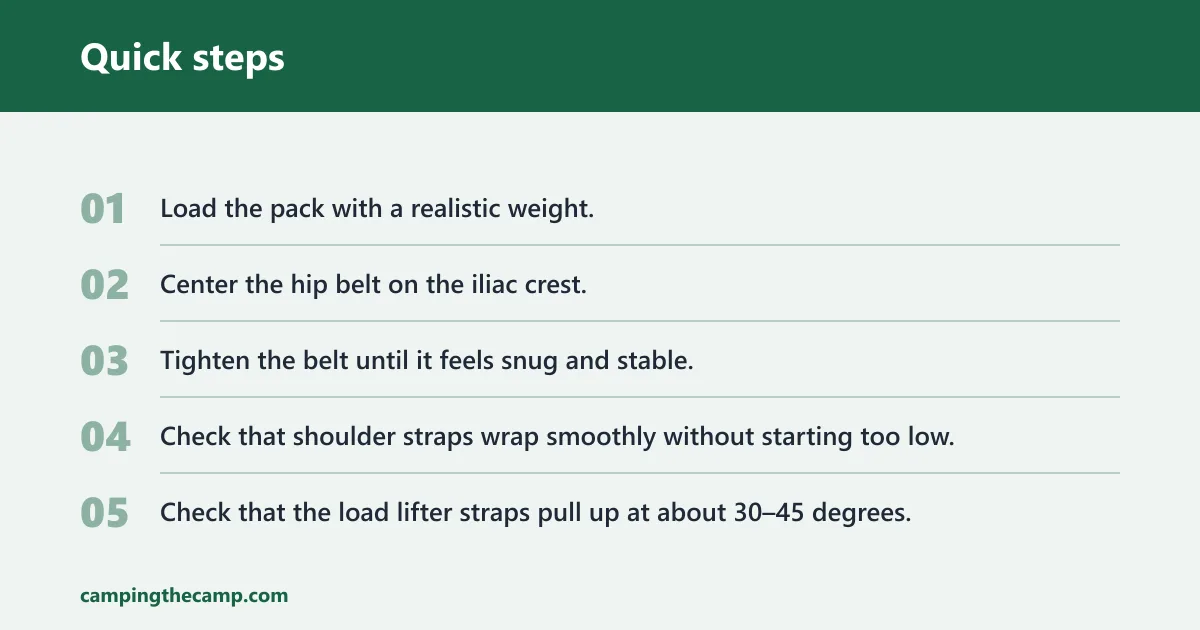
Use this fit-check sequence
- Load the pack with a realistic weight.
- Center the hip belt on the iliac crest.
- Tighten the belt until it feels snug and stable.
- Check that shoulder straps wrap smoothly without starting too low.
- Check that the load lifter straps pull up at about 30–45 degrees.
Picture a short day pack with a torso around 17 inches. If the belt sits correctly but the straps pull from low on the shoulders, the torso setting is probably too long. Suppose the torso fits but the belt cannot close over a roughly 38-inch hip measurement; the hip belt size is the mismatch, not the frame.
What if your measurements split sizes?
If your torso falls between two sizes, start with an adjustable torso system if the model has one. If the hip-belt size misses while the torso is correct, change belt size before changing pack size. If both keep failing, move to a different pack line because same-brand size families can fit differently.
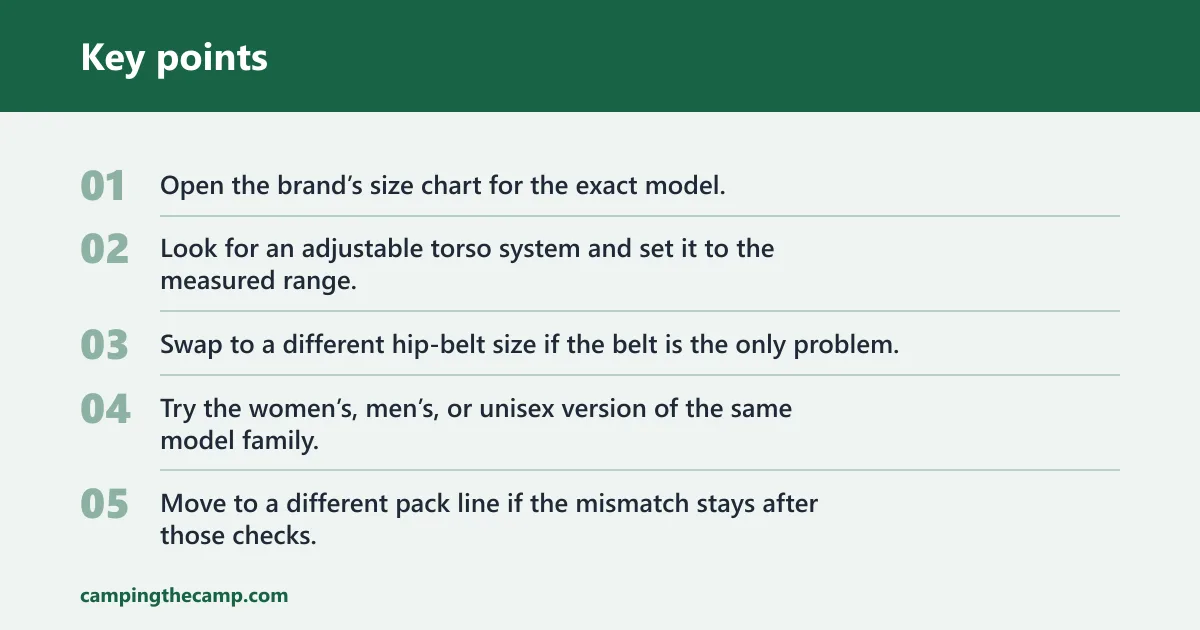
Try these fixes in order
- Open the brand’s size chart for the exact model.
- Look for an adjustable torso system and set it to the measured range.
- Swap to a different hip-belt size if the belt is the only problem.
- Try the women’s, men’s, or unisex version of the same model family, since cut and range can differ.
- Move to a different pack line if the mismatch stays after those checks.
Adjustable torso systems help most when the fit is borderline, but they do not fix every mismatch. A pack can still carry poorly if the hip belt is too small, the shoulder yoke starts in the wrong place, or the model’s size chart is built around a different body shape.
Common mistakes
The biggest errors are simple: measuring height instead of torso length, starting from the wrong neck point, skipping the hip measurement, and assuming the same size means the same fit across brands. Another common miss is ignoring women’s, men’s, and unisex chart differences within one brand family.
- Height instead of torso: use C7 to iliac crest, not overall height.
- Wrong neck landmark: start at the bony bump at the base of the neck.
- Waist instead of iliac crest: the hip belt rides on the hip bones, not on the narrowest waist point.
- One chart fits all: check the exact model’s chart every time.
- Skipping the loaded test: a pack that feels fine empty can change under weight.
Backpack size ranges are not universal. A brand-specific chart still matters when you choose a pack.
Frequently asked questions
How do I measure my torso for a hiking backpack?
Measure from the C7 vertebra to the level of the iliac crest with a soft tape, keeping it close to the spine. Record that number, then compare it to the exact model’s size chart. Torso length, not height, is the sizing number that matters most.
Where is the C7 vertebra on my neck?
It is the bony point at the base of the neck, easiest to feel when you tilt your head forward. That bump marks the top of the torso measurement. If you feel two small bumps, use the one that is most prominent at the base of the neck.
How do I find my iliac crest for backpack fitting?
Place your hands on your hips and feel for the highest ridge of the hip bones. That ridge is the iliac crest and is the lower end of the torso measurement. It is also where the hip belt should sit so the load transfers to the pelvis.
What if my torso measurement is between two backpack sizes?
Choose the adjustable torso option first if the pack has one. If not, fit both adjacent sizes with a loaded pack and check whether the hip belt sits correctly and the shoulder straps start in the right place. If only one size passes both checks, take that one.
Are backpack sizes the same across different brands?
No. Size charts vary by brand, by model, and sometimes by men’s, women’s, and unisex versions inside the same line. Check the chart for the exact pack, then test the loaded fit. A “medium” in one line can land differently in another.