

Is sleeping on an air mattress bad for your back or joints?

An air mattress is often fine for a night or two if it holds pressure and stays firm, but it is a poor choice if back pain worsens on soft sleep surfaces or the bed sags before morning. Too much sinkage can cause morning stiffness, numb arms or hips, and a broken night’s sleep. This guide separates back pain, joint pain, and deflation risk, then gives a simple go/no-go rule.
When support stops being enough
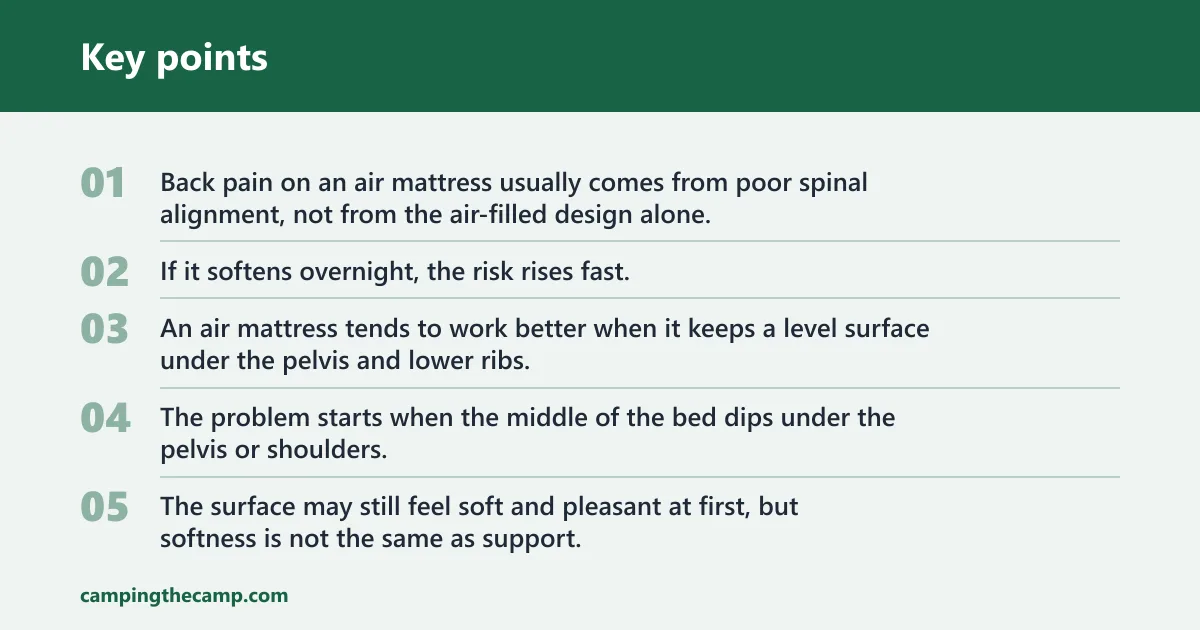
Not always. Back pain on an air mattress usually comes from poor spinal alignment, not from the air-filled design alone. If the surface stays firm enough to keep your lower back from sagging, many sleepers can use it for a short stay without trouble. If it softens overnight, the risk rises fast.
When support is usually good enough
An air mattress tends to work better when it keeps a level surface under the pelvis and lower ribs. Back sleepers often do best on a medium-firm setting, because the spine stays closer to neutral when the hips do not sink lower than the shoulders.
Body weight matters too. A lighter sleeper can often get by with less inflation loss before alignment changes, while a heavier sleeper can bottom out or create a hammock shape more easily.
When spinal alignment starts to slip
The problem starts when the middle of the bed dips under the pelvis or shoulders. That shifts the lower-back curve and can leave you waking up stiff even if bedtime felt fine. The surface may still feel soft and pleasant at first, but softness is not the same as support.
Stomach sleeping is the most likely position to strain the neck and lower back on an air mattress. Front sleeping can leave the neck in a crooked position all night, and it may raise the chance of long-term physical pain. Only about 10% of people sleep on their front, which is one reason that position gets less attention than side or back sleeping.
Why morning stiffness matters
Morning stiffness is a warning sign that the bed stopped supporting your spine well enough through the night. If the mattress feels acceptable at bedtime but your back feels tighter by morning, overnight deflation or poor firmness is often part of the problem. That pattern matters more than whether the bed felt soft in the evening.
Suppose a 180-pound back sleeper sets a queen air mattress to a medium-firm feel and wakes with mild stiffness after eight hours. If the same mattress feels noticeably lower at the center by morning, the issue is likely support loss, not just a “bad mattress” in the abstract.
Why an air mattress can cause joint pain
Joint pain on an air mattress is usually a pressure-point problem. The hips, shoulders, and knees can take more load when the surface is uneven or too soft, especially for side sleepers. That is different from back pain, which is more about spinal alignment and lumbar sag.
Hip and shoulder pressure points
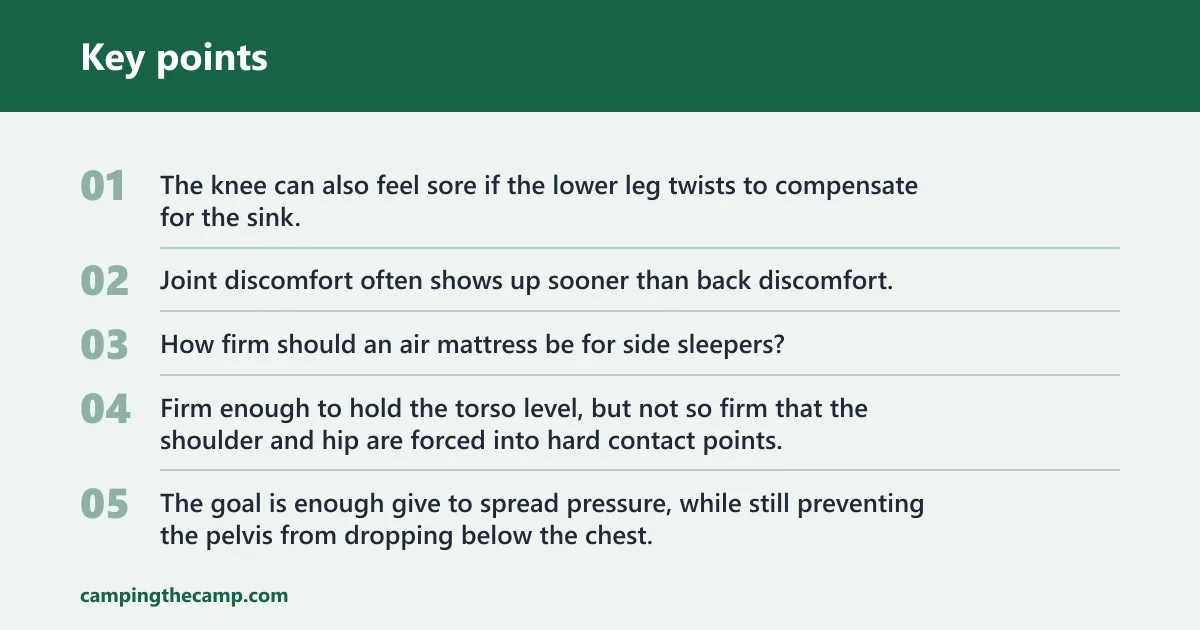
Side sleepers press more body weight into a smaller contact area, so the shoulder and hip can sink too far into a low-pressure bed. That can make the outer hip feel bruised or leave the shoulder numb by morning. The knee can also feel sore if the lower leg twists to compensate for the sink.
Joint discomfort often shows up sooner than back discomfort. A mattress that still feels “okay” to the spine can still irritate a hip or shoulder if the surface is too soft or uneven.
Side-sleep compression
How firm should an air mattress be for side sleepers? Firm enough to hold the torso level, but not so firm that the shoulder and hip are forced into hard contact points. The goal is enough give to spread pressure, while still preventing the pelvis from dropping below the chest.
A common first-timer mistake is adding a little air, lying down, and calling the bed done. After several minutes, the load settles and the surface often feels softer than it did at the start. That is when a side sleeper may need a small top-up.
Low inflation and uneven support
Low inflation makes the load distribution less even. Instead of the whole surface carrying your weight, the bed can form shallow troughs under the heaviest areas, which concentrates pressure at the hips and shoulders. That uneven support is a common reason for numbness or aching joints after a night on an air mattress.
Change position if numbness or tingling occurs. Persistent numb fingers or tingling toes are not something to ignore, because front sleeping and poor support can both contribute to those symptoms.
How overnight deflation changes comfort
An air mattress can feel fine at bedtime and painful by morning because air loss changes the shape of the support layer through the night. Even a small pressure drop can alter spinal alignment, deepen pressure points, and make the bed feel much firmer in some spots and softer in others.
Why it feels fine at bedtime
Freshly inflated beds often feel better before body heat, body weight, and room temperature changes have time to act on the material. A manual pump or electric pump can get the bed close to the right firmness, but the final feel under a sleeping body is what matters. That is why a bed can pass the bedtime check and still fail by dawn.
What changes by morning
By morning, a sagging center can pull the pelvis into flexion and leave the back stiff. Side sleepers may wake with sore shoulders or hips if the mattress softened enough to shift pressure onto one point. That is the main overnight deflation risk: the bed changes shape while you are asleep.
How material type affects air loss and fatigue
Material matters. Air mattresses are inflatable and usually made of plastic, textile-reinforced plastic, or rubber. Better quality air mattresses are constructed of fabric instead of sheet vinyl, while vinyl air beds are described as unsuitable for everyday use. Textile-reinforced construction tends to resist fatigue better than thin PVC or vinyl over time.
Premium models may use latex rubber air chambers, and permanent air beds can be designed to replace a conventional mattress or waterbed. That is a different category from a cheap guest bed or a lightweight camping pad.
Sleeping decision table
Use this table to match sleep position, body weight, inflation level, and trip length with the most likely discomfort risk and the simplest fix. It is meant to help you decide whether an air mattress is acceptable for the night or whether you should switch to a sleeping pad or a different bed setup.
| Sleep position | Body weight range | Inflation level | Intended use length | Likely discomfort risk | Best setup fix |
|---|---|---|---|---|---|
| Back sleeping | Under 160 lb | Medium-firm | 1 to 2 nights | Low to moderate back stiffness if the center softens overnight | Add a small amount of air before sleep; use a pillow under the knees if the lower back arches. |
| Back sleeping | 160 to 230 lb | Firm | 1 night | Moderate lumbar sag risk if the bed is underinflated | Inflate until the hips stay level with the rib cage; recheck after 10 to 15 minutes. |
| Side sleeping | Under 160 lb | Medium | 1 to 2 nights | Moderate shoulder and hip pressure | Increase firmness slightly and add a pillow between the knees to reduce twisting. |
| Side sleeping | 160 to 230 lb | Firm | One night only | High pressure-point risk if the mattress dips under the shoulder or hip | Choose a thicker mattress or a camping sleeping pad with foam insulation if packability matters more than guest-bed comfort. |
| Side sleeping | Over 230 lb | Any setting that still sinks visibly | 1 night or longer | High risk of joint pain and uneven support | Use a more supportive bed setup or a permanent air bed designed for everyday use. |
| Front sleeping | Any weight | Medium-firm to firm | 1 night | Neck twist, low-back strain, and possible tingling | Use a flatter, firmer setup and a thin pillow, or switch positions if the neck feels crooked. |
| Any position | Any weight | Starts firm, then softens by morning | Multiple nights | High pain risk from overnight deflation | Top off the bed before sleep and again in the morning; if it keeps losing air, stop using it as the main bed. |
What makes an air mattress more comfortable?
Comfort depends on firmness, body type, and whether the mattress keeps its shape through the night. For short-term use, the best setup usually combines the right inflation level, a stable pump system, and some extra support from pillows or bedding.
Firmness settings and inflation systems
Air mattresses may be inflated orally, by manual foot pump, or with an electric pump. Some include a firmness controller, which makes repeatable setup easier. A reliable inflation system matters because the bed that feels correct at bedtime should still feel close to that setting after the first hour of sleep.
-
Inflate in stages.
Pump the bed to about three-quarters full first, then add air in small bursts while someone lies on it or while you test it in your usual sleep position. This helps you avoid overinflation, which can feel hard and unstable under real body weight. -
Check the hips and shoulders.
Press your hand under the lower back, hip, and shoulder area. If the mattress swallows those points instead of supporting them, add air until the spine sits closer to neutral and the joints stop sinking unevenly. -
Recheck after settling.
Wait about 10 to 15 minutes, then adjust again. Air shifts, seams stretch, and the final feel often changes after the first round of loading.
Pillows, bedding, and body support
A pillow under the knees can reduce lower-back tension for back sleepers. Side sleepers often do better with a pillow between the knees to keep the pelvis from rotating. A thin topper or folded blanket can also soften a pressure point, but it should not replace real support from the mattress itself.
If the bed feels too firm at the shoulders, a thin bedding layer can reduce direct pressure without letting the hips sink too far. That matters more for temporary guest use than for long-term sleep.
Temporary use versus everyday use
Air mattresses are usually better for temporary use than for long-term everyday sleep. Vinyl air beds are described as unsuitable for everyday use, while permanent air beds can be designed to replace a conventional mattress or waterbed. That difference is important: a guest bed can be fine for a short stay, but a daily bed needs durable, repeatable support.
As a simple rule, an air mattress is acceptable if it stays firm all night, matches your sleep position, and does not trigger morning stiffness or joint pressure. It is a poor choice if you already have chronic back issues, arthritis, or recurring numbness, because those conditions make poor support more likely to show up fast.
Sleeping pad vs air mattress
A sleeping pad is a camping-focused insulation layer that is lighter and more packable than a full air mattress. Many versions add foam insulation under the air chambers, which helps with cold ground and backpacking use. A full air mattress usually gives more guest-bed comfort, while a pad is built more for portability.
| Feature | Sleeping pad | Air mattress |
|---|---|---|
| Support | Moderate support for camping sleep; often firmer and narrower | Better surface area and more cushioned feel for guest-bed use |
| Insulation | Often includes foam insulation and is built for cold ground | May insulate less unless designed for camping use |
| Packability | Smaller, lighter, and easier to carry | Bigger and bulkier, though it can still be rolled up or folded |
| Long-term comfort | Good for backpacking and short trips, not a full bedroom replacement | Better for temporary guest sleep or larger setups; less suited to everyday use unless built as a permanent air bed |
If you need packability and ground insulation, start with the sleeping pad. If you need a guest-room surface for a night or two, an air mattress is usually the better match. For daily use, neither is ideal unless the air bed is built for that purpose and stays stable under your weight.
Frequently asked questions
Is sleeping on an air mattress bad for your back?
It can be, but only when the bed lets your lower back sag or changes shape overnight. If the mattress stays firm enough to keep your spine aligned, short-term use is often fine. Morning stiffness is the clearest sign that support was not enough for your body or sleep position.
Can an air mattress cause joint pain?
Yes. Joint pain usually comes from pressure points at the hips, shoulders, or knees, especially for side sleepers. Low inflation makes those pressure points worse because the body sinks unevenly. A firmer setup and a knee pillow can help, but repeated numbness means the bed is not a good fit.
How long can you sleep on an air mattress before it hurts?
Some people can handle one or two nights with no problem, while others feel soreness after a single night if the bed is soft or deflates. The more nights you use it, the more important pressure retention becomes. If the mattress softens by morning, pain is more likely after the first night.
What makes an air mattress more comfortable for back pain?
Firmness that keeps the pelvis from sinking too far is the biggest factor. A good inflation system helps you return to the same setting each night, and a pillow under the knees can reduce lumbar strain. For repeated use, a fabric-covered or textile-reinforced bed is usually a better choice than thin vinyl.
How firm should an air mattress be for side sleepers?
Firm enough to keep the torso level, but not so firm that the shoulder and hip are forced into hard contact. If the bed sinks at those points, add air in small amounts. Side sleepers often need a little more firmness than they expect, because too-soft support is what drives joint pain.
Is an air mattress okay for everyday use?
Usually not unless it is a permanent air bed designed for that purpose. Vinyl air beds are described as unsuitable for everyday use, and ordinary guest beds tend to lose support too quickly for nightly sleep. If you need daily comfort, choose a conventional mattress or a purpose-built permanent air bed.