Symptoms of poor sleep from using the wrong sleeping bag

If you wake cold, sweaty, sore, or restless in a sleeping bag, the usual cause is a mismatch in warmth, fit, or shape; If two of those show up together, it is usually worth fixing the fit before buying a warmer bag. Miss the pattern, and you usually get more broken sleep, more turning, and a bag that still feels wrong. This guide links each symptom to the most likely sleeping bag issue so you can narrow the cause fast.
Why your sleeping bag may be the problem
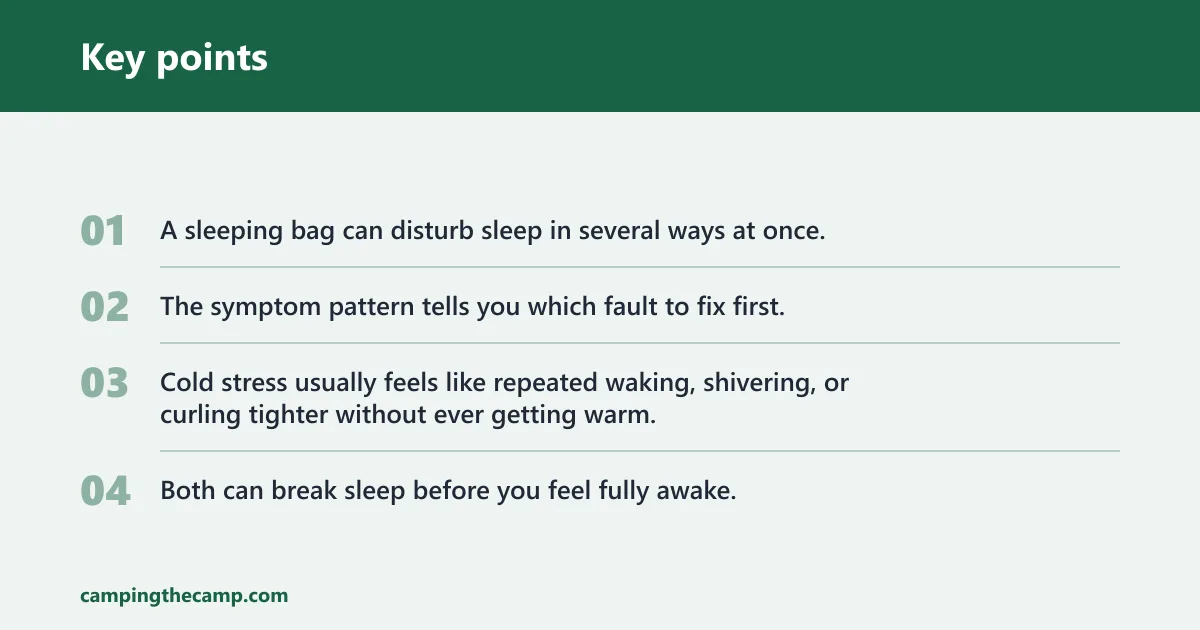
A sleeping bag can disturb sleep in several ways at once. Cold stress wakes you from below or through drafts, overheating brings on sweating and restless turning, and a tight fit creates pressure points that show up as sore shoulders, hips, or numb legs. The symptom pattern tells you which fault to fix first.
Cold stress, overheating, and restlessness
Cold stress usually feels like repeated waking, shivering, or curling tighter without ever getting warm. Overheating tends to feel like sweating, damp base layers, a hot chest or back, and a half-awake urge to unzip, kick a leg out, or keep rolling over. Both can break sleep before you feel fully awake.
Pressure points, cramped posture, and waking sore
Side sleepers often notice a different pattern: sore shoulders, compressed hips, cramped knees, or toe pressure at the footbox. That usually points to too little width, too little length, or a bag shape that makes you stack knees and roll your shoulders against resistance.
Symptoms-to-cause checklist
Use the pattern first, then change one feature at a time. If the symptom comes from below, the sleeping pad may be the real weak link. If the symptom sits on one side of the body, fit and shape matter more than a higher temperature rating.
| Symptom | Likely cause | How to test it on the next trip | Feature to change first |
|---|---|---|---|
| Waking cold on the back, hips, or shoulders | Bag too cold for the night, or pad too cold from below | Compare warmth after about one night on the same bag with a higher-R-value pad or a warmer shelter floor. | Sleeping pad R-value |
| Sweating, kicking off covers, then waking chilled | Bag too warm, poor venting, or too much layering | Zip down the bag before sleep and keep one leg outside for 10 to 15 minutes to see whether heat builds quickly | Ventilation features |
| Sore shoulders after side sleeping | Narrow cut or tight shoulder girth | Lie on your side and check whether the top shoulder presses into the shell or the insulation is compressed flat | Shoulder width |
| Numb hips or knees | Too little hip room, knee stack pressure, or side-sleeper cut too narrow | Roll from one side to the other and notice whether the bag pulls tight across the hips | Hip room |
| Toe pressure or cramped feet | Bag too short or footbox too shallow | Point and flex your feet inside the bag; toes should move without pushing hard into insulation | Bag length |
| Drafts around the neck or hood | Hood, collar, or zipper sealing poorly | Sleep with the hood adjusted, then repeat with the collar closed and note whether wakeups drop | Hood adjustability |
| Musty dampness or clammy insulation by morning | Moisture buildup, often worse in down bags with limited venting | Dry the bag fully after the trip and compare whether the next night feels warmer and less clammy | Insulation type |
Can the wrong sleeping bag cause poor sleep?
Yes. The wrong sleeping bag can cause poor sleep through cold stress, overheating, pressure points, restricted movement, moisture buildup, or a poor match between your body and the bag’s shape. If the bag is off in more than one way, you may wake often even when the temperature rating looks close enough on paper.
When the bag is too cold
A bag that is too cold usually causes repeated waking, clenched muscles, and a need to curl tighter or add clothing. If you keep waking with cold shoulders, cold hips, or cold from below, the issue may be insulation, fit, or the sleeping pad rather than the bag label alone.
Temperature ratings need careful reading. Most manufacturers list a comfort rating and a lower-limit rating; the comfort number is generally the better target for steady sleep, while the lower-limit number is usually closer to survival comfort for a warmer sleeper. Body size, sex-linked heat differences, and personal cold tolerance all change the result.
When the bag is too warm
A bag that is too warm can also ruin sleep. Sweating, damp base layers, a hot back, and restless turning are common signs. If you vent the bag and still feel overheated, the problem may be excessive insulation for the season, poor airflow at the hood or zipper, or too much added clothing.
When the fit is wrong for side sleeping
Side sleepers need room for shoulder roll, knee bend, and hip rotation. When the bag is narrow through the shoulders or legs, you can feel compressed even if the temperature is fine. That compression can cause numbness, sore joints, and the sense that you cannot settle into one position.
Why do side sleepers wake up sore?
Side sleepers wake up sore when the bag forces the body into a tighter shape than it wants to hold all night. The most common causes are shoulder compression, hip pressure, limited room for bent knees, and a length that pushes toes into the footbox or shifts the hood out of place.
Shoulder compression and hip pressure
A narrow mummy cut can be efficient, but it can also press the top shoulder forward and flatten insulation at the hip. That pressure is felt as soreness in the shoulder joint, the outside hip, or both. If the bag feels fine flat on your back but tight on your side, shape is likely the issue.
Knee bend, roll space, and dead-air gaps
Side sleepers usually need room to bend the top knee and roll the upper shoulder. A semi-rectangular bag or widened side-sleeper cut often handles that better than a standard narrow mummy. If the bag is roomy enough to avoid pressure but too roomy overall, dead air can form and make you feel colder.
How bag length changes toe pressure and hood position
Regular versus long length matters more than many buyers expect. Too short, and toes press into the footbox or the hood sits awkwardly on the face and neck. Too long, and extra space near the feet can trap more dead air, which may slow warm-up unless you have enough insulation and good pad support.
Say a 5’10” sleeper uses a regular-length mummy bag that fits in the shoulders but feels fine only until the knees bend. If the toes brush the end when the legs straighten, the next symptom is often a cold or sore forefoot rather than a simple “needs a warmer bag” problem.
Temperature rating and real-world warmth
Temperature ratings help, but they do not predict sleep on their own. The comfort rating is usually the better target for actual sleeping comfort, while the lower-limit rating is a harder edge that many sleepers will find cold, especially in wind, on a thin pad, or after a long day that leaves you less heat tolerant.
Comfort rating vs lower-limit rating
For most campers, the comfort rating is the number to match against expected overnight lows. If the forecast low sits close to the lower-limit number, a side sleeper with average cold tolerance may still wake cold. Smaller bodies often lose heat faster, while larger bodies and naturally warmer sleepers may feel fine a few degrees lower.
Matching the rating to overnight lows
A common rule of thumb is to choose a bag whose comfort rating is at or below the coldest expected low for the trip, then account for ground insulation and wind exposure. If conditions are damp or exposed, give yourself more margin. Seasonal use matters too: a summer bag that works in mild mountain nights may fail in shoulder season.
Why body size and heat tolerance change the result
Heat retention changes with body size, metabolic heat, age, and how still you sleep. A smaller or colder sleeper often needs more margin between expected low and bag rating than a larger or warmer sleeper. That is why two people can use the same bag and report opposite results.
Shape and fit for side sleepers
Shape sets how well the bag follows your sleeping posture. Mummy bags are usually warmer and more efficient because they reduce dead air, but they also give less room for shoulder roll and bent knees. Rectangular and semi-rectangular bags give more movement space, though they often need more heat to feel equally warm.
Mummy, rectangular, and semi-rectangular bags
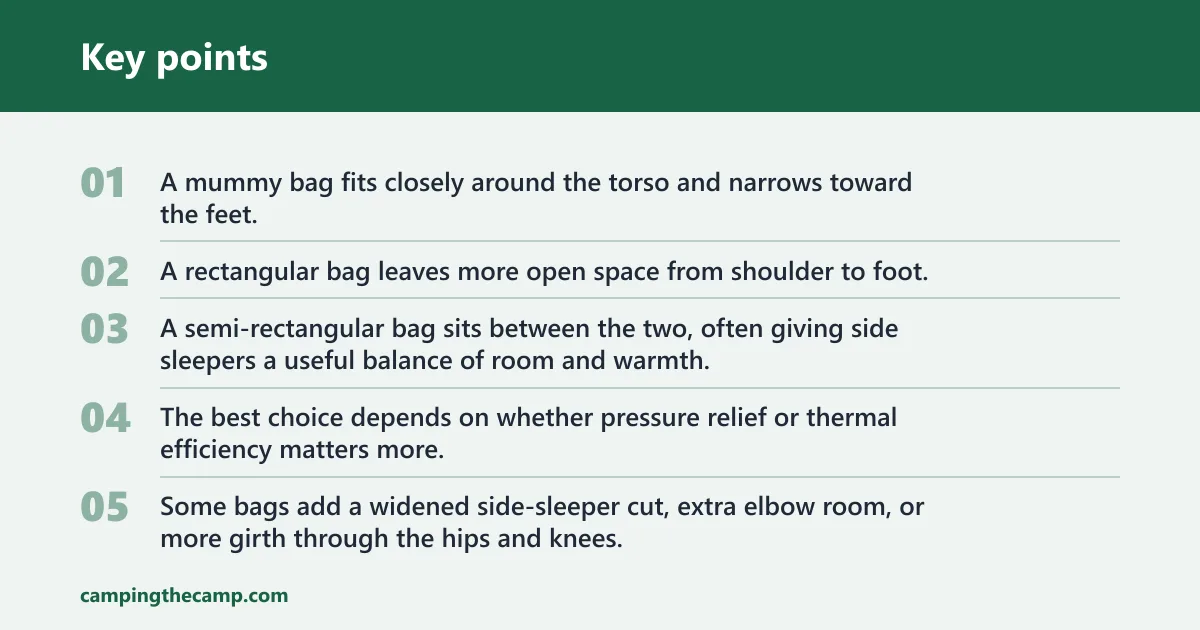
A mummy bag fits closely around the torso and narrows toward the feet. A rectangular bag leaves more open space from shoulder to foot. A semi-rectangular bag sits between the two, often giving side sleepers a useful balance of room and warmth. The best choice depends on whether pressure relief or thermal efficiency matters more.
Widened cuts and room for knee bend
Some bags add a widened side-sleeper cut, extra elbow room, or more girth through the hips and knees. Those features help when you need to bend the top knee without twisting the whole bag. They also reduce the chance that your shoulders and hips compress the insulation flat.
Shoulder width, hip room, and leg room
Check the spec sheet for shoulder girth, hip girth, and length, not just temperature rating. A bag can be long enough and still feel tight in the hips. Compression hotspots matter because crushed insulation loses warmth, while dead air from excess room can make you feel chilled if the pad and bag are not matched well.
Suppose a sleeper switches from a narrow mummy to a semi-rectangular bag and keeps the same pad. If the shoulder soreness drops but the feet still feel cold, the fit improved, but the remaining issue is likely at the pad or footbox rather than the whole bag being too cold.
Sleeping pad warmth and ventilation
A sleeping pad can mimic a bad sleeping bag. Cold-from-below symptoms often feel like a weak bag even when the bag itself is fine. Ventilation also matters because a bag that cannot dump heat well can leave you sweaty, then chilled, by dawn.
How pad R-value affects cold-from-below symptoms
Pad R-value measures resistance to heat loss through the ground. If you wake with cold hips, a cold back, or a chill that improves when you turn over but comes back after a few minutes, the pad is worth suspecting. For colder conditions, many sleepers need a higher-R-value pad than they expect, because the bag cannot fully offset ground loss.
Ventilation features that change sleep quality
Full-length zippers, two-way zippers, draft collars, hood adjustability, and footbox venting all change how easy it is to manage heat. A two-way zipper lets you open the lower half while keeping the chest covered. A draft collar helps hold warmth when temperatures drop. Footbox venting matters when your feet overheat first.
When moisture or overheating points to the pad, not the bag
If the top of the bag feels fine but the underside feels damp or cold, the pad may be the main issue. If you sweat after zipping up but cool off fast when you open the bag, the bag may be warm enough but too closed-in for your sleep style. Moisture buildup also happens when warm air cannot escape and condenses inside the bag.
Layering and small fixes before you replace the bag
Layering can help, but it is not a cure for the wrong bag. Base layers, sock choice, and a light extra insulation piece can smooth out small mismatches. If you add too much, though, you can trap moisture and make overheating worse.
Base layers and sock choice
Start with dry, breathable base layers that do not bunch under pressure points. Thin sleeping socks often work better than thick socks because they warm the feet without compressing circulation. If your feet overheat first, go lighter rather than piling on insulation.
- Check the symptom pattern. Note whether you wake cold, sweaty, sore, or restless, and where the problem shows up. That tells you whether to look first at warmth, fit, shape, or the pad.
- Inspect the tight spots. While lying on your side, check shoulder width, hip room, toe space, and whether the hood pulls when you roll. Any point of pressure is a sign the bag is too narrow or too short in that area.
- Adjust one variable. Change only one thing on the next night, such as the pad R-value, zipper position, or base layer weight. A single change makes the result easier to read.
- Use venting before adding warmth. If you are hot, open the two-way zipper, loosen the hood, or vent the footbox before adding more clothing. If you are cold, close draft points before assuming the whole bag is too light.
- Replace the weak link. If fit symptoms stay after venting and layering changes, move to a better shape or size. If cold-from-below symptoms stay, raise pad R-value before buying a warmer bag.
Adding or removing insulation
Extra insulation should fill a small gap, not solve a major mismatch. A light midlayer or liner can help on a marginal night, and a blanket over the top can reduce drafts at the shoulders. If you need thick layers every night, the bag rating or shape is probably wrong for your use.
When layering backfires
Layering backfires when it traps sweat, limits movement, or makes the bag tighter. That can turn a fit problem into a heat problem. A side sleeper who already feels squeezed may sleep worse with more clothing because the bag loses loft where pressure is highest.
Frequently asked questions
Why do I wake up sore after sleeping in a sleeping bag?
Soreness usually points to compression at the shoulders, hips, knees, or toes. Side sleepers are more likely to feel this because the body twists more inside the bag. A bag with more shoulder room, hip room, or a wider side-sleeper cut often helps more than simply choosing a warmer rating.
What sleeping bag issues make side sleeping uncomfortable?
Side sleeping gets uncomfortable when the bag is too narrow, too short, or shaped to favor back sleeping. Tight shoulders, cramped knees, and a footbox that presses on the toes are common signs. A semi-rectangular or widened cut often works better than a snug mummy for this sleep position.
How do I know if my sleeping bag is too tight?
If you feel compression at the shoulders, hips, or feet, the bag is too tight for your body or sleep position. Another sign is that the insulation looks flattened where you lie on it. If you cannot bend your knees or roll your shoulders without resistance, the fit is too restrictive.
Can a sleeping bag make you feel cold at night even if it’s warm enough?
Yes. A bag can feel cold even when the rating seems warm enough if the pad is too cold, the fit leaves too much dead air, or drafts leak through the hood or zipper. Moisture buildup can also make you feel chilled later in the night, especially after sweating early on.
Can lack of sleep be caused by overheating in a sleeping bag?
Yes. Overheating often causes restlessness, frequent waking, sweat, and the urge to keep adjusting the zipper or hood. If you cool off only after opening the bag, the issue is likely venting or insulation level, not just a need for a different season rating.