Camp stove vs backpacking stove: Key differences

A camp stove is a common choice for car camping, groups of 3+, or pan-and-pot meals; a backpacking stove is a common choice when every carried ounce matters and you mostly boil water or cook simple one-pot food. Pick wrong, and you carry extra bulk or end up with weak heat control, shaky pot support, and a fuel setup that takes more space and effort than the trip allows. This guide compares the full cooking system, stove, fuel, cookware, wind performance, and total packed weight, so you can match the stove to trip length, group size, and meal style.
| Decision factor | Camp stove | backpacking stove | Winner |
|---|---|---|---|
| Best fit trip style | Car camping, base camping, walk-in sites, repeated meals | Carry-in trips, hiking, low-bulk overnights | tie |
| Cookware support and stability | Wide burner spacing and broader pot supports handle larger pots and frying pans better | Smaller supports favor compact pots; tall pots and wide pans are less stable on many models | Camp stove |
| Flame spread for simmering and frying | Usually broader flame pattern, better for pancakes, eggs, sauces, and larger pan bottoms | Often concentrated flame, excellent for boiling but more likely to create hot spots in wide pans | Camp stove |
| Wind performance | Can lose efficiency in exposed camps unless the built-in wind guards are effective and the cookware shields the burner well | Integrated and some remote-canister systems often do better for fast boils in wind with narrow heat exchangers and sheltered burners | backpacking stove |
| Total carried system weight | Stove, propane cylinder, and larger cookware add up quickly | Stove body, small canister, and compact pot usually stay much lighter for one or two people | backpacking stove |
| Group cooking speed | Two burners, bigger pots, and more counter-like workspace help feed several people faster | Single-burner systems slow down multi-dish meals and larger batches | Camp stove |
| Fuel convenience and availability | 1 lb propane cylinders are common at big-box and camp stores; larger tanks work well at established camps | Screw-on isobutane-propane canisters are common outdoors-store items; liquid fuel helps in remote or cold trips | tie |
Camp stove vs backpacking stove at a glance
The real trade-off is meal capability versus total carried system weight. A camp stove earns its space when you need two burners, steadier support for pots and skillets, and repeated meals for several people. A backpacking stove wins when stove, fuel, and cookware all have to fit in your pack and still leave room for the rest of your gear.
Why the stove body alone is the wrong comparison
A stove body rarely works by itself. Fuel choice changes packed weight, cold-weather output, and refill options. Cookware matters too, because a burner that struggles with a 10-inch skillet may work perfectly with a 1-liter pot.
That is why a tiny burner does not always mean a light cooking setup, and a heavy stove does not always mean wasted weight at camp. The useful unit is the whole system: stove, fuel, pot or pan, and the conditions you expect.
Cookware support and stability
This row goes to Camp stove because burner spacing and support width matter once meals move past boiling water. A broad grate holds larger pots, spreads weight better, and cuts tip risk on uneven picnic tables.
Flame spread and pan performance
This row also goes to Camp stove. Higher BTU figures can look impressive, but a narrow flame under a wide skillet often scorches the center while the edges stay pale.
Wind behavior
Wind often changes the comparison faster than shoppers expect. A wide camp-stove burner under a large pan can bleed heat quickly in open sites, while an integrated backpacking system with a sheltered burner, tight pot fit, and heat-exchanger pot can boil faster using less fuel in the same gusts.
Total carried system weight
This row goes to backpacking stove because fuel and cookware usually widen the gap, not shrink it. Once a propane cylinder and larger pan are added, the difference is measured in pounds rather than ounces.
Group cooking speed
Camp stove wins here because meal timing matters. Two burners let you simmer oatmeal while frying eggs, or boil pasta while heating sauce, instead of running one pot after another.
Which stove is lighter for your trip?
The supporting guide answers the simplest version of the decision: a backpacking stove is usually the lighter choice, often by a wide margin. It breaks down the real numbers behind bare stove weight and total system weight, so you can see how fuel and setup change the picture before you pack.
That matters because “lighter” is not just about the burner in your hand. The article compares typical weight ranges and explains when a camp stove’s extra bulk may be worth it, helping you choose the right option for route length, group size, and how much weight you want to carry. camp stove weight comparison
What is the difference between a camp stove and a backpacking stove?
A camp stove is built around wider burners, larger pot supports, and low-bulk transport by car, while a backpacking stove is built around compact size, low pack weight, and simple cookware. The real difference is not category labels. It is burner layout, pan stability, fuel format, and the kind of meals each system handles well.
Stove layout and burner design
Most camp stove setups use one or two burners on a broad base. That gives you space for a frying pan, a kettle, or a larger stockpot, and it keeps the center of gravity lower.
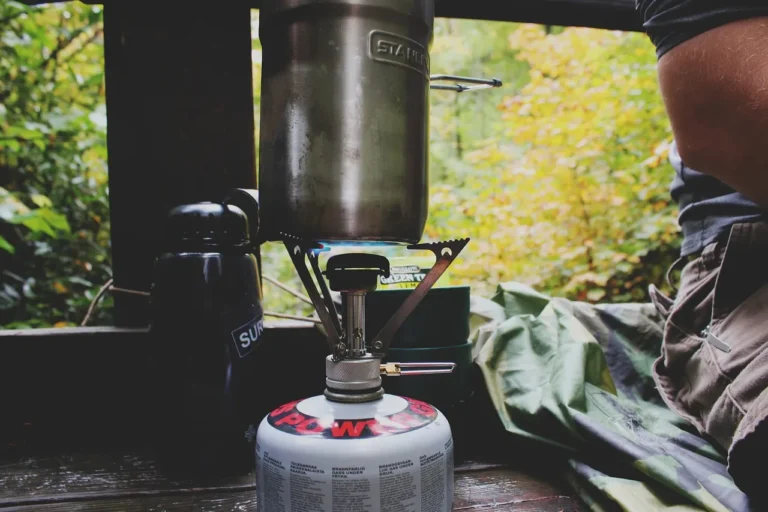
Most backpacking stove setups use a single burner. Upright canister models screw directly onto a fuel canister, remote-canister models place the burner on folding legs with a hose to the canister, and integrated systems pair one burner with one matched pot.
Cookware support and pan stability
Cookware stability is one of the biggest practical differences. A 2-quart pot usually sits comfortably on a camp stove grate, but that same pot can feel top-heavy on a small upright burner, especially if the ground is uneven.
Picture a 10-inch skillet on a narrow upright burner at a breezy overlook. The center of the pan gets the strongest heat, the handle pulls the whole setup to one side, and stirring raises the tip risk. That is a system problem, not a simple power problem.
Where each category fits
Camp stove fits drive-up campsites, family campgrounds, and trips where you want to cook eggs in a skillet, run two pots at once, or make several meals a day without fighting for burner space. Backpacking stove fits carry-in travel, ounce-conscious weekends, and simple meals where a compact pot and quick boil are enough.
How do weight and packed size really compare?
The meaningful comparison is total system weight, not just the stove body. A backpacking stove usually stays lighter for one or two people because it pairs with smaller fuel canisters and smaller pots, while a camp stove gains weight from the stove itself, propane, and bulkier cookware.
Stove weight versus total system weight
Many two-burner propane camp stoves listed by manufacturers weigh roughly 10 to 13 pounds before fuel. Many upright canister backpacking stoves weigh only a few ounces, and remote-canister models often stay under a pound.
That sounds decisive until cooking style enters the picture. If two people need only hot drinks and freeze-dried meals, the lightweight option keeps its edge. If four people need breakfast and dinner from pots and pans, the heavier stove may cut enough hassle to be the better pick.
Fuel weight over short and longer trips
Fuel weight does not scale the same way. Small screw-on backpacking canisters are commonly sold with 100-gram, 230-gram, or 450-gram fuel contents, while camp stoves often run from 1-pound propane cylinders or larger refillable tanks.
A full 1-pound propane cylinder weighs about 2 pounds overall once the steel bottle is included. That is easy to ignore in a trunk and hard to justify in a pack.
Cookware penalties
Bigger burners often lead to bigger cookware. That helps when feeding a group, but it adds bulk fast. A 10-inch skillet and a 3-quart pot can outweigh an entire solo backpacking cook kit.
Suppose two campers compare only stove bodies and see a 3-ounce upright burner against an 11-pound two-burner camp unit. If the lighter setup then needs a second pot, a larger canister, and careful batch cooking for every meal, the stove still weighs less, but the whole system may no longer fit the trip.
How do they cook differently?
Camp stove and backpacking stove can both boil water, but they cook differently because burner shape, pot support, and available burner space change the results. Camp stove usually handles frying, simmering, and multi-pot meals better. Backpacking stove usually handles quick boils with less carried weight and less packed volume.
Boil time, burner output, and why BTU is incomplete
BTU is common on camp stoves, but it does not settle the comparison. Burner output helps only when the pot can absorb that heat and the wind does not strip it away.
Boil time depends on several linked parts: burner output, pot diameter, pot material, lid use, starting water temperature, wind, and fuel condition. A higher BTU camp burner can still boil slower than an integrated backpacking system if the larger setup sheds more heat to moving air.
Flame spread, pot diameter, and real cooking
For real cooking, flame spread matters as much as raw output. A broader burner head tends to heat more of a skillet bottom, which helps with pancakes, fish, or sauces that need a gentle simmer.
Many upright backpacking burners concentrate heat in a small circle. That is efficient with a narrow pot, but wide pans can develop a hot center and cooler edges. Remote-canister and liquid-fuel backpacking models with wider burner heads usually do better here than tiny upright burners.
Group cooking and meal timing
Camp stove pulls ahead once meals require two pans or repeated batches. Even a modest two-burner layout lets one pot simmer while another boils, which shortens breakfast and dinner for larger groups.
Backpacking stove works best when the menu is sequential: boil, pour, eat, repeat. That is fine for solo travel and fine for two people with simple meals. It gets slow when three or four people all need hot food at once.
What fuel types do camp stoves and backpacking stoves use?
Camp stove usually uses propane in 1-pound cylinders or larger tanks, while backpacking stove commonly uses screw-on isobutane-propane canisters or liquid fuel. The important detail is compatibility. Fuel type, valve style, and connector design do not automatically cross over, and the wrong match can leave a new stove unusable.
Propane for Camp stove
Propane is common for Camp stove because it is easy to find and gives stable flame output for base camping. Many models connect directly to 1-pound cylinders, and some can connect to larger refillable tanks through a hose and regulator made for that stove.
Propane works well when weight is not the main limit. The bottle and steel hardware are the penalty.
Isobutane-propane for backpacking stove
Most backpacking stove users end up with a screw-on canister that uses the common Lindal valve. The fuel inside is typically an isobutane-propane blend, sold in several sizes to balance trip length and pack space.
These canisters are lighter to carry than propane setups for short trips, but performance drops as temperature falls because canister pressure drops. Cold-soaked canisters can run weak even if fuel remains inside.
Liquid fuel and compatibility limits
Liquid-fuel backpacking stoves still matter for cold weather, high-mileage travel, and places where white gas or similar liquid fuels are easier to source than threaded canisters. They also avoid some cold-canister limits because the stove pressurizes fuel differently.
A common first-timer mistake is assuming a propane bottle, a screw-on backpacking canister, and any adapter can be mixed freely. Connector threads, pressure management, and regulator requirements differ. Use only fuel and adapters the stove maker allows.
What changes in wind, cold, and rough camp conditions?
Wind, low temperatures, and uneven ground can reverse what looked like the better stove on paper. Backpacking stove often gains ground in exposed boil-only use if the burner is sheltered or integrated, while Camp stove keeps its advantage when larger cookware, stable footing, and repeated cooking matter more than a headline boil time.
Wind resistance
Real wind behavior depends on how much of the flame sits inside shelter, how closely the pot matches the burner, and whether the pot has a lid. Integrated backpacking systems often do very well here because the burner and pot are designed as a pair.
Camp stoves usually include side panels, but broad burners and wide pans still expose more flame path and pan surface to crosswinds. In gusty camps, fuel use can rise sharply.
Cold weather and altitude
Cold affects canister fuel more than altitude does. Isobutane-propane blends lose pressure as temperatures fall, so a canister stove that feels lively in mild weather can struggle near freezing.
Liquid-fuel stoves and propane camp setups avoid some of that weakness. For shoulder-season or winter trips, that can matter more than nominal output ratings.
Uneven ground and tip risk
Tall pots on small supports are harder to trust on rocks, dirt pads, or sloped camps. Remote-canister backpacking stoves help because the fuel sits off to the side and the burner stands lower, but a Camp stove still offers the broadest and most stable cooking platform.
Stove decision tables
Decision matrix
| Trip type | Group size | Meal style | Fuel availability | Wind exposure | Pack weight tolerance | Recommended stove category |
|---|---|---|---|---|---|---|
| Drive-up campground, 2 nights | 4 | Eggs, bacon, pasta, coffee | 1 lb propane easy to buy | Low to moderate | High | Camp stove |
| Backpacking overnight, 1 person | 1 | Boil water for dehydrated meals | 100 g or 230 g threaded canister packed in | Moderate | Low | backpacking stove |
| Backpacking weekend, 2 people | 2 | One-pot rice or pasta dinners | 230 g threaded canister available | Moderate | Low | backpacking stove |
| Walk-in campsite, 3 people | 3 | Skillet breakfast and one-pot dinner | Both propane and canisters available | Low | Medium | Camp stove |
| Exposed alpine camp, 2 people | 2 | Mostly boiling water | Threaded canister packed in | High | Low | backpacking stove |
| Cold shoulder-season camp, 2 people | 2 | Simple hot meals | Liquid fuel or propane available | Moderate | Medium | backpacking stove |
| Base camp, 6 people | 6 | Repeated family meals | Propane easy to resupply | Low | High | Camp stove |
Camp stove vs backpacking stove table
| Representative cooking system | Stove | Fuel | Cookware | Combined weight | What changes once counted as one system |
|---|---|---|---|---|---|
| Camp stove weekend family setup | 11 lb two-burner propane stove | 1 full 1 lb propane cylinder at about 2 lb total weight | 10-inch skillet at 2 lb plus 3-qt pot at 1.5 lb | 16.5 lb | Clearly a Camp stove job; the larger cookware that makes real meals easier also drives weight up fast |
| backpacking stove solo boil setup | 3 oz upright canister stove | 230 g threaded canister at about 13 oz full | 1-liter pot at 7 oz | 23 oz | Strong case for backpacking stove; system stays near 1.4 lb and packs into a small pot |
| backpacking stove two-person cook setup | 7 oz remote-canister stove | 230 g threaded canister at about 13 oz full | 1.5-liter pot at 8 oz plus 8-inch pan at 14 oz | 42 oz | Still lighter than most Camp stove kits, but the cookware needed for real meals narrows the advantage |
How to use the tables
- Start with meals. Decide whether the trip is mostly boiling water, one-pot cooking, or actual pan cooking. Burner shape and pot support matter more once eggs, fish, pancakes, or sauces enter the plan.
- Count every component. Add stove, full fuel container, and the smallest cookware that truly fits the menu. This is where many mixed-use buyers realize the stove body alone hid several pounds of difference.
- Check conditions. Note expected wind, overnight temperatures, and whether the cooking surface will be a solid table or uneven ground. These factors change whether a tiny upright burner feels efficient or frustrating.
- Match the group. For three or more people, ask how many hot items must be ready at the same time. If the answer is more than one, Camp stove usually makes life simpler.
For mixed-use campers, the most workable compromise is often a backpacking stove at the heavier end of that category: a remote-canister model with wider pot supports. It will not match a true Camp stove for family skillet cooking, but it travels better and handles more than boil-only duty.
Choose Camp stove if… / Choose backpacking stove if…
Choose Camp stove if…
- You are car camping or walking only a short distance from the vehicle.
- You are cooking for 3 or more people, especially breakfast or multi-pot dinners.
- You need better cookware stability for wider pans, heavier pots, or simmered foods.
- Propane availability is easy and system weight is not a meaningful limit.
Choose backpacking stove if…
- You have to carry the full system on your back and pack weight matters every mile.
- Your meals are mostly boiling water, oatmeal, soup, pasta, or other simple one-pot food.
- You expect exposed camps where an integrated or sheltered burner can protect heat better.
- You want one stove for backpacking first, with only occasional light-duty car camping.
Best compromise for mixed-use buyers
If one stove must cover both short backpacking trips and occasional drive-up weekends, a remote-canister backpacking stove is usually the least-bad compromise. It packs smaller than a Camp stove, offers better stability than a tiny upright burner, and handles modest pan cooking better than many integrated boil systems. It still will not replace a true two-burner Camp stove for family meals.
Frequently asked questions
Which stove is better for car camping?
Camp stove is better for most car camping because it handles larger cookware, repeated meals, and groups more comfortably. The broader base and wider burners make simmering, frying, and two-pot cooking easier, and the weight penalty matters far less when the stove rides in a vehicle.
Which stove is better for backpacking?
backpacking stove is better for backpacking because the whole system usually weighs far less and packs into a much smaller space. It is the stronger choice when you carry fuel, cookware, and food on your back and your meals are mostly boils or simple one-pot cooking.
Is a backpacking stove powerful enough for real cooking?
Yes, some are. Upright canister models are strongest at boiling and simple pot meals, while remote-canister and liquid-fuel models usually do better with simmering and wider cookware. The limit is often pot support and flame spread, not whether the burner can produce enough heat at all.
Are camp stoves more fuel efficient than backpacking stoves?
Sometimes, but only for certain jobs. Camp stove can be efficient for repeated group meals because it supports larger pots and fewer batches. backpacking stove can be more efficient for small boils, especially integrated systems in wind. Efficiency depends on cookware match, wind, and cooking style more than category alone.
Can you use a camp stove on a backpacking trip?
You can, but it rarely makes sense beyond very short carry-ins. The stove bulk, propane cylinder weight, and larger cookware usually create a large penalty in both pack space and total load. For true carry-in travel, backpacking stove is almost always the more practical system.
How do I choose the right stove for my trip length and group size?
Start with group size and menu, then count the whole system: stove, full fuel container, and cookware. For one or two people on short carry-in trips, backpacking stove usually wins. For groups of 3 or more, or for skillet and multi-pot cooking, Camp stove is usually the better fit.