Best RV surge protector 50 amp: Top options and key specs

For 50 amp RV service, a common choice is a true EMS with 50-amp compatibility, voltage monitoring, and automatic shutoff. Skip surge-only units if you plug into unknown pedestals; reverse polarity, open ground, open neutral, low voltage, and high voltage can burn appliances and control boards. This guide compares portable and hardwired 50-amp options, separates EMS from basic surge guards, and lists the specs that matter most.
50 amp RV surge protector picks

The right choice depends on how often you move, how poor campground power tends to be, and whether you want always-on protection or a portable unit you can store between trips. For a 50A rig, the first filter is simple: the device must be rated for 50A service.
| Product | Joules | Portable or hardwired | Waterproofing | Display type | Auto shutoff behavior | Certification | Best-fit use case |
|---|---|---|---|---|---|---|---|
| Progressive Industries EMS-HW50C | Check the manufacturer listing | Hardwired | Check the manufacturer listing | Check the manufacturer listing | Always-active EMS protection; monitors the full 50A feed and shuts down on unsafe power | Check the manufacturer listing | Full-time RVs and owners who want a permanent install |
| Kohree 50 Amp RV Surge Protector | 16,000 | Portable | Waterproof voltage guard | LED display | Auto shut off | Check the manufacturer listing | Portable 50A surge protection with a strong feature set |
| Kohree 50 Amp RV Surge Protector with Circuit Analyzer | 14,000J | Portable | Waterproof power guard | LED indicators | Check the manufacturer listing | ETL certified | Portable monitoring with a lower price-first filter |
| Southwire portable surge guard | Check the manufacturer listing | Portable | Check the manufacturer listing | Rudimentary monitoring | Surge protection only; check the listing for cutoff behavior | Check the manufacturer listing | Budget buyers who want simpler protection |
| Hughes Autoformer 30A voltage booster | Not a surge protector | Portable accessory | Check the manufacturer listing | Check the manufacturer listing | Raises low voltage gradually; use with a surge protector | Check the manufacturer listing | Weak campground power where low voltage is the main issue |
What matters in a 50A protector
For 50A service, the important filters are protection type, cutoff behavior, and fit for your wiring. A surge protector absorbs spikes and helps guard appliances. An RV EMS adds continuous voltage monitoring and can cut power automatically when the feed is unsafe.
Joules and surge-only versus EMS
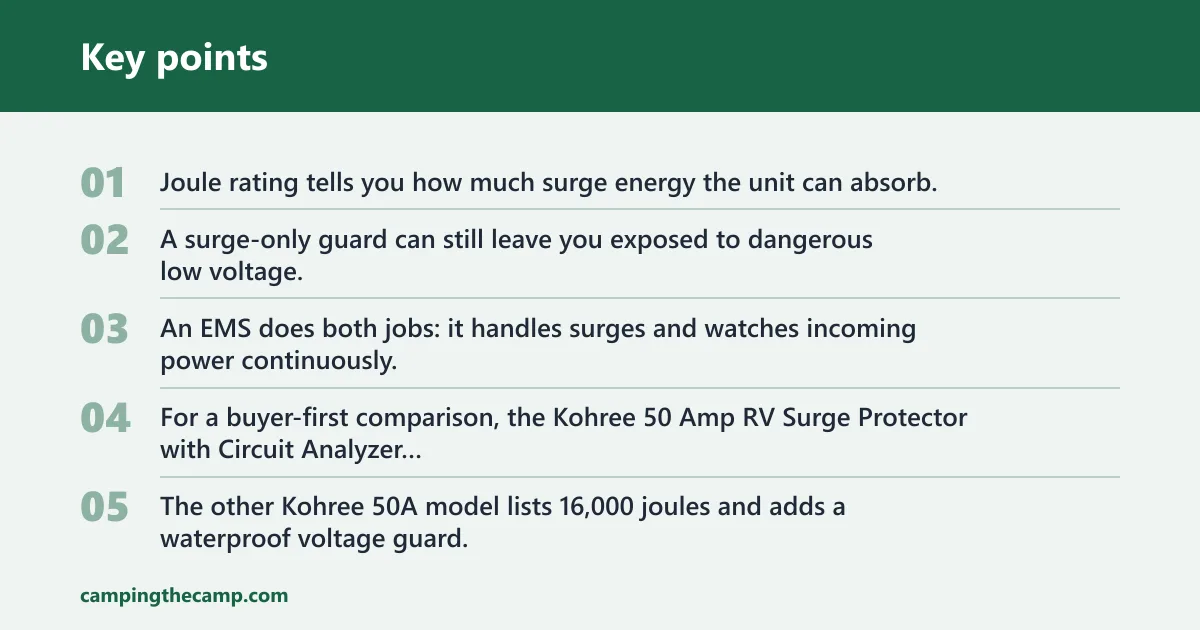
Joule rating tells you how much surge energy the unit can absorb, but it does not tell the whole story. A surge-only guard can still leave you exposed to dangerous low voltage. An EMS does both jobs: it handles surges and watches incoming power continuously.
For a buyer-first comparison, the Kohree 50 Amp RV Surge Protector with Circuit Analyzer is the clearest portable value play because it gives you 14,000J and ETL certification. The other Kohree 50A model lists 16,000 joules and adds a waterproof voltage guard, LED display, and auto shut off. The Progressive Industries EMS-HW50C sits in a different class because it is a hardwired EMS, not a basic surge guard.
Voltage cutoff behavior
Cutoff thresholds matter because campground voltage can drift high or low before you see a problem inside the RV. The Progressive Industries EMS-PT30X is commonly reported to shut off power when voltage drops below about 104 volts or rises above about 132 volts. Those numbers show the kind of automatic protection a true EMS provides.
That matters for sensitive appliances. Low voltage makes compressors work harder. High voltage can damage electronics. If you want the device to act before the problem reaches your rig, automatic shutoff matters more than a simple alarm.
Portable, hardwired, and weatherproof housings
Portable units are easy to move between rigs and simple to replace. Hardwired units are better when you want protection that is always in the circuit. For exterior use, choose a housing that is weather resistant or waterproof, because the device will sit near the pedestal in rain, dust, and heat.
Picture a travel trailer that changes campgrounds every weekend. A portable 50A guard is easier to pack and inspect. Now picture a fifth wheel that stays plugged in for months at a time. A hardwired EMS is the cleaner fit if you want protection to stay in place.
Display type and certification
A readable display helps you spot wiring errors fast. LED indicators are common on portable units, and an LED display is even easier to read at a glance. Certification also matters. If the listing shows ETL or UL-style certification, that is a better filter than a bare product page with no safety language.
The Kohree 50 Amp RV Surge Protector with Circuit Analyzer checks both boxes: LED indicators and ETL certification. The Kohree 16,000-joule model adds an LED display, while the Southwire portable surge guard stays simpler with rudimentary monitoring.
Do you need an EMS or just a surge protector?
If you camp at well-maintained parks and want basic surge defense, a surge protector may be enough. If you plug into unfamiliar pedestals, or if you want the unit to shut off the RV during unsafe voltage, an EMS is the safer choice. Full-time use points even more strongly toward EMS.
When surge-only is enough
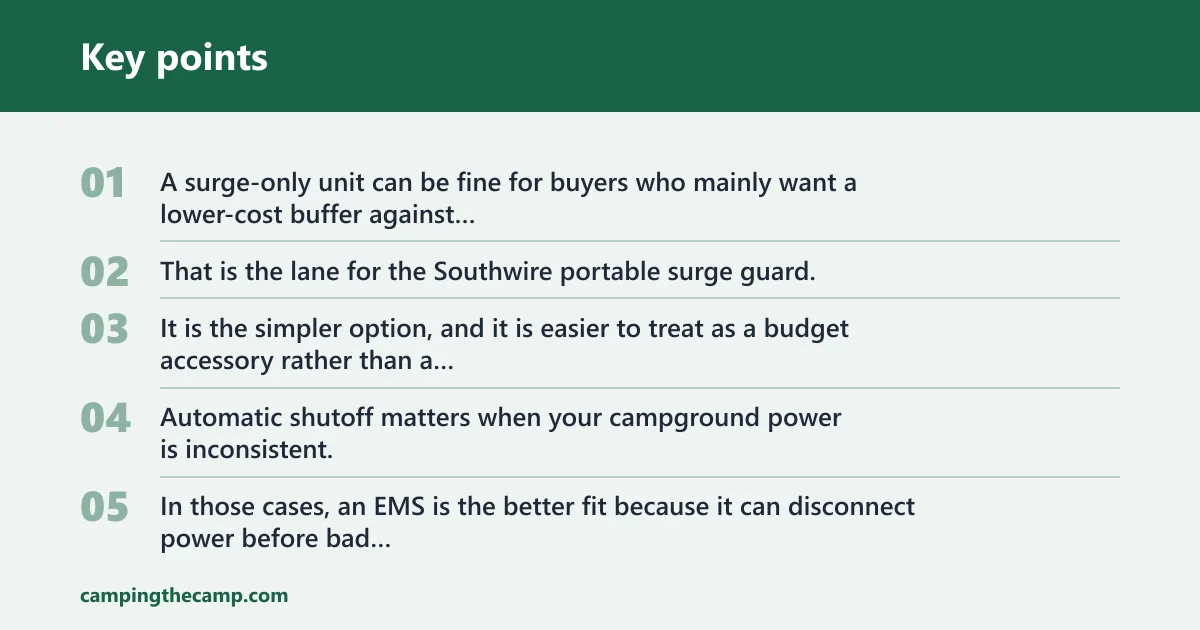
A surge-only unit can be fine for buyers who mainly want a lower-cost buffer against spikes and do not need continuous voltage management. That is the lane for the Southwire portable surge guard. It is the simpler option, and it is easier to treat as a budget accessory rather than a full electrical manager.
When automatic shutoff matters more
Automatic shutoff matters when your campground power is inconsistent, when the pedestal is old, or when you simply do not want to guess whether the voltage is safe. In those cases, an EMS is the better fit because it can disconnect power before bad voltage reaches the coach.
Say your 50A motorhome is parked at a rural site with a weak pedestal and the air conditioner keeps cycling off and on. A protector that only absorbs surges does not solve low voltage. An EMS, or a booster paired with protection, gives you a clearer response to the problem.
Why full-time use points to EMS
Full-time RV living increases the number of times you plug into unknown power. That makes voltage monitoring more valuable, not less. The Progressive Industries EMS-HW50C is the premium-tier choice in this group because it is hardwired and always active, which suits a rig that stays connected for long stretches.
Portable or hardwired for your RV?
Portable and hardwired protection solve the same basic problem in different ways. Portable units are easier to buy, move, and replace. Hardwired units are better when you want a permanent electrical layer that stays with the RV.
Progressive Industries EMS-HW50C as a hardwired choice
The Progressive Industries EMS-HW50C is the right comparison point for buyers who want a permanent 50A solution. It is a hardwired premium-tier option, and it watches the full 50A feed, including the two hot legs, neutral, and ground. That makes it a strong fit for long-term owners who do not want to keep handling a portable box.
Portable protection for travel trailers and frequent moves
Portable units make more sense if you change camps often, store the RV between trips, or want a device you can visually inspect before each hookup. The Kohree 50A models fit that pattern well because both are portable and both add weather-resistant protection with visible readouts.
What installation and storage change in practice
Hardwired protection usually needs professional installation. Portable protection does not. That difference matters if you want the simplest path to use, or if you want the device to remain part of the RV instead of another item to pack, secure, and remember.
How the main 50A options differ
The cleanest way to separate these products is by protection depth, install style, and whether the device solves low voltage or only surge risk. The table below keeps that straight.
| Option | Main strength | Main limitation | Best fit |
|---|---|---|---|
| Progressive Industries EMS-HW50C | Always-active hardwired EMS protection for a 50A rig | Requires professional installation | Full-time RV living and premium protection |
| Kohree 50 Amp RV Surge Protector | 16,000 joules, waterproof voltage guard, LED display, auto shut off | Check listing details for certification and cutoff specs | Portable buyers who want strong feature density |
| Kohree 50 Amp RV Surge Protector with Circuit Analyzer | 14,000J, waterproof power guard, ETL certified, LED indicators | Lower joule figure than the other Kohree model | Portable monitoring with certification checked up front |
| Southwire portable surge guard | Simple, more affordable surge protection | Surge protection only, with rudimentary monitoring | Budget buyers who want the basics |
| Hughes Autoformer 30A voltage booster | Raises weak voltage gradually | Not a surge protector and not a 50A protector | Low-voltage campground power, paired with protection |
A common first-timer mistake is thinking an adapter solves the protection problem. It does not. An adapter changes the connection, not the electrical safeguards. If you adapt a 50A rig to a 30A pedestal, the service limit is still 30A total.
Can a 50A RV use a 30A pedestal safely?
Yes, with the right adapter and realistic expectations. The adapter only changes the plug pattern. It does not create more amperage, and it does not add surge protection. A 50A RV on a 30A pedestal is limited to 30A total service.
What an adapter does and does not do
An adapter lets the cord fit the pedestal. It does not upgrade the campground circuit, and it does not make a 30A source behave like 50A service. You still need protection if the pedestal is the source of the problem.
Why the service limit stays
The pedestal breaker sets the ceiling. If the source is 30A, the RV cannot draw more than that safely. Heavy loads have to be managed carefully, especially if the coach has two air conditioners or other high-demand appliances.
How to pair weak power with the right protection
If voltage is the concern, pair a protector with a voltage booster rather than assuming the adapter covers everything. The Hughes Autoformer 30A voltage booster is the accessory in this group for weak campground power. It boosts low voltage gradually, and it belongs with a surge protector, not in place of one.
Choose Progressive Industries EMS-HW50C if…
Choose the Progressive Industries EMS-HW50C if you want always-on, hardwired protection and plan to stay with the RV for a long time. Choose the Kohree 50 Amp RV Surge Protector if you want a portable 50A guard with a strong joule figure and a readable display. Choose the Kohree 50 Amp RV Surge Protector with Circuit Analyzer if ETL certification is a key filter and you want a portable monitoring setup. Choose the Southwire portable surge guard if you want a simpler budget surge-only option. Choose the Hughes Autoformer 30A voltage booster if weak campground voltage is the main problem and you already have surge protection in place.
If you are full-time in a 50A coach, the hardwired EMS is the cleanest long-term answer. If you move often and want a portable unit you can deploy in minutes, the Kohree options are the easier fit. If you camp mostly at decent parks and want basic defense on a tighter budget, the Southwire unit is the simpler call.
Frequently asked questions
What is the best 50 amp RV surge protector?
The best choice for most 50A RV owners is a true EMS with 50A compatibility, continuous voltage monitoring, and automatic shutoff. For a hardwired option, the Progressive Industries EMS-HW50C is the premium-tier pick in this guide. For a portable option, the Kohree 50 Amp RV Surge Protector stands out for its 16,000 joules, waterproof voltage guard, LED display, and auto shut off.
Do I need an EMS or just a surge protector for my 50 amp RV?
If you only want spike protection, a surge protector can be enough. If you want the unit to monitor voltage continuously and cut power when the pedestal is unsafe, choose an EMS. That matters more for full-time RV use and for campgrounds where power quality changes from site to site.
How many joules should a 50 amp RV surge protector have?
There is no single required number, but higher joule ratings generally give more surge capacity. In this comparison, the Kohree options list 16,000 and 14,000J. Treat joules as one filter, not the only one. Cutoff behavior, certification, and housing matter too.
Should I buy a portable or hardwired 50 amp RV surge protector?
Buy portable if you want easy storage, fast replacement, or you move rigs often. Buy hardwired if you want always-on protection and do not want to handle the device at every stop. The Progressive Industries EMS-HW50C fits the hardwired use case; the Kohree and Southwire units fit portable use.
What voltage cutoff should an RV surge protector use?
For EMS-style protection, a low-voltage and high-voltage cutoff is the key behavior to look for. Check the listing for the exact cutoff on your model.
Can I use a 50 amp RV on a 30 amp pedestal safely?
Yes, if you use the proper adapter and manage the load carefully. The adapter does not raise the pedestal rating, and the coach is still limited to 30A total service. If voltage is weak, a booster such as the Hughes Autoformer 30A voltage booster can help, but it should be paired with surge protection.
Which 50 amp RV surge protector is best for full-time RV living?
Full-time RV living points most strongly to a hardwired EMS. The Progressive Industries EMS-HW50C is the best fit here because it is always active and built for permanent installation. That matters when you are connecting to different pedestals week after week.
What features matter most in a 50 amp RV surge protector?
Start with 50A compatibility, then look for voltage monitoring, automatic shutoff, weather-resistant housing, readable indicators, and certification in the listing. Joules matter too, but they should not be the only buying filter. For a 50A coach, the protection style has to match your travel pattern and campground quality.