What size RV sewer hose storage tube do you need?

Many RV sewer hoses are reported to fit in a 4-inch inside-diameter tube that is hose-length plus about 2 to 4 inches for end caps and fittings; a 5-inch tube may be a better fit if you store a bulky elbow, two hoses, or fixed fittings. A tube that is too short or too narrow can crush fittings, jam the hose, or force you to leave the compartment door open. This guide gives the sizing rule, common hose lengths, and the fit checks for commercial or DIY carriers.
Measure length, fittings, and clearance
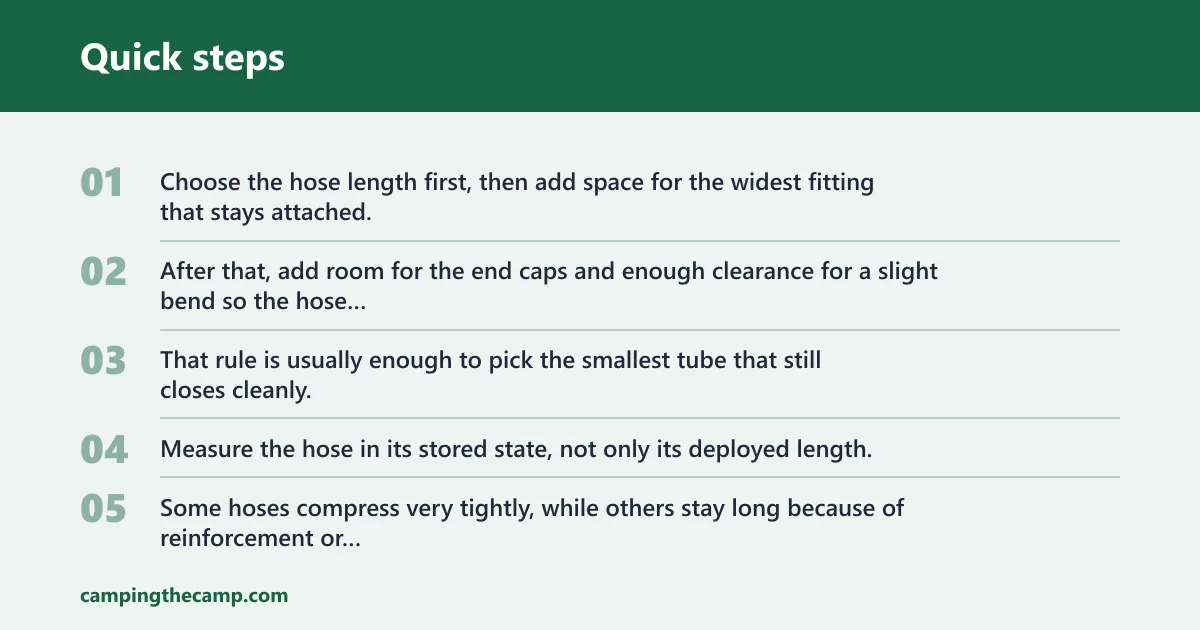
Choose the hose length first, then add space for the widest fitting that stays attached. After that, add room for the end caps and enough clearance for a slight bend so the hose slides in and out without binding. That rule is usually enough to pick the smallest tube that still closes cleanly.
Measure the hose length and compressed length
Measure the hose in its stored state, not only its deployed length. Some hoses compress very tightly, while others stay long because of reinforcement or stiff cuffs. A common RV bumper fit example is the Camco RhinoFLEX 20-foot kit, and each 10-foot RhinoFLEX section compresses to 39 inches.
The compressed length matters because the tube must be longer than the stored hose plus the end caps. If the hose is stored with an elbow attached, measure from the end of that fitting too. That fitting often sets the minimum tube length more than the hose body does.
Check the widest fitting you plan to store
The widest part of the stored setup usually determines diameter. A plain hose body may fit a 4-inch tube, but a rotating bayonet fitting, glued elbow, or bulky adapter may need more room. If the fitting rubs the cap, the hose can twist, snag, or keep the lid from closing flat.
Use the widest outside diameter of the attached part, not the hose wall thickness. That is the number that tells you whether a 4-inch pipe is enough or whether you should move to a larger carrier.
Leave clearance for end caps and bend radius
End caps take space. Threaded caps add a little length and can seal well; slip-on caps are simpler, but they depend on the fit and the retaining method. Either way, the tube should leave enough space for the hose to slide in without forcing a tight bend right at the opening.
If the hose has to curve sharply to fit, the real usable space is smaller than the tube label suggests. That is why a tube that measures “close enough” on paper can still be annoying in practice.
What size tube fits a standard RV sewer hose?
A standard RV sewer hose often fits a 4-inch inside-diameter tube if the hose is stored without a bulky elbow or adapter attached. If you keep a large fitting on the hose, or if the hose stores with two lines together, a 5-inch-class tube is the safer choice. The fit comes down to the widest stored part, not the hose brand alone.
When a 4-inch pipe works
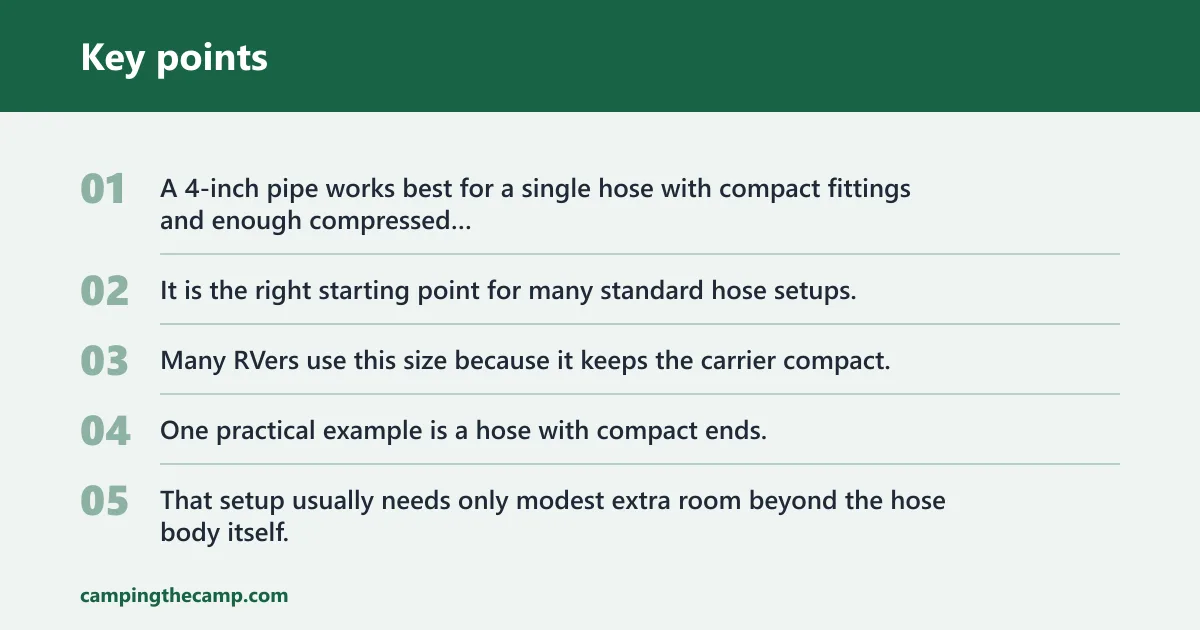
A 4-inch pipe works best for a single hose with compact fittings and enough compressed length to slide in flat. It is the right starting point for many standard hose setups, especially if the hose is stored by itself and the end pieces are removable. Many RVers use this size because it keeps the carrier compact.
One practical example is a hose with compact ends, stored in a straight run with standard caps. That setup usually needs only modest extra room beyond the hose body itself.
When you need a larger inside diameter
Move to a larger tube when the hose includes a bulky bayonet fitting, a glued elbow, a fixed adapter, or a second hose. Those parts usually create the first bind. A tube that is only barely wide enough may still close, but it can press against the cap and make removal harder.
Suppose a hose stores with a large elbow left on the end. The hose body may fit 4 inches, but the elbow can turn the same setup into a 5-inch job. That is why fitting shape matters more than hose wall thickness.
Why fitting shape matters more than hose wall thickness
Hose wall thickness rarely decides the carrier size by itself. The connector shape does. A round, compact end is easier to store than a wide rotating bayonet or an elbow with a larger outside diameter. That difference is why two hoses with the same nominal length can need different tubes.
Do you need 4-inch PVC or a larger tube?
Four-inch PVC is a common starting point, but it is not universal. It often works for a single hose stored cleanly and separately from bulky fittings. If you plan to store the hose in a bumper, keep an adapter on it, or carry two hoses together, the larger option is often the cleaner fit.
Bumper storage versus mounted tube storage
Rear bumper storage is convenient only when the bumper is hollow and long enough for the hose in its stored form. A 4-inch square bumper can work for some hoses, but the inside space is limited by the bumper length and any adapters at the ends. If the bumper opening is crowded, the hose may not slide far enough in to close the cap.
A mounted tube gives you more control over length and diameter. It also lets you choose a tube that matches the fittings instead of forcing the hose to match the bumper.
Adapter removal and elbow clearance
Some setups only fit after you remove the adapter or elbow before storage. That is especially common with bumper storage. The Camco RhinoFLEX 20-foot kit is a useful reference here: it uses 23 mil polyolefin reinforced with steel wire, and it fits inside a standard 4-inch square bumper when the adapter is removed.
The key point is simple. If the adapter stays on, the clearance changes. If it comes off, the hose may fit the bumper that looked too small at first.
When 4-inch square bumper storage is a fit
Use a 4-inch square bumper only if the hose stores compactly enough to slide through the full length without a hard bend. A bumper is best for a single hose with removable ends and no bulky fittings left attached. If the hose hangs up halfway in, the bumper is too tight for that configuration.
Sizing worksheet
This worksheet gives a fast buying rule. Match your hose setup to the smallest tube size that still lets the cap close without forcing the fittings.
| Hose length | Fittings stay attached? | Widest fitting diameter | Storage location | Minimum recommended tube size |
|---|---|---|---|---|
| 15 to 20 feet, one hose | No, compact ends removed | Under 4 inches | Mounted tube or hollow bumper | 4-inch inside diameter |
| 15 to 20 feet, one hose | Yes, elbow or adapter stays on | About 4 inches or more | Mounted tube | 5-inch inside diameter |
| 20 feet, one hose | No, adapter removed | Compact | 4-inch square bumper | 4-inch bumper only if the hose slides freely |
| 20 feet, one hose | Yes, bulky elbow left attached | Bulky | Bumper or mounted tube | 5-inch inside diameter |
| Two hoses together | Usually yes | One or more bulky fittings | Mounted tube or two separate carriers | 5-inch to larger, or separate tubes |
For a 16-foot RV sewer hose, start with a 4-inch tube if the hose stores alone and the ends are compact. Move up if the hose keeps a large fitting attached. For the shortest clean fit, measure the stored hose, then add room for the widest attached part and both end caps.
Single-hose versus two-hose storage
A single hose usually needs only enough room for the hose body and one fitting at each end. Two hoses change that quickly. The bundle gets wider, the bends get stiffer, and the end caps have to clear more material. In many cases, two separate tubes are smaller and easier to close than one oversized tube.
A common first-timer mistake is buying a tube for one hose, then trying to stuff a second hose beside it because the lengths seem similar. The extra hose does not simply “stack.” It increases the diameter needed for the bundle and can make the cap fight the contents.
Common carrier options and sizes
DIY carriers and commercial tubes solve the same problem in different ways. A fence post or PVC tube is cheap and simple. A purpose-built carrier is easier to mount, and it often comes with caps and hardware that are already sized for storage.
5×5 vinyl fence post
A 5×5 vinyl fence post is a common DIY carrier size. It is often chosen because it gives more room than a narrow pipe, and it can hold a standard RV sewer hose with end caps and, in some builds, a rain gutter tray. That extra width can help if you keep larger fittings on the hose.
Use end caps that secure the hose without letting road dust in. Threaded caps usually close more positively; slip-on caps are simpler but depend more on fit and retention. If the tube is mounted where water can collect, drainage or venting matters so moisture does not sit inside.
Valterra EZ hose carrier
The Valterra EZ Hose Carrier is commonly described as an adjustable commercial option with a length range from 50 to 94 inches. It is commonly listed as having a 4.5-inch inside diameter and vented caps. That makes it a practical choice when a 4-inch tube is too tight but you still want a compact carrier.
That extra half inch can matter for fittings that barely miss a 4-inch pipe. It also leaves a bit more forgiveness when the hose does not compress evenly.
Camco RhinoFLEX 20-foot kit
The Camco RhinoFLEX 20-foot kit is a useful benchmark for bumper storage. It uses 23 mil polyolefin reinforced with steel wire. Each 10-foot section compresses to 39 inches, and it fits inside a standard 4-inch square bumper when the adapter is removed.
The lesson is not that every hose behaves the same way. The lesson is that bumper fit can depend on one removable piece. Leave that piece on, and the answer can change fast.
Can you store two sewer hoses in one tube?
Sometimes, yes, but two hoses often need a larger tube than most buyers expect. If both hoses are stored together with fittings attached, the bundle usually needs more than a standard 4-inch pipe. A 5-inch tube or separate carriers is often the cleaner answer because it protects the fittings and lets the caps close without pressure.
How two hoses change the minimum diameter
Two hoses do not just double the length problem. They increase the bundle width and create more air gaps around the fittings, which makes the stored shape less predictable. If one hose has a bulkier end, that piece can set the minimum tube size for both hoses together.
What to do with bulky bayonet fittings
Bulky bayonet fittings are the most common reason a two-hose bundle gets too wide. If those fittings stay on, a 4-inch tube is often too tight. If you remove the fittings or store the hoses separately, you may get back to a smaller carrier size and easier cap closure.
Why separate tubes are sometimes the smaller choice
Separate tubes can be smaller overall because each hose can sit flat in its own space. That avoids one large bundle with awkward protrusions. For many RV owners, two small carriers are easier to mount and drain than one oversized tube that must hold everything at once.
How long should an RV sewer hose carrier be?
Choose a carrier that is longer than the stored hose and long enough for the end caps you plan to use. For many setups, that means the carrier should be close to the hose’s compressed length, with a little extra room for fittings and clearance at the cap. If the carrier is too short, the hose bends at the opening and wears the edge.
What size rv sewer checklist
- Measure the hose in its stored shape.
- Measure the widest fitting you will keep attached.
- Check the inside width of the tube or bumper.
- Allow room for threaded or slip-on end caps.
- Confirm the hose slides in without a hard bend.
Say your hose is 20 feet long and the adapter comes off before storage. If the hose body compresses cleanly, a 4-inch bumper or tube may work. If the same hose keeps a bulky elbow attached, the same tube can turn into a jammed fit even though the length did not change.
Frequently asked questions
What size RV sewer hose storage tube do I need?
For a single hose, a 4-inch inside-diameter tube is a common starting point if the fittings are compact and removable. If you store a bulky elbow, a fixed adapter, or two hoses together, a 5-inch-class tube may be a better choice. The widest stored part, not the hose label, sets the real minimum size.
Will a standard RV sewer hose fit in a 4-inch pipe?
Often yes, if the hose is stored by itself and the large fittings are removed. A standard hose can also fit in a 4-inch square bumper in some setups. The fit fails when a bulky fitting stays attached or the hose cannot slide in without bending sharply at the opening.
Do I need 4-inch PVC or a larger tube for my hose fittings?
If your fittings are compact, 4-inch PVC may be enough. If the hose keeps a large bayonet, elbow, or adapter attached, go larger. The fitting diameter matters more than hose wall thickness, and the cap needs space too. That extra room keeps the hose from binding when you close the carrier.
What is the difference between a bumper storage tube and a mounted carrier?
A bumper storage tube uses the hollow rear bumper as the storage space, so the size is fixed by the bumper. A mounted carrier is a separate tube with its own length and diameter. Mounted carriers are easier to size for bulky fittings, while bumper storage is best when the hose and adapters are compact.
What size tube works for a 16-foot RV sewer hose?
For a 16-foot hose, a 4-inch tube is usually the first size to check if the hose stores alone and the ends are small. If the hose stays assembled with a large fitting, step up to a larger tube. The safest choice is the smallest tube that closes without pressing on the connector.