
RV sewer hose storage tube vs box: Which is better?

A storage tube is often a better choice for RV sewer hoses because it usually costs less, weighs less, and uses fewer mounting parts; choose a storage box only if extra room for fittings and gloves, along with a fully enclosed setup, is the priority. Poor storage leads to hose contamination, awkward access, and leaks inside compartments. This guide compares fit, cleanup, protection, access, and the best choice for bumper, frame, and rear-compartment mounting.
| Decision factor | RV sewer hose storage tube | storage box | Winner |
|---|---|---|---|
| Hose fit | Best when the hose compresses straight and the stored length matches the sections and fittings. | More forgiving for odd shapes, heavy couplers, elbows, and extra accessories. | storage box |
| Elbow clearance | Tight clearances can become the limiting factor near end caps and bends. | Usually leaves more room for elbow clearance and bulky adapters. | storage box |
| Weather protection | Good against road spray if sealed and mounted well, but less forgiving if moisture stays inside. | Better enclosure against sun, dust, and wash water. | storage box |
| Debris protection | Protects the hose walls, but loose grit can still collect at the ends. | Usually keeps dirt and residue contained more fully. | storage box |
| Access speed | Fast when mounted in a bumper or along the frame. | Fast for compartment access, slower if packed with fittings and caps. | RV sewer hose storage tube |
| Rattle risk | Higher if the carrier is long, lightly supported, or loosely capped. | Usually lower when the box is secured and the contents are packed tightly. | storage box |
| Mounting difficulty | Usually simpler, especially on a bumper or straight frame run. | Often needs more layout work and a better place to fasten the box. | RV sewer hose storage tube |
| 4-inch bumper compatibility | Many hose setups fit, but not all do. | Less common in bumper storage. | RV sewer hose storage tube |
The real trade-off
The trade-off is straightforward: a storage tube gives you straight, protected carry, while a storage box gives you more room for fittings, easier access, and a looser fit. The right choice depends on where the setup lives and how much extra gear rides with the hose.
When a tube makes more sense
Choose a tube when the hose compresses into a predictable shape and you want the shortest path from dump valve to storage. Tubes work well for bumper mounts and straight frame runs because they keep the hose aligned and out of the wind, road spray, and loose gravel.
Say your hose set is a clean two-section layout with only one elbow and one cap. A tube usually keeps that package tidy, while a box can feel too large unless you also need room for gloves, adapters, or a secondary rinse hose.
When a box makes more sense
Choose a box when your storage includes bulky elbows, multiple caps, or hose ends that do not nest neatly. A box also makes more sense if you want faster hand access in a rear compartment or if you dislike fighting a tight tube opening after dumping.
Suppose your hose needs to go in wet after a dump and still carry a bayonet cap, a clear elbow, and a rinse fitting. A box keeps those parts together instead of forcing a snug slide-in that can scrape residue onto the inside walls of a tube.
Sewer hose storage matrix
This table scores the two options on the issues that actually decide day-to-day use. The winner is not always the more protected option; it is the one that fits your hose, your mounting spot, and the amount of cleanup you want to do afterward.
| Criteria | RV sewer hose storage tube | storage box | Winner |
|---|---|---|---|
| Hose fit | Best for hoses that compress straight and stay narrow at the fittings. | Best for awkward shapes and extra hardware. | storage box |
| Elbow clearance | Limited by tube diameter and end-cap space. | More room for elbows, caps, and adapters. | storage box |
| Weather protection | Good if sealed and mounted to shed spray. | Better enclosure from sun, dust, and wash water. | storage box |
| Debris protection | Good for the hose body, less forgiving for dirty ends. | Better at containing loose grit and drips. | storage box |
| Access speed | Quick to reach on a bumper or open frame mount. | Quick in a compartment, but slower if packed full. | RV sewer hose storage tube |
| Rattle risk | Can rattle if the hose shifts inside the carrier. | Usually quieter when packed tight and secured. | storage box |
| Mounting difficulty | Usually simpler to position and fasten. | Usually needs more room and better support points. | RV sewer hose storage tube |
| Compatibility with 4-inch bumper storage | Often compatible, depending on hose and fittings. | Usually not the first choice for a standard bumper. | RV sewer hose storage tube |
Hose fit
The tube wins when the hose compresses to a shape that stays narrow and straight. The box wins when the hose and its parts do not want to stack cleanly, because the enclosed space tolerates elbows, caps, and uneven folds better.
Elbow clearance
Elbow clearance is where many storage plans fail. A hose may fit on paper, then get stuck at the cap because the elbow, adapter, or connector needs more room than the straight barrel provides.
Weather protection
A box usually shields the contents better from sun, dust, and wash water. A tube still does a good job against road spray when mounted correctly, but it gives less room for leftover moisture after use.
Debris protection
A closed box keeps dirt and residue better contained, especially if the hose goes back in while still damp. Tubes protect the hose from exterior grime, but they can hold a bit of slurry near the ends if drainage is poor.
Access speed
For quick dump days, a tube is often faster to grab and return, especially on a bumper mount. A box can be just as quick in a rear compartment, but only if the contents are arranged so the lid or door opens to usable space right away.
Rattle risk
Loose space is the enemy of quiet storage. A tube that is longer than the hose package can let the contents shift and knock, while a box packed with the hose and fittings is more likely to stay still if its latch and mount are solid.
Mounting difficulty
A tube is easier to mount because it can follow a bumper rail or a straight frame line. A box needs a mounting surface that supports its footprint and still leaves room to open, load, and clean it without fighting nearby hardware.
How tube and box compare on fit
Fit is the first filter, not an afterthought. The best carrier is the one that matches the hose’s compressed length, the size of its elbows and adapters, and the space available at the mounting point.
Hose length and compression
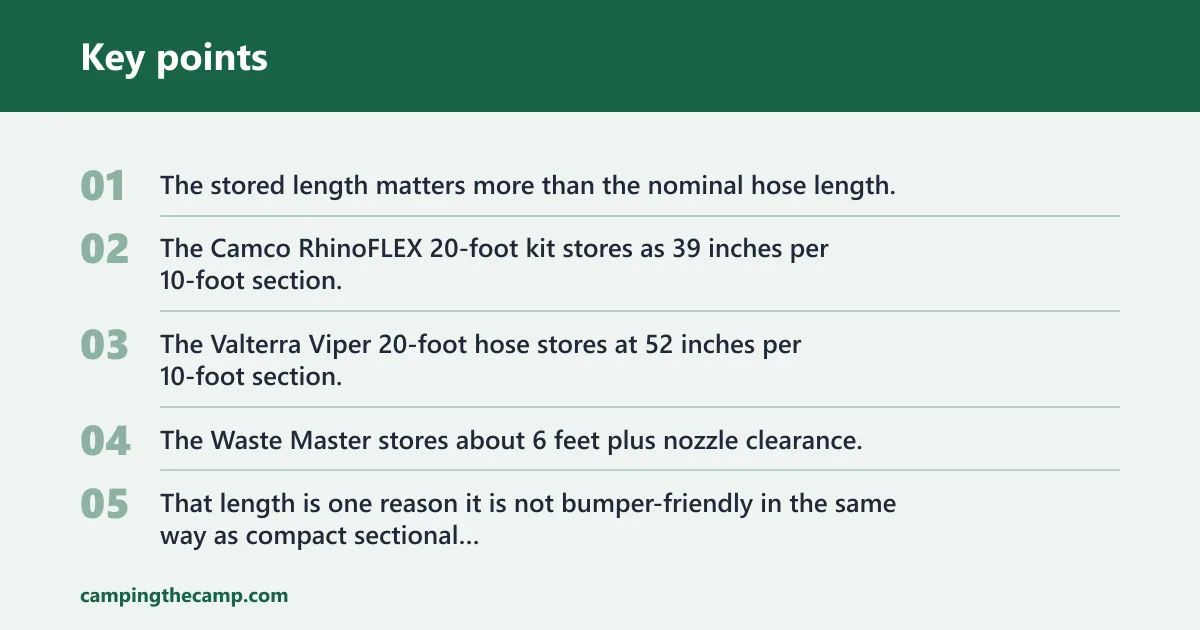
The stored length matters more than the nominal hose length. The Camco RhinoFLEX 20-foot kit stores as 39 inches per 10-foot section, which is why it can work in a standard 4-inch bumper when the adapter is removed. The Valterra Viper 20-foot hose stores at 52 inches per 10-foot section, and the Camco RhinoEXTREME 20-foot hose stores at about 57 inches per section.
The Waste Master stores about 6 feet plus nozzle clearance, so it is a very different storage problem. That length is one reason it is not bumper-friendly in the same way as compact sectional hoses.
Elbows, adapters, and caps
Do not size the carrier to the hose alone. End caps, bayonet fittings, elbow clearance, and any adapter that stays attached can add the length that decides whether the hose slides in cleanly or jams at the opening.
A storage box usually handles those extras better because the parts can lie beside the hose. A tube needs a straighter package, and that often means removing an adapter or choosing a hose with a shorter compressed profile.
4-inch bumper compatibility
A 4-inch bumper can work well for some hose kits, but it is not a universal fit. The RhinoFLEX fits a standard 4-inch bumper when the adapter is removed, and the RhinoEXTREME fits a 4-inch bumper with the adapter removed. The Valterra Viper does not fit a 4-inch bumper, and that is the sort of detail that should end the debate before you buy.
Fit also depends on whether the bumper is truly open, whether the end caps steal interior space, and whether the hose ends need room to turn as they enter. If those parts are tight, a box or a frame-mounted tube can be the safer choice.
Which protects better from weather and dirt?
A storage box usually protects better from weather and dirt because it encloses the hose, fittings, and residue more completely. A tube still protects well from road spray and sun, but it depends more on a dry, straight storage path and a good seal at the ends.
Road spray and sun exposure
A tube shields the hose from direct sunlight and road grit when mounted under the frame or inside a bumper. A box adds another layer of enclosure, which helps when the carrier sits where wash water, mud, or splashback can reach it.
Dust, grit, and wash water
A box usually keeps dust and grit from getting into the ends of the hose and fittings. That matters if your storage spot sits low or near the rear of the coach, where spray and grime can collect after a wet trip or a dusty road.
Odor and drainage after dumping
Odor control depends less on the label and more on drainage and sealing. A box can hold odor better if it is ventilated and allowed to dry, while a tube can trap smell if the hose goes back in wet and the carrier has nowhere for liquid to drain.
What about access, cleanup, and rattles?
Access speed, wet-hose cleanup, and movement noise often decide the final choice after fit checks are done. The better storage is the one you can load quickly, rinse without a mess, and keep quiet while driving.
Loading and unloading speed
A tube is fast when the hose package is narrow and the mounting path is straight. A box is fast when the lid opens wide and the contents do not need to be bent or compressed to get them back inside.
Wet-hose cleanup
A box is usually easier for wet storage because it contains drips and gives you room to stash caps and elbows beside the hose. A tube works if the hose drains well first, but it can be annoying if residue collects at the opening or along the bottom of the carrier.
Mounting noise and movement
Rattle risk rises when a carrier is longer than necessary or attached with weak hardware. Tubes are more likely to clatter if the hose has room to move; boxes are quieter when the contents fill the space and the latch or door stays firm.
Choose RV sewer hose storage tube if… / Choose storage box if…
Pick the carrier that matches your storage spot first, then match the hose to it. For bumper and frame mounting, the tube usually wins on simplicity; for rear compartments and mixed accessories, the box usually wins on flexibility and cleanup.
Best for bumper storage
Choose RV sewer hose storage tube if you want to use a standard 4-inch bumper, if your hose compresses to a compact straight package, or if you want the easiest mounting path. It also makes sense when you want quick access without opening a larger container.
Best for rear compartments
Choose storage box if your rear compartment has room for a broad footprint, if you carry elbows and adapters with the hose, or if you want to keep wet parts contained in one enclosed place. It is also the better call when the hose shape is awkward or the fit is less exact.
Best for frame-mounted setups
Choose RV sewer hose storage tube if you need a straight run under the frame and you want less mounting work. Choose storage box if the frame area is busy, if the hose needs extra elbow clearance, or if you want less chance of loose parts shifting and banging.
What size storage do you need?
Size the carrier around the hose as it is stored, not just the advertised hose length. Add room for elbows, caps, adapters, and the bend radius at the mounting point, then compare that total to the available opening before you buy.
How to size the carrier
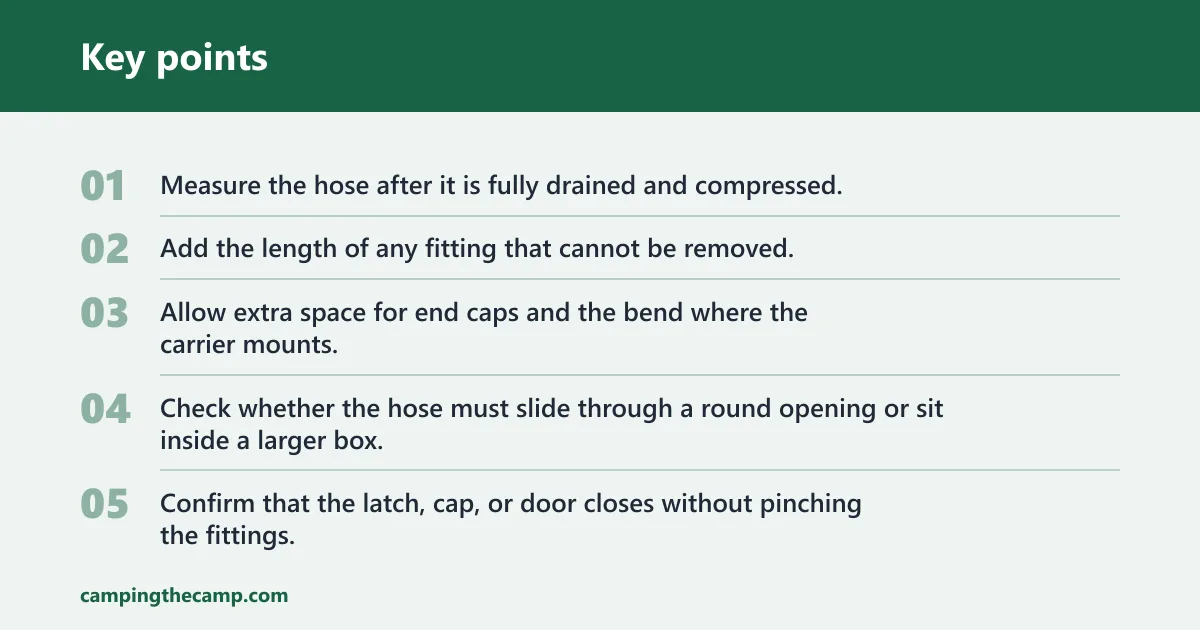
- Measure the hose after it is fully drained and compressed.
- Add the length of any fitting that cannot be removed.
- Allow extra space for end caps and the bend where the carrier mounts.
- Check whether the hose must slide through a round opening or sit inside a larger box.
- Confirm that the latch, cap, or door closes without pinching the fittings.
A common first-timer mistake is sizing the carrier to the hose body only. That can leave no room for the elbow, which turns a “fits on paper” setup into one that will not close.
How hose examples fit
The Camco RhinoFLEX 20-foot kit is the easiest fit example here because it stores as 39 inches per 10-foot section and fits a standard 4-inch bumper when the adapter is removed. The Camco RhinoEXTREME 20-foot hose also fits a 4-inch bumper with the adapter removed, but its stored length is about 57 inches per section, so the fit is less forgiving.
The Valterra Viper 20-foot hose stores at 52 inches per 10-foot section and does not fit a 4-inch bumper, which pushes many owners toward a frame mount or a box. The Waste Master’s about 6 feet plus nozzle clearance makes a box or a dedicated long carrier more realistic than bumper storage.
What to do when the hose will not fit
If the hose misses by a little, remove the adapter if the system allows it, then recheck elbow clearance and cap depth. If it still will not fit, move to a box or a longer frame-mounted tube rather than forcing a tight carrier that will wear the hose and make cleanup worse.
Frequently asked questions
Is a sewer hose storage tube or storage box better for an RV?
A storage tube is better for most RV sewer hoses because it is simpler, lighter, and easier to mount in a straight run. A storage box is better when you need extra room for fittings, gloves, or a hose that does not compress neatly.
Will an RV sewer hose fit in a 4-inch bumper?
Some do, but not all. The RhinoFLEX fits a standard 4-inch bumper when the adapter is removed, and the RhinoEXTREME fits with the adapter removed, while the Valterra Viper does not fit a 4-inch bumper. Fit depends on compressed length, adapters, and elbow clearance.
How long should an RV sewer hose storage tube be?
It should be long enough for the hose after compression plus the fittings, caps, and any bend at the mounting point. If the hose needs to enter at an angle or carry bulky elbows, a longer tube or a box is safer than a tight fit.
What are the pros and cons of a storage tube vs box?
A tube is easier to mount, lighter, and better for straight carry. A box gives more room for odd shapes, fittings, and wet storage, but it usually takes more space and can be more involved to install.
Can you store a sewer hose in a bumper safely?
Yes, if the hose actually fits and the bumper is designed for storage use. Check the compressed length, remove the adapter if needed, and leave enough elbow clearance so the hose does not scrape or jam at the opening.
What storage option is best for full-timers versus weekend campers?
Weekend campers often do well with a tube because it is simpler and faster to manage. Full-timers usually benefit from a box if they carry more fittings, dump more often, or want better containment for wet gear and residue.