
Which is lighter: Camp stove or backpacking stove?

Backpacking stoves are often much lighter than camp stoves: many backpacking burners weigh about 2 to 8 ounces, while camp stoves often start around 1 pound and can exceed 4 pounds. Pick the wrong one and you carry extra bulk, burn more fuel than expected, or end up with a setup that is too heavy for the route. This guide compares bare stove weight and realistic total system weight so you can pick the lighter option for your trip.
| Factor | camp stove | backpacking stove | Winner |
|---|---|---|---|
| Bare stove weight | Usually heavier. Larger burners, wider supports, and more metal add up fast. | Usually much lighter. Common backpacking burners often land in the 2 to 8 ounce range. | backpacking stove |
| Packability | Bulkier, with bigger pot supports and larger fuel components. | Smaller packed size, especially with screw-on canister burners. | backpacking stove |
| Total trip weight | Can climb quickly once you add fuel, bottle, and cookware. | Usually lighter for solo or short trips, but fuel choice changes the gap. | backpacking stove |
| Cold-weather and wind use | Often stronger in cold and wind if it is a liquid-fuel or shielded setup. | Fine in three-season use, but can lose efficiency in wind and freezing temperatures. | camp stove |
| Cooking flexibility | Better for larger pots and more elaborate meals. | Often boil-focused, though some models simmer well. | camp stove |
Which stove is lighter for your trip?
For most backpacking trips, the backpacking stove is lighter. For a solo weekend, a small canister burner plus a small fuel canister usually beats a camp stove by a lot. For winter, long food-heavy trips, or cold high-altitude travel, the answer can shift because fuel type, bottle weight, and wind control start to matter as much as the burner itself.
Solo weekend trips
Backpacking stove setups are usually the lighter choice here, especially if you are boiling water for one or two people. A small canister stove and a compact pot can stay very light, and you do not need the bulk of a larger camp stove system. If your menu is simple, total system weight stays low.
3-season thru-hikes
Backpacking stove setups almost always win for a three-season thru-hike. The light burner, small fuel canister, and compact pot create the best weight-to-effort ratio for a long route. A lighter burner also matters less than fuel efficiency over time, which is why small canister stoves are so common on long-distance trails.
Cold-weather and shoulder-season trips
The lighter option can change here. A canister backpacking stove may still weigh less on paper, but a liquid-fuel or more protected system can carry less risk and waste less fuel in freezing temperatures or strong wind. In those conditions, a slightly heavier setup can be the better trip weight choice because it avoids failed boils and extra fuel carry.
Backpacking stove weight ranges
Backpacking stove weight depends on category. Small canister burners are the lightest common backcountry option, integrated canister systems add pot weight and heat-exchanger parts, liquid-fuel stoves add pumps and bottles, and wood or alcohol options cut some burner weight but often trade that for fuel or setup compromises.
Small canister stove
This is usually the lightest common backcountry stove category. The Soto Amicus measured 102 g, or 3.6 oz, in testing, and the Soto Windmaster measured 108 g, or 3.8 oz, in testing. The BRS-3000T weighs 1.4 ounces, according to OutdoorGearLab. These stoves usually screw directly onto a canister and use isobutane fuel.
Integrated canister stove system
Integrated systems include the burner plus a pot or heat-exchanger pot, so they are heavier than a bare burner. OutdoorGearLab says the Jetboil Zip measured 6.8 oz with stove, pot, lid, and bag. These systems are often wind-resistant and convenient, which can reduce fuel waste on short trips even though the burner itself is not the lightest.
Liquid fuel stove
Liquid-fuel stoves are heavier and bulkier than canister stoves because they need a fuel bottle and a pump, and they usually require priming. Switchback Travel says they run on white gas, and that white gas performs better in cold temperatures and at altitude. That extra hardware is why they make sense when conditions are tougher.
Wood and alcohol alternatives
Wood and alcohol stoves can look very light in bare stove weight, but the total system story is mixed. Alcohol fuel adds carried weight, and wood stoves may depend on available fuel at camp and can be restricted in some areas. They are best treated as niche alternatives rather than the default lightest answer for every route.
Canister fuel weight changes everything
Fuel weight is the reason a bare burner comparison can be misleading. The same source says canister fuels come in 4-, 8-, and 16-ounce capacities, and that canister stoves use a pressurized mix of isobutane and propane. The empty canister still weighs something, so the real number is burner plus canister plus pot system.
4-, 8-, and 16-ounce canisters
Small canisters are common for solo trips, mid-size canisters work for longer weekends, and larger canisters reduce the chance of running dry on a group trip. But a larger canister adds weight whether you use all the fuel or not. If you carry more fuel than the trip needs, you are carrying dead weight.
How much fuel a 3-day trip needs
A 3-day solo trip usually does not need a large canister if you are only boiling water once or twice a day. The exact amount depends on wind, boil volume, and how much simmering you do. That is why total system weight should be calculated for the route, not guessed from burner weight alone.
Why empty canister weight still counts
An empty canister is not weight-free, and it still rides in your pack at the end of the trip. That matters most on short trips, where the canister may be a meaningful part of the total carried weight. It also matters if you are comparing a small burner to an integrated system, because the pot and lid add weight too.
Stove setup weight comparison table
The table below uses realistic planning numbers for a solo 3-day trip with a pot, lighter, and enough fuel for simple boil-and-eat meals. The exact total changes with cooking style, wind, and whether you are carrying extra fuel for safety. Bare stove weight alone is not the whole answer.
| Setup | Typical bare weight | What that excludes | Estimated 3-day system weight | What that includes | Lighter if… |
|---|---|---|---|---|---|
| Small canister | 1.4 to 3.8 oz | No fuel, no pot, no lighter, no windscreen | 9 to 13 oz | Burner, 4- to 8-ounce fuel canister, compact pot, lighter | You are solo or with one partner on a 3-season trip and want the lightest common setup. |
| Integrated canister | 6.8 to 12 oz | No fuel, and some weights include pot while others do not | 13 to 18 oz | Burner, integrated pot, lid, canister, and ignition | You want fast boiling, better wind control, and fewer loose parts on a short trip. |
| Liquid fuel | 10 to 16 oz | No fuel bottle, no fuel, no priming hardware | 24 to 36 oz | Stove, fuel bottle, white gas, and a small pot | You are traveling in cold weather, at altitude, or for a long route where fuel efficiency matters more than packed weight. |
| Wood or alcohol alternative | 1 to 6 oz | No fuel, no pot, no tinder, no windscreen | 8 to 20 oz | Burner, fuel or burnable material, pot, and ignition | You are matching a very specific trip style and accept more setup tradeoffs. |
What each number includes
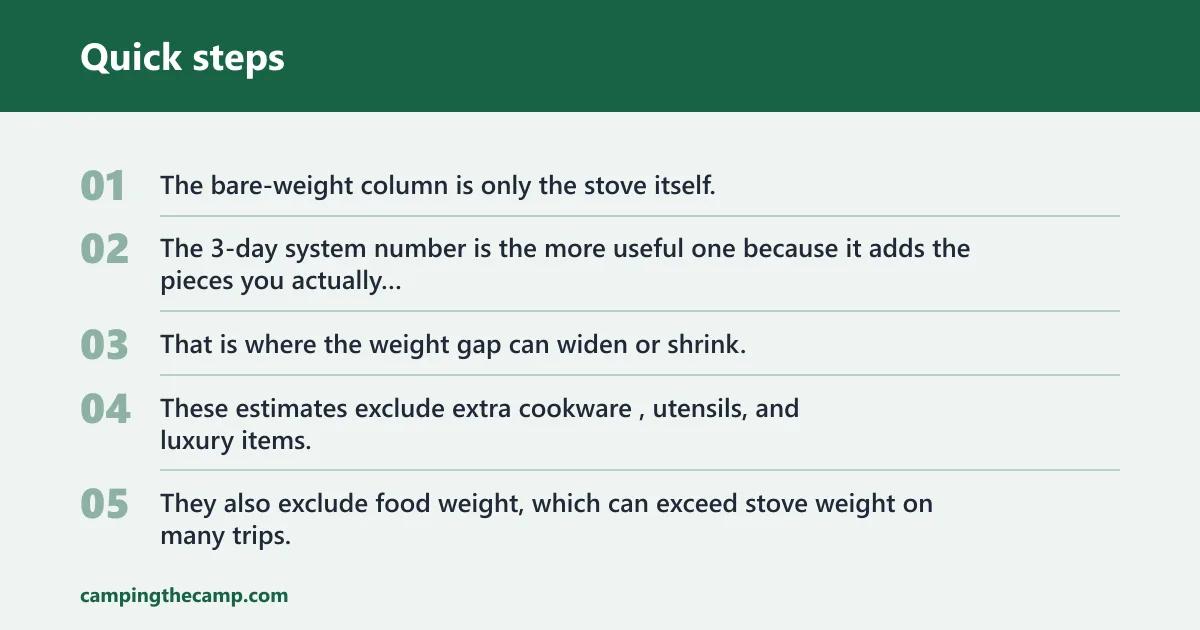
The bare-weight column is only the stove itself, or the main stove package in the case of an integrated system. The 3-day system number is the more useful one because it adds the pieces you actually carry on trail. That is where the weight gap can widen or shrink.
What each number excludes
These estimates exclude extra cookware, utensils, and luxury items. They also exclude food weight, which can exceed stove weight on many trips. If you use a wide pot, simmer sauce, or cook for two, expect the total to climb.
Lighter if verdicts by trip type
Solo weekend: small canister is usually lighter.
3-season thru-hike: small canister is still usually lighter, unless your cooking style pushes you toward a larger integrated setup for efficiency.
Cold-weather trip: liquid fuel may be heavier at the start, but it can be the lighter practical choice if it prevents fuel waste and unreliable boils.
Does performance matter as much as weight?
Yes. Weight matters most at the start of the trip, but performance affects fuel use, time, and whether your stove works well in the conditions you actually have. Wind resistance, boil time, pot supports, and simmer control all change the real carried weight because they change how much fuel and effort you need.
Wind resistance and fuel use
Wind can make a light stove inefficient fast. Exposed ridgelines and breezy camps can stretch boil times and waste fuel, which raises total system weight over the course of a trip. Integrated systems often reduce wind exposure, while some bare burners need more careful sheltering.
Boil time as a practical proxy
Boil time is useful, but it is only a proxy for efficiency and convenience. Reviews often measure 0.5 liters or 1 liter, and faster systems are not always the lightest once fuel use is counted. A stove that boils quickly in wind can still be the better weight choice.
Put your camp on an open ridge and a small burner may take longer to boil each meal. Those extra minutes do not just cost time, they can also mean more fuel use across three mornings and three dinners. A slightly heavier, more wind-resistant system may finish the trip lighter overall.
Pot supports and simmer control
Pot supports affect stability, especially with larger pots and real cooking beyond simple boiling. Detachable legs can save pack space, but they may feel less secure. Simmer control matters if you want sauces, rice, or sautéing; many ultra-light stoves sacrifice it, which is fine for dehydrated meals and limiting for everything else.
When a heavier stove makes sense
A heavier stove makes sense when the trip conditions punish light, open designs. Cold weather, altitude, group cooking, and extended trips all reward more fuel efficiency, more stable pot support, and better control. In those cases, a few extra ounces can reduce frustration and wasted fuel.
Cold weather and altitude
The same source says liquid-fuel stoves perform better in cold temperatures and at altitude, which is why they stay relevant even though they are heavier. Canister fuel struggles in freezing temperatures, and canister performance can drop when pressure falls. If reliability matters more than shaving ounces, the heavier setup can be the smarter carry.
Long trips and expedition use
On long trips, the fuel bottle and more efficient burn of white gas can make sense despite the larger stove package. Less expensive fuel per ounce can matter when you are resupplying repeatedly or cooking for more than one person. The total system may still be heavier than a small canister setup, but the route may justify it.
Safety and setup basics
Use a stable surface, keep the flame away from tent fabric, and check that the canister or bottle is secure before lighting. For canister stoves, screw the burner on firmly and keep the canister upright unless the stove is designed otherwise. For liquid fuel stoves, prime carefully and follow the stove’s start-up sequence before cooking.
- Set the stove on level ground before lighting.
- Keep fuel containers upright and away from open flame.
- Use a pot that matches the support width.
- Ventilate the cooking area and never cook inside a tent.
- Pack out empty canisters and store fuel away from heat.
Choose camp stove or backpacking stove if…
Choose a backpacking stove if you are counting ounces, cooking for one to two people, and hiking in three-season conditions. That is the lighter choice for most backpacking trips, especially when you use a small canister stove with a modest fuel load.
Choose a camp stove if your route includes winter conditions, bigger meals, group cooking, or a need for more stable heat control. It may weigh more, but the extra weight can pay off when wind, cold, or longer cooking sessions would otherwise waste fuel or make the meal harder to manage.
For the exact question, the lighter answer is usually the backpacking stove. For the exact trip, the better answer is the setup that stays efficient, stable, and reliable once fuel, pot, and weather are part of the calculation.
Frequently asked questions
Which is lighter, a camp stove or a backpacking stove?
Backpacking stoves are usually lighter. Many backpacking burners weigh 2 to 8 ounces, while camp stoves often start around 1 pound and can be much heavier once you include larger burners, fuel bottles, or integrated pots. The gap narrows only when trip conditions force a heavier but more efficient system.
How much does a backpacking stove weigh?
Integrated systems are heavier because they include the pot, lid, and bag.
How much does a camp stove weigh?
Camp stove weight varies a lot, but the category is usually heavier than backpacking stoves because it often includes larger burners, wider supports, and more cookware. If you are comparing a liquid-fuel setup or a larger integrated cooking system, total carried weight can rise quickly once you add fuel and bottle.
What is the lightest backpacking stove?
Among common backcountry options, tiny titanium canister burners are the lightest by bare weight. The BRS-3000T weighs 1.4 ounces, according to OutdoorGearLab. That said, the lightest burner is not always the best total system, especially if wind, stability, or simmer control matter on your route.
Is an integrated canister stove heavier than a small canister stove?
Usually yes, because an integrated system includes the burner plus the pot or heat-exchanger pot. The same source says the Jetboil Zip measured 6.8 oz with stove, pot, lid, and bag, while small canister burners such as the Soto Windmaster measured 108 g, or 3.8 oz, in testing. The full system can still be efficient on short trips.
How do you use a backpacking stove safely?
Place it on level ground, attach the fuel securely, and keep the flame away from tent fabric and loose gear. Use it in a ventilated area, especially with canister or liquid fuel. Do not cook inside a tent or enclosed shelter, and let the stove cool before packing it away.
Can I use a backpacking stove for car camping?
Yes, but it is often overkill unless space and weight are limited. A backpacking stove works for car camping when you want a compact backup or a simple boil-only setup. If you are cooking for several people or making more elaborate meals, a larger camp stove usually gives better pot support and control.
How do camp stove fuel types compare in weight?
Canister fuel comes in 4-, 8-, and 16-ounce sizes, and the canister itself adds weight that you must carry even when partly empty. White gas is used by liquid fuel stoves and usually needs a bottle, which adds more initial weight but can work better in cold weather and at altitude.
